


This article was automatically translated from the original Turkish version.
+1 More
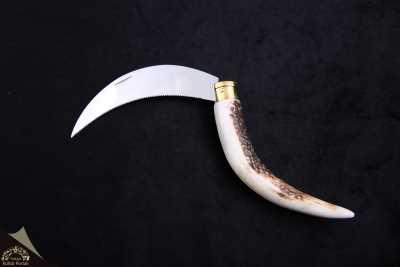
Bursa Knife is a traditional cutting tool with a history of approximately 700 years in the province of Bursa. This craft, which began during the Ottoman period with the production of swords and daggers, gradually expanded to include various applications such as kitchen knives, hunting knives, and butcher knives. According to the 1913 industrial census, there were over a hundred knife-making workshops in Bursa, with annual production exceeding one million units.
The Bursa Knife is distinguished by its distinctive features, particularly the skillfully crafted “three V” edge profile, the traditional heat treatment using chestnut shell charcoal, and the use of horn, bone, or rare woods for the handles. The blade’s flexibility, sharpness, and handcrafted detailing make it both a functional and artistic product.

Bursa Knife (Türkiye Culture Portal)
The history of the Bursa Knife dates back to the founding period of the Ottoman State. From the Orhangazi era onward, Bursa has been a center for metallurgy and knife-making. Various sources indicate that weapons such as swords, daggers, axes, and spears belonging to the first seven Ottoman sultans were produced in this city, and that the arms used by Ottoman soldiers in the Battle of Ankara between Yıldırım Bayezid and Timur were also manufactured in Bursa.
In the early years of the Republic, demand for military weapons declined, and production shifted toward everyday tools such as table knives, bread knives, and fruit knives. During this transition, traditional production techniques were preserved, product variety increased, and the Bursa Knife came to be classified into approximately 150 subtypes based on usage.
From the late 19th century onward, production scale expanded significantly. The 1913 industrial census recorded over a hundred knife-making workshops in the Hüdavendigar (Bursa) province. Official records also confirm that annual production exceeded one million units during this period.
The practice of engraving the master’s name on Bursa knives demonstrates the strong association between production and individual craftsmanship. The public visibility of this craft is documented by the case of master Remzi Sarıçetin, who sent a knife to Mustafa Kemal Atatürk in 1922 and received a letter of thanks in return.
In 2018, the Bursa Knife was officially registered as a geographical indication by the Turkish Patent and Trademark Office, maintaining its production through both traditional and modern methods.

Bursa Knife (Türkiye Culture Portal)
The Bursa Knife has been registered as a geographical indication under the Industrial Property Law No. 6769, in the category of designation of origin. The registration was completed on 15 February 2018, with protection retroactively effective from 26 December 2014. The application was submitted by the Bursa Metropolitan Municipality, and the geographical boundary of the product is defined as the administrative borders of Bursa province. The method of use is marking.
The primary features distinguishing the Bursa Knife from similar cutting tools are the method of steel treatment and the unique sharpening profile of the blade. When viewed from the front, the blade is shaped using a three-stage sharpening technique known as the “three V” method. This structure consists of a fine edge at the cutting tip, a broad surface in the middle, and a sloping spine leading toward the edge, thereby enhancing cutting efficiency.
Heat treatment of the steel is another distinctive feature that determines the blade’s durability and sharpness. Hardness is typically set between 52–56 HRC. The traditional use of chestnut shell charcoal, due to its high carbon content, imparts a unique hardness and color to the steel. The double-quenching process known as “meneviş” applied to the blade increases its flexibility, allowing it to return to its original shape after bending without breaking.
The handle design is also a characteristic element of the Bursa Knife. Depending on the production technique, handles may be single-piece, capped, or molded. Natural materials such as juniper wood, deer horn, and buffalo bone are commonly used. Strength is prioritized in handle construction, while aesthetic qualities are achieved through local motifs, decorative elements, and the master’s signature. These features define the Bursa Knife both functionally and culturally.

Bursa Knife (Türkiye Culture Portal)
The production of the Bursa Knife can be carried out either through traditional handcraft methods or via modern industrial techniques. While the fundamental processes are similar in both approaches, differences exist in materials and tools used.
In traditional production, high-carbon steel is first heated in a forge using chestnut shell charcoal and then forged to shape the blade blank. The steel is subsequently cooled and shaped through filing and grinding to form the cutting edge. During the quenching phase, masters heat the steel to a narçiçeği (dogwood flower) hue and rapidly cool it by immersion in water to achieve hardness. This step is critical for the blade’s durability and sharpness. A second heat treatment, known as “meneviş,” imparts flexibility to the steel. Once the blade is completed, the handle is prepared and attached to the blade using riveting or adhesive methods. Materials such as wood, horn, or bone are preferred for handles. Finally, the blade undergoes grinding, polishing, and honing; the master’s signature is added, and the knife is packaged and made ready for sale.
In modern production, steel is sourced in pre-fabricated strip form and shaped using presses. Blades are heated and cooled in heat treatment furnaces to achieve a hardness of 52–56 HRC. Grinding operations are performed serially using motorized systems. Handles are selected from pre-manufactured synthetic or metal materials and attached using metal pins or adhesives. Polishing and marking processes are typically machine-assisted. While this method increases production volume, the mastery and oversight of skilled artisans remain essential components of the process.
The Bursa Knife is produced exclusively within the administrative boundaries of Bursa province, as required by its geographical indication registration. Production is concentrated particularly in the districts of Osmangazi, Yıldırım, and Nilüfer, and takes place in settings ranging from small workshops to large manufacturing facilities. Artisans practicing traditional methods typically operate in historic marketplaces and craft streets, while modern producers are located in organized industrial zones or artisan clusters.
Bursa knife makers transmit this craft from generation to generation through the master-apprentice relationship. Mastery encompasses not only technical skills but also knowledge of materials, quenching techniques, and the precise determination of grinding angles. In traditional production, every stage of the knife’s creation is performed by the master, making each piece the result of individual labor. Artisans commonly engrave their names or marks on the blade to identify their work.
The recognition of the Bursa Knife has been further enhanced by the individual achievements of certain masters. For instance, Remzi Sarıçetin’s act of sending knives to Mustafa Kemal Atatürk in the early years of the Republic and the subsequent appreciation of these gifts strengthened the place of Bursa’s artisanal tradition in the collective memory of society.
Today, institutions such as the Bursa Metropolitan Municipality and the Bursa Knife Makers Association support traditional production and ensure compliance with geographical indication standards through monitoring mechanisms. Thus, production sustains both the continuity of cultural heritage and economic viability.

Bursa Knife (Türkiye Culture Portal)
The production of the Bursa Knife is subject to specific regulations to ensure compliance with its geographical indication status and is regularly monitored. The monitoring process is coordinated by the Bursa Metropolitan Municipality. The monitoring commission consists of designated representatives from institutions including the Bursa Chamber of Commerce and Industry, the Bursa Knife Makers Association, and the Uludağ University Vocational School of Technical Sciences. The commission conducts at least one routine inspection annually and performs a re-evaluation within one month upon receipt of a complaint.
Inspections are carried out in three main stages: production process, post-production product control, and sales phase. During the production stage, the quality of steel, handle material, heat treatment (quenching and meneviş), grinding, and assembly are inspected on-site. In the post-production stage, physical and functional criteria such as visual form, blade flexibility, sharpness level, and the integrity between blade and handle are tested. Laboratory analyses may be conducted when necessary.
During the sales phase, packaging is checked to ensure that appropriate labels such as “Bursa Knife” and “handmade” are correctly displayed for products made by traditional methods. For products made by modern methods, misleading labels are strictly prohibited. This system aims to guarantee that products meet both physical standards and cultural identity requirements.
Bursa İl Kültür ve Turizm Müdürlüğü. "Bursa Bıçağı JPG." Türkiye Kültür Portalı. Accessed May 17, 2025. https://www.kulturportali.gov.tr/medya/fotograf/fotodokuman/9805/bursa-bicagi
Bursa İl Kültür ve Turizm Müdürlüğü. "Bursa Bıçağı JPG." Türkiye Kültür Portalı. Accessed May 17, 2025. https://www.kulturportali.gov.tr/medya/fotograf/fotodokuman/9806/bursa-bicagi
Bursa İl Kültür ve Turizm Müdürlüğü. “Bursa Bıçağı JPG.” Türkiye Kültür Portalı. Accessed May 17, 2025. https://www.kulturportali.gov.tr/medya/fotograf/fotodokuman/9811/bursa-bicagi
Go to Bursa. "Bıçak Kültürü." Go to Bursa Web Sitesi. Accessed May 17, 2025. https://www.gotobursa.com.tr/tr/icerik/bicak-kulturu-285/
Ministry of Culture and Tourism of the Republic of Turkey. "Bursa Bıçağı." Türkiye Kültür Portalı. Accessed May 17, 2025. https://www.kulturportali.gov.tr/portal/bursa-bicagi
Ministry of Culture and Tourism of the Republic of Turkey. “Bursa Bıçağı - Bursa.” *Turkey Culture Portal.* Accessed May 17, 2025. https://www.kulturportali.gov.tr/turkiye/bursa/kulturatlasi/bursa-bicagi
Turk Patent and Trademark Office. "Bursa Bıçağı." Geographical Indications Portal. Accessed May 17, 2025. https://ci.turkpatent.gov.tr/Files/GeographicalSigns/326.pdf

Historical Development
Geographical Indication Registration
Distinctive Characteristics
Production Processes
Traditional Method
Modern Method
Production Areas and Artisans
Monitoring