


This article was automatically translated from the original Turkish version.
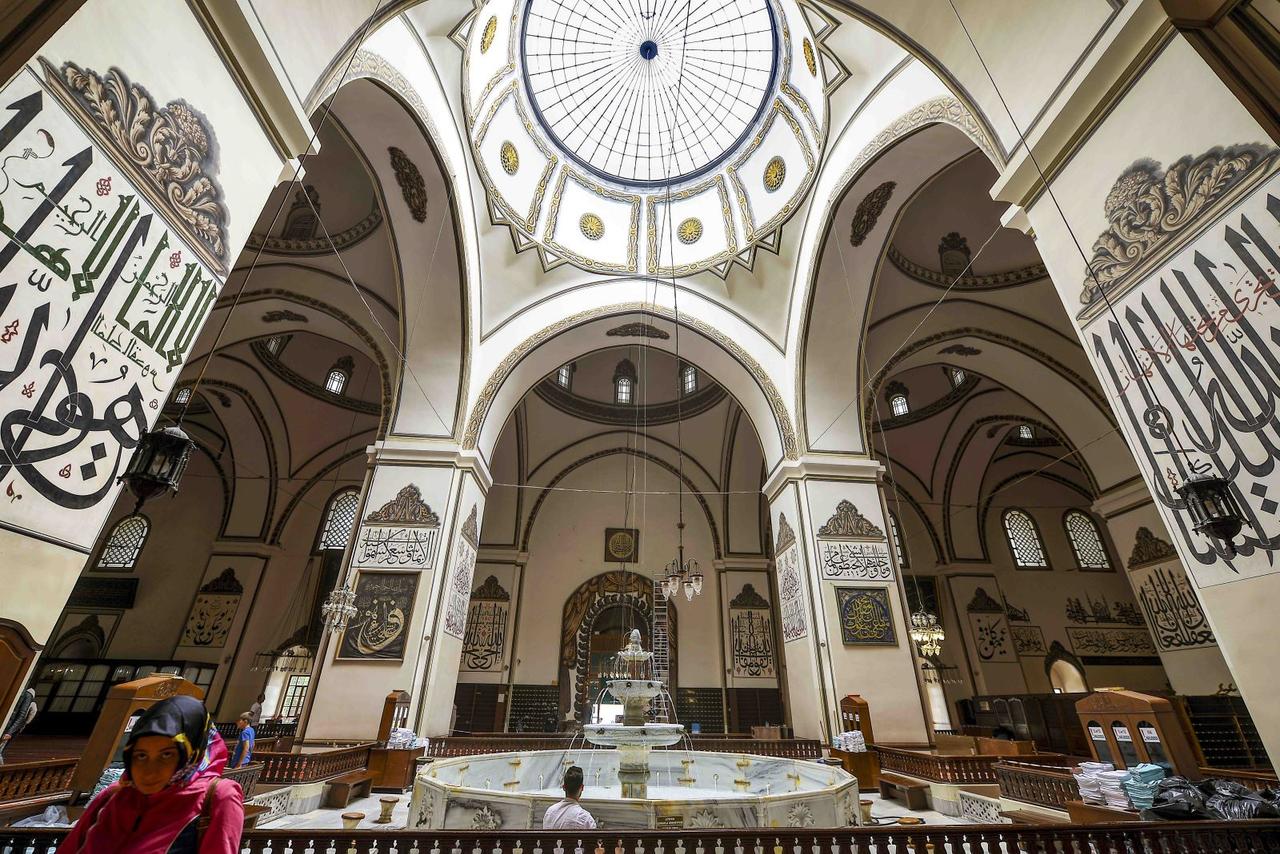
Bursa Ulu Camii
Location | Bursa Türkiye | ||||||||
|---|---|---|---|---|---|---|---|---|---|
Construction Years | 1396–1400 | ||||||||
Architectural Style(s) | Early Ottoman Architecture Multi-Domed Plan | ||||||||
Interior Area | 3.165 m² | ||||||||
Number of Domes | 20 | ||||||||
Entrance Door | 3 (East, West, North) | ||||||||
Number of Minarets | 2 | ||||||||
Bursa Ulu Camii, Bursa's center, built between 1396 and 1400 by Bayezid, is a historic mosque and the largest multi-domed example of early Ottoman architecture. Beyond serving as a central place of worship, it has also functioned throughout history as a center for religious, social, and cultural activities. The mosque is notable for its 20 domes, central şadırvan, wood kündekari minbar, and rich hat art collection.

(Bursa Ulu Camii - Türkiye Kültür Portalı)
As one of the earliest architectural structures of the Ottoman State, Bursa Ulu Camii was constructed between 1396 and 1400 by Yıldırım Bayezid. After the Battle of Nicopolis, the sultan wished to build 20 separate mosques, but upon the advice of the period’s religious leader Emir Sultan, it was decided to construct a single large mosque with 20 domes within one complex.
The first sermon was delivered by Somuncu Baba, and its first imam was Süleyman Çelebi, the author of the Mevlid-i Şerif. The mosque became one of the spiritual centers of the Ottoman State. Over the centuries, the mosque has suffered damage from multiple events: it was destroyed during Timur’s Anatolia Campaign and later damaged by the Karamanoğulları. In the great earthquake of 1855, most of its domes collapsed, and its minarets were damaged in the fire of 1889. From the mid-20th century onward, it underwent various restoration efforts and entered a comprehensive renovation process between 2008 and 2010.
Bursa Ulu Camii is the largest example of the multi-domed mosque form in Ottoman architecture. With dimensions of 55 by 69 meters, its total interior area is 3,165 square meters and it is recognized as the largest Ulu Camii in Türkiye.
The mosque is covered by 20 domes supported by thick body walls and 12 large square piers. Initially, the central dome was left open at the top, allowing natural light to enter the interior. Today, this opening has been sealed with a ceiling. The mosque has three entrance doors. The largest and most ornate is the marble Taçkapı on the north façade. The 26 lower and 32 upper windows are key elements in illuminating the interior space.
Another striking feature of the Ulu Camii is the şadırvan located within the interior. This 16-sided fountain with three-tiered spouts is considered a rare interior element in Ottoman mosque architecture.

(Bursa Ulu Camii - Türkiye Kültür Portalı)
The minbar of the Ulu Camii is one of the most important examples of Ottoman woodwork. Built without nails or adhesive using the kündekâri technique by Hacı Muhammad bin Abdülaziz İbnü’d-Dakki, this art masterpiece consists of 6,666 pieces and features the sun system and depictions of the Milky Way Galaxy.
The mihrab reflects 14th-century architectural traditions through its stalactite structure, hourglass-shaped columns, and carved decorations. It assumed its present form following restoration work carried out in 1751. Around the mihrab are inscriptions of Bismillah, Ayet-el Kürsi, and Surah Ikhlas.
Bursa Ulu Camii is regarded as one of the most important structures housing examples of Islamic calligraphy. A total of 192 writing and 41 calligrapher have been inscribed on the mosque’s interior walls by masters including Kazasker Mustafa İzzet Efendi, Abdülfettah Efendi, Sami Efendi, and Mehmed Şefik Bey like, among the most significant calligraphers of the Ottoman era.
The large-scale calligraphic panels inside the mosque are artistic masterpieces executed with exceptional skill in large-scale, sülüs and Kufic scripts. A calligraphic panel commissioned by Sultan Mahmud II is among the mosque’s most notable inscriptions.

(Bursa Ulu Camii - Türkiye Kültür Portalı)
One of the most important artifacts displayed in the Ulu Camii is the Kaaba door covering. Yavuz Sultan Selim, after conquering Egypt in 1517, commissioned repairs to various sacred sites in Mecca and Medina, and brought the old covering of the Kaaba to Istanbul, presenting it as a gift to Bursa Ulu Camii. The verses embroidered in gold thread have suffered damage over time due to moisture and are now only visible under bright light.
The Ulu Camii has two minarets. The West minaret was built during the reign of Yıldırım Bayezid, while the east minaret was commissioned by Çelebi Mehmed. The western minaret features a unique design in Ottoman minaret architecture, with a original structure that provides two separate access routes to different levels.

Throughout its history, Bursa Ulu Camii has suffered damage from wars, natural disasters and fires.
Today, the Ulu Camii continues to be one of Bursa’s most important tourist and religious sites, maintaining its significance as both a place of worship and a cultural center, attracting both domestic and foreign visitors.
Anadolu Ajansı. "Bursa’nın Ayasofyası: Ulu Cami." Anadolu Ajansı, May 29, 2018. Accessed February 25, 2025. https://www.aa.com.tr/tr/turkiye/bursanin-ayasofyasi-ulu-cami/1159399.
Bursa Büyükşehir Municipality. "Ulu Cami." Bursa.com.tr, Accessed February 25, 2025. https://www.bursa.com.tr/tr/mekan/ulucami-40/.
Bursa UluCamii Resmi Website. "Bursa Ulu Camii." Bursa Ulu Camii, Accessed February 25, 2025. https://www.bursaulucamii.com/.
Culture Portal. "Bursa Ulu Cami." Culture and Tourism Ministry Culture Portal, Accessed February 25, 2025. https://www.kulturportali.gov.tr/turkiye/bursa/gezilecekyer/bursa-ulu-cami.
Islamic Thought Atlas. "Bursa Ulu Camii." Islamic Thought Atlas, Accessed February 25, 2025. https://islamdusunceatlasi.org/bursa-ulu-camii/3453.
T.C. Bursa Valiliği. "Ulu Cami." Bursa Valiliği Resmi Web Sitesi, Accessed February 25, 2025. http://www.bursa.gov.tr/ulucami.

Bursa Ulu Camii
Location | Bursa Türkiye | ||||||||
|---|---|---|---|---|---|---|---|---|---|
Construction Years | 1396–1400 | ||||||||
Architectural Style(s) | Early Ottoman Architecture Multi-Domed Plan | ||||||||
Interior Area | 3.165 m² | ||||||||
Number of Domes | 20 | ||||||||
Entrance Door | 3 (East, West, North) | ||||||||
Number of Minarets | 2 | ||||||||
History
Architectural Structure
Minbar and Mihrab
Calligraphy and Interior Decorations
Relic Treasures
Minarets
Repairs and Restorations