This article was automatically translated from the original Turkish version.
Catalog Name | NGC 6302 | ||||||||
|---|---|---|---|---|---|---|---|---|---|
Constellation | Bow (Sagittarius) | ||||||||
Object Type | Planetary Nebula | ||||||||
Distance(s) | ~3 800 light years 400 – 3 | ||||||||
Apparent Magnitude | Approximately 0.6 arcminutes | ||||||||
Central Star Temperature | ~200,000 K | ||||||||
Nebula Morphology | Bipolar (two-lobed) | ||||||||
Nebula Size | Approximately 3 light years (distance between lobes) | ||||||||
Visible Wavelengths | Infrared, ultraviolet, visible, X-ray | ||||||||
Chemical Composition | H, He, O, N, C, S, Ne, silicates and carbon dust | ||||||||
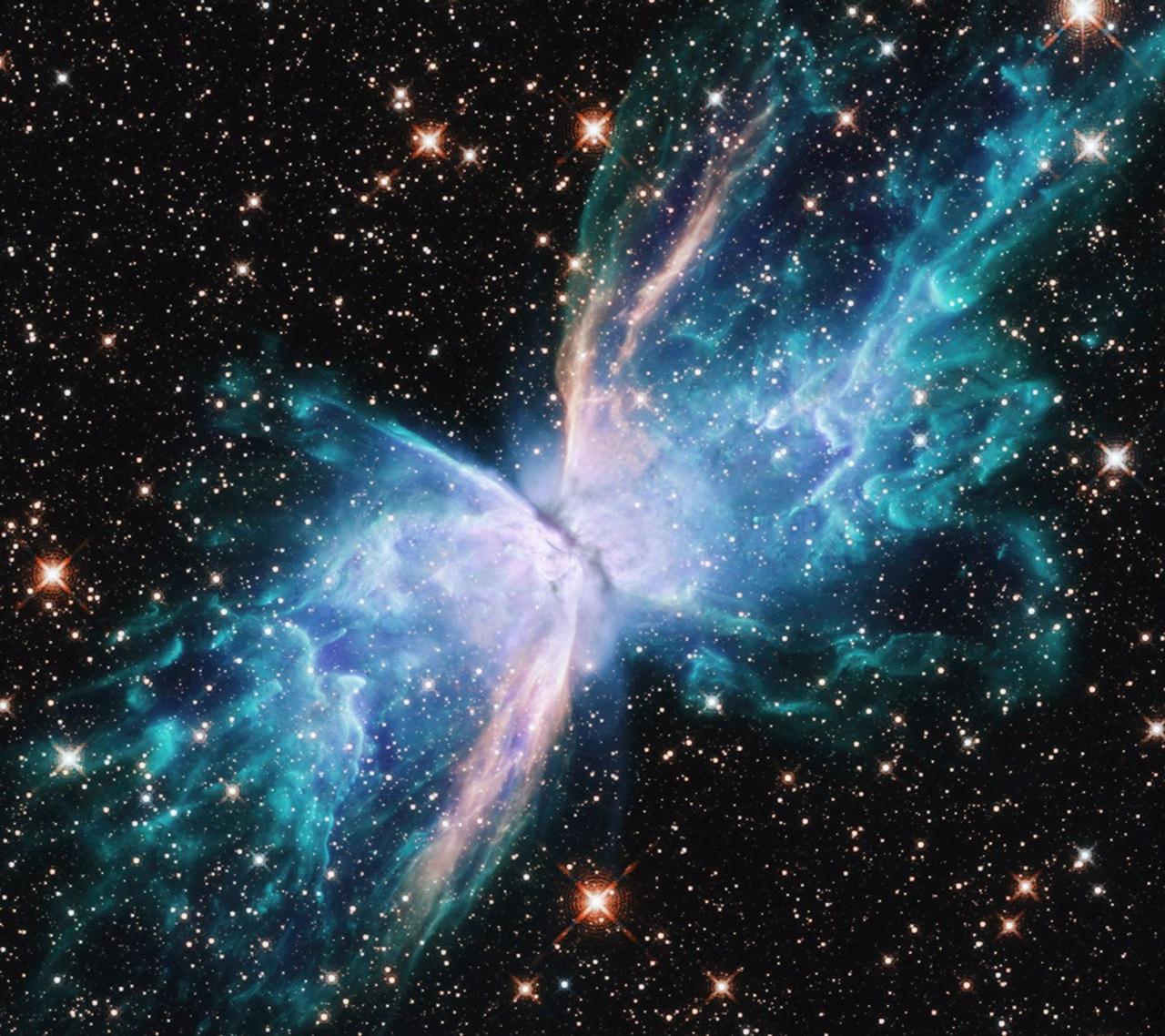
NGC 6302 is a planetary nebula located in the direction of the Sagittarius constellation, whose visual appearance resembles a butterfly with two wings. It was first cataloged in the mid-19th century by James Dunlop. The nebula is also commonly known as the "Butterfly Nebula" or the "Bug Nebula." This celestial object stands out in observations due to its complex morphology and the extremely hot central stellar remnant, placing it among structures formed during the final stages of stellar evolution.

Butterfly Nebula. (NASA)
The estimated distance to NGC 6302 is approximately 3,400 to 3,800 light years. From Earth, the nebula appears about 0.6 arcminutes wide in the sky.
NGC 6302 formed when a star similar to the Sun ejected its outer layers into space during the final stages of its life. This process begins when the star’s core exhausts its nuclear fuel and continues with a series of violent ejections that expel the outer layers. The remaining dense core evolves into an extremely hot white dwarf.
The term "planetary nebula" for such objects stems from a historical misconception; these nebulae have no connection to planets. The name arose because early observers, viewing them through telescopes, mistook their round shapes for those of planets.
The central star of NGC 6302 remained unobservable for a long time because it is surrounded by a dense dust disk. However, observations made in 2009 using the advanced optical systems of the Hubble Space Telescope finally allowed this star to be imaged.
The surface temperature of this central star is estimated at approximately 200,000 Kelvin, making it one of the hottest known stellar remnants. This extreme temperature ionizes the surrounding gas, causing the nebula to glow.
NGC 6302 is notable for its bipolar structure. This shape results from ionized gas expanding symmetrically in two opposite directions from a central dust disk. Each lobe can extend up to about three light years in length. The symmetry of this structure is typically explained by the presence of a companion star or a dense dust disk around the central star.
The dust disk is highly dense and opaque, causing the central region to appear dark in visible wavelengths. The nebula is studied in greater detail at infrared, ultraviolet, and radio wavelengths.
NGC 6302 is a chemically rich planetary nebula. Spectroscopic analyses have revealed the presence of ionized forms of many elements, including hydrogen, helium, oxygen, nitrogen, sulfur, carbon, and neon. In particular, the [O III] (doubly ionized oxygen) emission lines are characteristic spectral features of such nebulae.
Additionally, dust grains composed of silicates and carbon-based compounds have been detected within the nebula.
NGC 6302 has been imaged multiple times in high resolution by the Hubble Space Telescope. The images obtained in 2009 are striking both aesthetically and scientifically. They clearly show gas clouds extending symmetrically from the dense central region. The nebula is also studied using telescopes such as the Chandra X-ray Observatory, which detect high-energy emissions.
NGC 6302 provides important insights into the late stages of stellar evolution and the formation of planetary nebulae. The extremely hot central stellar remnant is used to test models of ionization processes. Furthermore, its morphological structure draws attention to how stellar mass is asymmetrically distributed and how the star interacts with its environment during this phase.
With its symmetric structure, high-temperature central star, and complex chemical composition, NGC 6302 is a critical example for astrophysical research. This nebula offers a vital observational window into understanding the death processes of stars and their impact on the galactic environment. Despite its visually striking appearance, when evaluated with a scientifically neutral perspective, NGC 6302 serves as a multi-layered data source for researchers seeking answers to fundamental questions in astrophysics.
ESA/Hubble. “NGC 6302 (The Butterfly Nebula).” *ESA/Hubble – Images*, https://esahubble.org/images/heic2011b/. Accessed July 16, 2025.
NASA. “NGC 6302.” *NASA Science*, https://science.nasa.gov/asset/hubble/ngc-6302/. Accessed July 16, 2025.
NASA. “NGC 6302: The Butterfly Nebula.” *NASA Science*, https://science.nasa.gov/asset/hubble/ngc-6302-the-butterfly-nebula/. Accessed July 16, 2025.

Catalog Name | NGC 6302 | ||||||||
|---|---|---|---|---|---|---|---|---|---|
Constellation | Bow (Sagittarius) | ||||||||
Object Type | Planetary Nebula | ||||||||
Distance(s) | ~3 800 light years 400 – 3 | ||||||||
Apparent Magnitude | Approximately 0.6 arcminutes | ||||||||
Central Star Temperature | ~200,000 K | ||||||||
Nebula Morphology | Bipolar (two-lobed) | ||||||||
Nebula Size | Approximately 3 light years (distance between lobes) | ||||||||
Visible Wavelengths | Infrared, ultraviolet, visible, X-ray | ||||||||
Chemical Composition | H, He, O, N, C, S, Ne, silicates and carbon dust | ||||||||
No Discussion Added Yet
Start discussion for "Butterfly Nebula (NGC 6302)" article
Formation and Evolutionary Process
Central Star and Temperature Values
Morphological Structure and Symmetry
Chemical Composition and Spectral Analysis
Observation and Imaging
Technical Specifications
Scientific Significance