

This article was automatically translated from the original Turkish version.
+2 More
Çakrak Yaylası is a highland within the administrative boundaries of Alucra district in Giresun province, featuring historical settlement traces and architectural remnants. It is defined by its continuous habitation from antiquity to the present and the religious and civil architectural elements it contains. Due to its historical characteristics, the Çakrak settlement is assessed within the scope of faith tourism.
Çakrak Yaylası (Giresun)
Çakrak Yaylası is approximately 80 kilometers from the center of Giresun. Today, access to the highland is possible via Yağlıdere and Kümbet Yaylası. Historically, access was long maintained via the Espiye–Yağlıdere–Sınır village route, while the Çıkrıkkapı–Kümbet route began to be used after the 1960s.【1】
Çakrak has been used as a settlement area throughout known and recorded history. It is stated that some of the earliest Christian communities, who migrated to Anatolia due to pressures from the Roman Empire in the early years of Christianity, settled in this region after moving from Cappadocia to the Black Sea. This settlement is dated to the years AD 375–395. During this period, the population of Çakrak is estimated to have been between 3,000 and 5,000 people. Remnants and traces of the ancient settlements in the area are still visible today.【2】
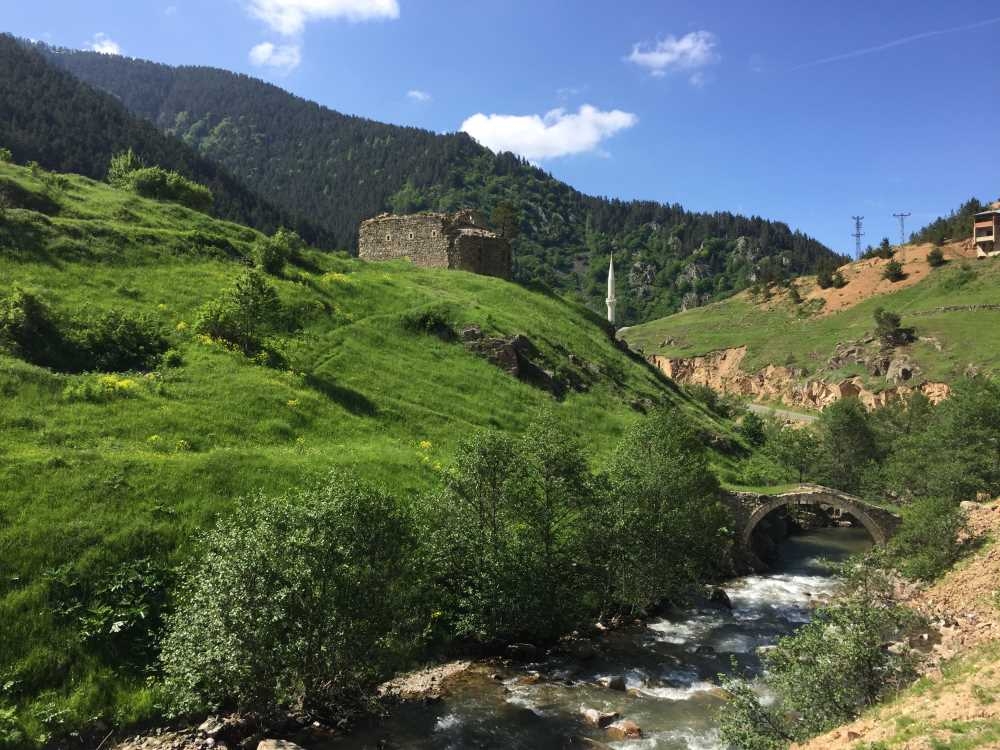
At the center of Çakrak Yaylası, there are three arched bridges and two surviving church ruins. Near the highland, in Kırkharman Obası, a well-preserved church and five mill ruins are located.【3】In the region, remnants of 8 to 10 churches and places of worship are also known to exist.【4】These structures provide data regarding the historical settlement and belief systems of the region.

Çakrak Kilisesi (Türkiye Kültür Portalı)
Located in Çakrak Village and known as the “Second Church,” the Çakrak Church is one of four churches built after the proclamation of the Islahat Fermanı. The structure is among the Rum architectural remains of the region. Built using a rubble masonry system, it incorporates broken stone, finely dressed stone, and cut stone. The building has a rectangular plan oriented east-west in basilica form and lacks a narthex. It features a triple apse with a semicircular form.
The entrance is located on the western facade. Single rows of rectangular windows are found on the north and south facades. Above the entrance on the western facade there are three openings, and three small window openings are present on the eastern apse. The outer walls of the structure have survived to the present day, but the upper roof, except for the apse covering, is largely missing.

Kemer Köprü (Türkiye Kültür Portalı)
No definitive inscription or contemporary source has been found to determine the construction date or builder of one of the arched bridges around Çakrak Yaylası. However, based on the materials used and construction techniques, the bridge is assessed to have been built in the second half of the 19th century.
Located in Çıkrıkkapı Obası, the Hacı Abdullah Wall is said to be the second largest wall ever constructed after the Great Wall of China, built for protective purposes. The single-gated structure has stood for 404 years, measures 6.5 kilometers in length and 1.5 meters in height, and was constructed in the 1610s by Greek laborers.【5】

Çakrak Kilisesi ve Köprüsü (Türkiye Kültür Portalı)
The Çakrak region is characterized by its historical settlement heritage and numerous religious structure remnants. The churches, places of worship, and other architectural remains in the area provide information about the social and cultural life of the communities that once lived here. Due to these features, the Çakrak settlement is evaluated in terms of faith tourism.
There is evidence that Çakrak was historically connected to production and trade activities. It is stated that part of the wine used in competitions at the Mount Olympus games in Greece—the oldest known international sporting events in recorded history—was shipped from Çakrak.【6】This reflects the region’s role within historical networks of production and trade.
[1]
Cavit Yavuz, "Doğu Karadeniz Turizminde Giresun–Ordu İşbirliği Düşüncesi ve Yeniden Yapılanması," (2008), Access 21 April 2026, http://earsiv.odu.edu.tr/xmlui/handle/11489/2820
[2]
Yavuz, "Doğu Karadeniz Turizminde Giresun–Ordu İşbirliği Düşüncesi ve Yeniden Yapılanması," Access 21 April 2026, http://earsiv.odu.edu.tr/xmlui/handle/11489/2820
[3]
T.C. Giresun Valiliği. “Yaylalarımız Çakrak Yaylası.” Access 21 April 2026. https://www.giresun.gov.tr/yaylalarimiz
[4]
Yavuz, "Doğu Karadeniz Turizminde Giresun–Ordu İşbirliği Düşüncesi ve Yeniden Yapılanması," Access 21 April 2026, http://earsiv.odu.edu.tr/xmlui/handle/11489/2820
[5]
T.C. Giresun Valiliği. “Yaylalarımız Çakrak Yaylası.” Access 21 April 2026. https://www.giresun.gov.tr/yaylalarimiz
[6]
Yavuz, "Doğu Karadeniz Turizminde Giresun–Ordu İşbirliği Düşüncesi ve Yeniden Yapılanması," Access 21 April 2026, http://earsiv.odu.edu.tr/xmlui/handle/11489/2820

Location and Access
Historical Settlement Process
Historical Structures
Highland Center and Surroundings
Çakrak Church
Arched Bridges
Hacı Abdullah Wall
Cultural and Historical Features
Historical Economic Connections