


This article was automatically translated from the original Turkish version.
A device designed to perform mathematical operations, either electronic or mechanical. Basic models carry out the four fundamental arithmetic operations—addition, subtraction, multiplication, and division like—while advanced scientific and graphic account calculators trigonometry, logarithm support complex functions such as statistical calculations and even graphical boot.
In ancient times, counting boards such as the abacus were used for calculations. It is believed that the earliest counting boards did not survive to the present day due to the perishable nature of wood. In 1623, Wilhelm Schickard developed the first mechanical calculator at the University of Heidelberg Germany. Schickard’s device could perform multiplication and six-digit addition vehicle. Approximately twenty years later, in 1642, the French philosopher Blaise Pascal designed a calculator capable of performing the four basic operations, known as the Pascaline. Gottfried Wilhelm Leibniz designed a mechanical device in 1671 square capable of performing the four operations and extracting square roots. However, these devices were not widely used. About a century later, Charles Xavier Thomas’s Arithmometer, which could perform the four operations and calculate square roots, became the ancestor of mechanical calculators used until the 1970s. Subsequent calculators evolved into highly complex electronic devices resembling computers, featuring capabilities such as storing intermediate results, recalling previous values, and supporting trigonometric, statistical, and advanced mathematics functions, as well as programmability.
1. Standard Calculators: Used for everyday arithmetic operations (addition, subtraction, multiplication, division), percentage calculations, VAT, and discount computations.

2. Scientific Calculators: Used in engineering, mathematics, physics, and chemistry for trigonometry, logarithms, integration, differentiation, and statistical analysis.

3. Graphing Calculators: Used for graphical representation of equations, data analysis, and in engineering and academic research.
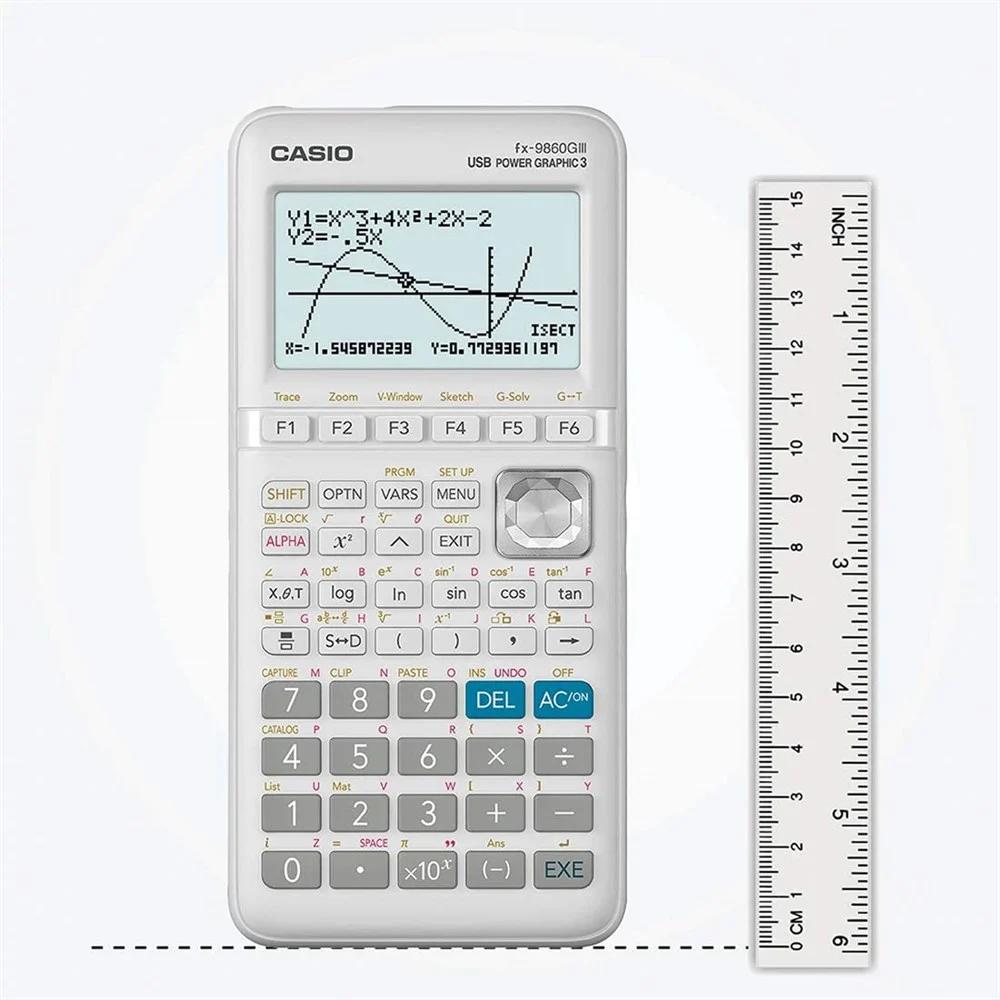
4. Financial Calculators: Used for interest calculations, depreciation, net present value (NPV) value, and internal rate of return (IRR) yield calculations.

5. Programmable Calculators: Used for repetitive calculations requiring custom algorithms (engineering, physics).

6. Ribbon (Accounting) Calculators: Used for printing on paper tape in accounting, invoicing, and auditing tasks.

7. Smart Telephone/Online Calculators: Designed for use in situations requiring Fast access.

8. Abacus: Abaci based on the decimal system system function using beads on rods arranged within two rectangle sections.

Standard operation: Numbers and mathematical operators are entered in sequence ('2 + 2 =': result is 4).
RPN operation: Numbers are entered first, followed by the operation ('2 ent 2 +': result is 4).
Accessed November 26, 2025. www.ee.ryerson.ca.
Accessed November 26, 2025. www.thecalculatorsite.com.
Accessed November 26, 2025.
Akanegbu, Anuli; Ribeiro, Ricky. "The History of Calculators: Evolution of the Calculator (Timeline)". EdTech Magazine.

History of Calculators
Types:
Data Entry Methods: