

This article was automatically translated from the original Turkish version.
Category | Amphibious Firefighting Aircraft | ||||||||
|---|---|---|---|---|---|---|---|---|---|
Origin(s) | Canada (De Havilland) | ||||||||
Engine(s) | 2 x Pratt & Whitney Canada PW123AF turboprop engines | ||||||||
Commissioned | Mid-1990s | ||||||||
Crew | 2 people | ||||||||
Water Capacity | 6,137 litres | ||||||||
Maximum Speed | 375 km/h | ||||||||
Range(s) | 2 427 km | ||||||||
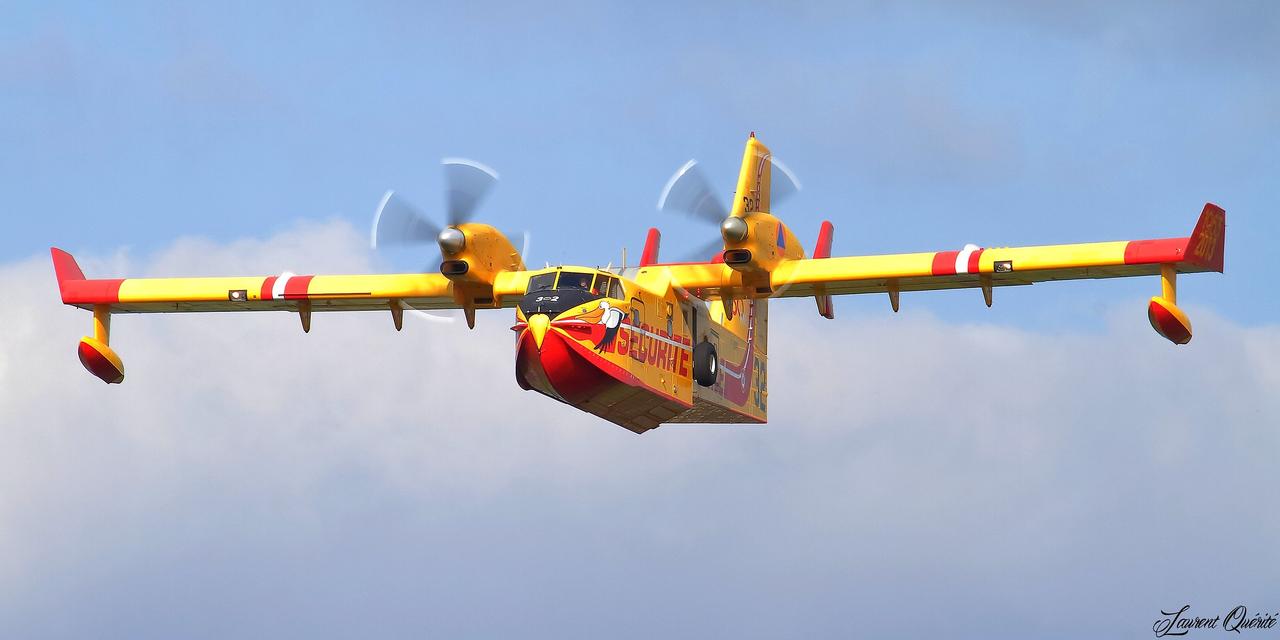
Canadair CL-415 is a multi-engine amphibious aircraft designed and manufactured by De Havilland Aircraft of Canada in Canada, specifically developed for firefighting missions. Thanks to its water-collection capability, it plays a vital role in combating forest fires worldwide. Due to its speed and effectiveness in firefighting operations, it is also commonly known as the "SuperScooper".

Canadair CL-415 (Laurent Quérité)
The CL-415 is an upgraded version of the piston-engine CL-215, developed in the 1960s. Introduced into service in the mid-1990s, the CL-415 retains the fuselage and hydrodynamic structure of its predecessor but is equipped with turboprop engines and advanced avionics systems. These improvements enhance the aircraft’s performance, safety, and operational efficiency. The high-wing design provides pilots with an extensive field of view both in flight and over water.
The aircraft lands on a lake or sea surface with its wheels submerged and collects water using two scoops that open at two-second intervals. Within approximately 12 seconds, while traveling at a speed of 130 km/h (70 knots), it can intake 6,137 litres of water. After completing water collection, the aircraft takes off again and heads toward the fire zone. Foam or fire-retardant chemicals can be added to the collected water. The aircraft can release the water at a single point or along a line to help contain the fire. This method reduces the need for the aircraft to return to an airport when water sources are located near the fire area, thereby shortening operational cycles.
Canadair CL-415 (Corrky & Lorraine)
The CL-415 can take off and land on both conventional runways and suitable water surfaces such as seas or lakes. Its ability to operate from water enables access to remote and difficult-to-reach terrain.
The performance characteristics of the CL-415 are as follows.

Canadair CL-415 (Laurent Quérité)
Due to its effectiveness in firefighting, the CL-415 is operated by numerous countries worldwide. Major operators include Canada, France, Italy, Spain and Greece. It has become a critical asset for Mediterranean countries, which frequently face forest fires during summer months. To date, the CL-415 has played a key role in controlling many major fires.
Avincis. "CL-415 Specifications Flyer." Avincis. Accessed August 16, 2025. https://www.avincis.com/wp-content/uploads/2024/11/A4-CL-415-Specifications-Flyer-Low-Res.pdf
Conair. "CL-415." *Conair*. Accessed August 16, 2025. https://conair.ca/conair_fleet/cl415
Corrky & Lorraine. "CANADAIR CL-415 Fire Fighter I CROATIA TRAVEL VLOG." YouTube. Accessed August 16, 2025. https://www.youtube.com/watch?v=Gyw0i0mpbxU
De Havilland. "CL-415." *De Havilland.* Accessed August 16, 2025. https://dehavilland.com/cl-415-2
Hellenic Air Force. "Canadair CL-415." Hellenic Air Force. Accessed August 16, 2025. https://www.haf.gr/en/equipment/canadair-cl-415
Laurent Quérité. "Canadair CL-415." Flickr. Accessed August 16, 2025. https://www.flickr.com/photos/laurent_spotter/27126710395/in/photolist-Hk6tVn-316Tvd-2hqQzDu-2k7ANry-2raAHqa-2n7xKW7-25o823u-xKvhbL-Ntqo1i-xtWVu5-7eH4it-7eH4oe-23vjy6D-WNQkNe-U1iLSb-HfZMop-2nyDj3b-2nAPkfi-5Kc5y7-2n2mDtf-8GSWQR-SMsf1C-2nwZG3i-2oSLtqj-262GJ26-2oQQFoG-LsYUDL-2nLoqSH-75T3Ti-TSkcwT-75T4dP-U6X6yS-m147dQ-8GWCuC-WWX3Qu-5yDrfP-262GJ1K-5PPSGh-LsYU5Q-2nLoqTj-LsYTJQ-LsYSEW-5N8cTQ-GU7uE8-JWVaTP-2dZ6une-rsTBpk-niwAQi-2dZ6uuP-JMogXk
Laurent Quérité. "Canadair CL-415." Flickr. Accessed August 16, 2025. https://www.flickr.com/photos/laurent_spotter/43337242780/in/photolist-292yGr3-2n4DNvX-2j56jpz-2j57VbY-25zbpE3-2j57S9k-2j57Vyr-2j53HT1-2j57TEM-2j56nKx-2n77JWq-2p5CkGV-2bmqtJ9-2j53JaU-EsYnvv-2j9nT4o-2j57Wf1-2jcTL8A-2iW4NzS-2iW7z2X-2iW7o5X-2iW4BDJ-2jcSqDw-2iW8TXg-2jz1aiL-2i5y1wr-2bmqEs3-m2DhVP-2ooXQ9W-2iqAyEE-aCA1hD-rsUJsC-Hk6tVn-316Tvd-2hqQzDu-2k7ANry-2raAHqa-2n7xKW7-25o823u-xKvhbL-Ntqo1i-xtWVu5-7eH4it-7eH4oe-23vjy6D-WNQkNe-U1iLSb-HfZMop-2nyDj3b-2nAPkfi
Win Air. "Everything You Need to Know About the Canadair CL-415." *Win Air.* Accessed August 16, 2025. https://winair.ca/blog/everything-need-know-canadair-cl-415

Category | Amphibious Firefighting Aircraft | ||||||||
|---|---|---|---|---|---|---|---|---|---|
Origin(s) | Canada (De Havilland) | ||||||||
Engine(s) | 2 x Pratt & Whitney Canada PW123AF turboprop engines | ||||||||
Commissioned | Mid-1990s | ||||||||
Crew | 2 people | ||||||||
Water Capacity | 6,137 litres | ||||||||
Maximum Speed | 375 km/h | ||||||||
Range(s) | 2 427 km | ||||||||
Design and Development Process
Water Collection and Delivery System
Amphibious Capability
Technical Specifications
Users and Global Impact