

This article was automatically translated from the original Turkish version.
Çanakkale Martyrs' Monument
Management | Attached to the General Staff Headquarters | ||||||||
|---|---|---|---|---|---|---|---|---|---|
Opening Date(s) | 21 August 1960 | ||||||||
Earthquake Resistance | Resistant to earthquakes of magnitude 7.5 | ||||||||
Dimension(s) | platform 45 × 45 m gallery 30 × 30 m base dimensions 25 × 25 m elevation above sea level approximately 92 m Total height 41.7 m | ||||||||
Designers | Feridun Kip İsmail Utkular Doğan Erginbaş | ||||||||
Architectural Style(s) | Modernist monumental architecture | ||||||||
Location | Türkiye Çanakkale Gallipoli Peninsula Morto Cove Eski Hisarlık Hill | ||||||||
Foundation Laying | 17 April 1954 | ||||||||
Technologies | 3D virtual tour Smart building infrastructure Multilingual guidance system Augmented reality stations | ||||||||
Construction Materials | bronze castings used in details exterior cladding of marble and travertine Reinforced concrete structural system | ||||||||
Çanakkale Şehitler Abidesi was constructed on Eski Hisarlık Tepe, overlooking Morto Koyu on the Gallipoli Peninsula, as a symbol of the Turkish nation’s resistance during the Çanakkale Battles. Erected to honor the soldiers who died in 1915, this monument is not merely an architectural structure but also a spatial representation of national memory.
The idea of constructing the monument emerged after the war but was postponed for many years due to economic constraints, political priorities, and events such as the Second World War. At the time, the fact that only foreign states had graves and memorials on Ottoman territory led to widespread public awareness of this omission. Indeed, in 1944 the Ministry of National Defense organized a design competition for a project titled “The Monument to Victory and the Unknown Soldier” to commemorate the soldiers who fell on the Çanakkale Front. The winning design, submitted jointly by Doğan Erginbaş, İsmail Utkular, and Feridun Kip, was selected from among 37 entries.
However, due to financial shortcomings, the winning design could not be implemented for many years. Construction finally began in 1954. The foundation-laying ceremony took place on 17 April 1954, but the project was halted after the initially contracted contractors violated their agreements and substandard concrete was used. Numerous technical problems arose during construction. In 1958, a new contract was awarded to Ertuğrul Barla and his associates, restarting the work. Thanks to contributions collected from various segments of society, construction progressed with intense public and media attention. In particular, a donation campaign led by the newspaper Milliyet played a decisive role in completing the construction. Finally, on 21 August 1960, the monument—standing 41 meters and 70 centimeters tall—was officially opened to the public in a formal ceremony and has since hosted annual commemorative events on 18 March, the Day of Martyrs of Çanakkale.
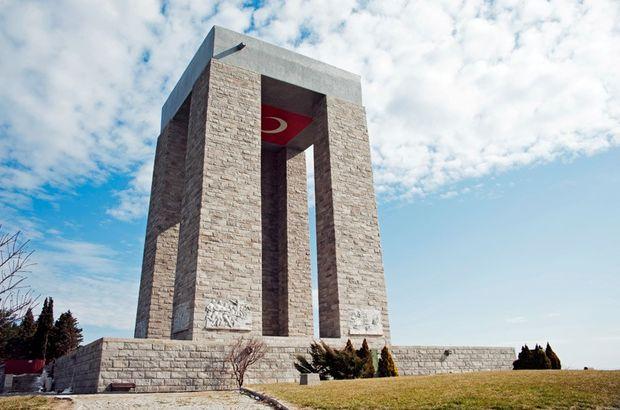
The architectural composition of the Çanakkale Şehitler Abidesi was developed according to the monumental building concepts of its era, based on a symmetrical, simple, and functional plan. The design was prepared by Doğan Erginbaş, İsmail Utkular, and Feridun Kip, whose entry won first prize in the 1944 design competition. The architectural approach aimed to create a structure with high visibility from both sea and land, and a powerful monumental impact. The building’s four massive legs culminate in a box-shaped cap at the top. This composition demonstrates the application of geometric purity, simplicity, and symmetry principles in modernist Turkish memorial architecture. The monument achieves a balanced visual unity through its strong vertical lines and the horizontal platforms and honor halls it creates.
The Çanakkale Şehitler Abidesi was designed to achieve both environmental dominance and symbolic visibility. The total height of the structure is 41 meters and 70 centimeters, forming a silhouette of 92 meters above sea level. Its base measures 25 by 25 meters, and the cap supported by the four box-shaped legs rises 5 meters above ground. The honor hall measures 30 by 30 meters, while the stone-paved platform surrounding the monument spans 45 by 45 meters. Including the entrance, the platform is 175 meters long and 45 meters wide. These proportions reflect the design’s symmetrical and impactful mass composition.
The monument’s structural system employed modern construction technologies and was built using reinforced concrete. Durable marble and travertine stone claddings were chosen for the exterior surfaces of structural elements. These materials ensure the building’s longevity against environmental conditions while providing an aesthetic appearance that is simple yet monumental. Bronze cast elements were used in fine details to achieve both durability and artistic richness. All materials used have transformed the monument from a mere memorial into a national memory space.
The monument features a symmetrical structural arrangement composed of four main massive legs supporting a box-shaped cap at the top. These legs rise slightly tapering upward, enhancing both the aesthetic and structural integrity of the building. Geometric purity, balance of horizontal and vertical lines, and symmetry form the defining characteristics of the design. The monument’s visibility from both sea and land was established as a primary aesthetic and symbolic criterion in the design. Its elevated location and chosen architectural form serve the purpose of making the Çanakkale Victory visible within the collective historical consciousness of the Republic of Türkiye.
"Türk'ün Vatan Aşkı: Çanakkale Şehitler Abidesi." (TRT News Official YouTube Channel
The Çanakkale Şehitler Abidesi is not merely a monument but also a multifaceted commemorative and visitation complex. Covering approximately 62,500 square meters, this built environment transcends physical architecture to enable the spatial representation of historical memory. The site accommodates both monumental ceremonial functions and visitor information and orientation arrangements. Within this context, the complex can be functionally classified under three main categories.
The main ceremonial platform consists of a large open area of approximately 1,500 square meters, designed to accommodate official commemorative ceremonies. Behind the monument, a symbolic cemetery opened in 2007 contains the names of 59,408 soldiers who died in the Çanakkale Battles and whose identities could be identified. Thanks to the advantageous location of Hisarlık Tepe, visitors are offered a 360-degree panoramic view of natural and historical landmarks; sightlines from the platform toward the Dardanelles and Morto Koyu aim to enhance the site’s symbolic power. Various sloped ramps and access pathways have been designed to ensure controlled and directed visitor movement.
The museum and exhibition units within the monument complex cover approximately 750 square meters of enclosed space. These areas include period-specific exhibition halls that display documents, images, and artifacts related to the war. Additionally, multimedia presentation rooms enable interactive storytelling about the Çanakkale Battles, reinforcing historical awareness. The museum area transforms the monument from a static structure into a dynamic learning environment through its dual functions of documentation and education.
The monument’s surroundings have been completed with a landscape plan that strengthens its symbolic meaning and enriches the visitor experience. Approximately 12,000 native plant species have been used to create green areas that harmonize with the region’s natural texture. Walking paths spanning approximately 3.5 kilometers allow visitors to explore the monument’s surroundings from various points and observe it from multiple perspectives. Furthermore, four designated observation terraces have been positioned to create both visual impressions and contemplative pause spaces. These landscape elements transform the monument area not merely into a visitation site but also into a space for reflection.
Approximately forty-five years after its completion, the Çanakkale Şehitler Abidesi began to exhibit various structural and aesthetic deteriorations due to environmental effects. Consequently, between 2005 and 2007, a comprehensive restoration and conservation process was initiated under the coordination of the Ministry of Culture and Tourism. These efforts aimed to strengthen the monument physically while preserving its historical and artistic value for future generations. The restoration process was classified under two main categories.
The first phase of restoration involved engineering interventions to reinforce the reinforced concrete structural system of the monument. Carbon fiber reinforcements were applied to control cracks and balance load distribution. Additionally, ground improvement works were carried out to address weaknesses observed in the foundation system, and waterproofing measures were implemented to protect the structure from moisture and seepage. These interventions aimed to ensure long-term structural stability for the monument.
Aesthetic and material-based conservation activities focused on the natural stone and metal components of the monument’s surface. Marble claddings were cleaned using modern techniques—particularly laser cleaning—to remove dirt, biological growth, and environmental deposits. Bronze cast inscriptions and metal details on the monument were treated with special protective agents against corrosion. Furthermore, all inscriptions and relief elements on the monument were digitally documented, ensuring their archival preservation as documented cultural heritage. These procedures are regarded as a vital conservation strategy, both for documentation and potential future reproduction.
The Çanakkale Şehitler Abidesi has been reconfigured not only as a historical monument but also as a cultural heritage site equipped with digital technologies that enhance contemporary visitor experiences. Developed in line with modern museological principles, the infrastructure enables visitors to acquire historical information about the site interactively. Specifically, augmented reality applications located at seven distinct points allow visitors to experience visualized war scenes and historical events through digital devices.
In addition, a 360-degree imaging-based 3D virtual tour feature enables detailed exploration of the monument in digital space, even if physical visitation is not possible. The multimedia guidance system offers eight language options, enhancing accessibility for international visitors; this system delivers content through both audio guides and information panels. Finally, integrated smart building automation systems centrally control climate, lighting, and security, supporting both the physical sustainability of the structure and visitor comfort.
The Gallipoli Peninsula, where the Çanakkale Şehitler Abidesi is located, lies within one of Türkiye’s active seismic zones due to its proximity to the Western Anatolia fault system. This situation highlights the importance of seismic resistance in large-scale and monumental structures. The design of the monument took this risk into account, adopting principles of resilience under static and dynamic loads. According to the latest technical reports, the monument was constructed to meet structural standards capable of maintaining its integrity during earthquakes up to magnitude 7.5.
Performance tests conducted in 2017 measured the reinforced concrete system’s resistance level at 92 percent, demonstrating that the monument provides a high degree of seismic safety. Additionally, a continuous monitoring system introduced in recent years tracks micro-level movements and deformations in the monument’s structural elements in real time.
These findings reveal that the Çanakkale Şehitler Abidesi is not only historically and symbolically significant but also a remarkable structure from the perspectives of engineering and conservation science. The monument is a concrete example of interdisciplinary approaches developed for the long-term preservation of cultural heritage in seismic zones. Such interventions demonstrate that Türkiye has adopted conservation policies aligned with contemporary standards in cultural heritage management.
Atabay, Mithat. "Çanakkale Şehitleri Abidesi." *Çanakkale Savaşları Ansiklopedisi.* Accessed April 25, 2025. https://canakkalesavaslariansiklopedisi.com/wp-content/uploads/2022/10/canakkale-sehitlikleri-abidesi-csa.pdf.
Atabay, Mithat. “Şehitlikleri İmar Cemiyeti Arşiv Belgelerine Göre Çanakkale Şehitler Abidesi İnşaatının Tamamlanması ve Açılış Töreni.” *Çanakkale Araştırmaları Türk Yıllığı* 14, no. 21 (Güz 2016): 213–232. Accessed April 25, 2025. https://dergipark.org.tr/tr/download/article-file/713687.
Ministry of Culture and Tourism. "Çanakkale Şehitler Abidesi." Kültür Portalı. Accessed April 4, 2025. https://www.kulturportali.gov.tr/turkiye/canakkale/gezilecekyer/canakkale-sehitler-abidesi.
Sarısamán, Sadık. “Çanakkale Şehitleri Abidesi’nin İnşaası ve Halkın Yardımları.” *Journal of History Studies / Tarih Araştırmaları Dergisi* 8, no. 2 (June 2016): 85–107. Accessed April 25, 2025. https://www.historystudies.net/dergi/canakkale-abidesinin-insaasi-ve-halkin-yardimlari201608.pdf.
TRT Haber. "Türk'ün Vatan Aşkı: Çanakkale Şehitler Abidesi." YouTube video, Accessed April 25, 2025. https://www.youtube.com/watch?v=WEnXfc50GS8.
Çanakkale Valiliği. "Çanakkale Şehitler Abidesi." Accessed April 6, 2025. http://www.canakkale.gov.tr/canakkale-sehitler-abidesi.

Çanakkale Martyrs' Monument
Management | Attached to the General Staff Headquarters | ||||||||
|---|---|---|---|---|---|---|---|---|---|
Opening Date(s) | 21 August 1960 | ||||||||
Earthquake Resistance | Resistant to earthquakes of magnitude 7.5 | ||||||||
Dimension(s) | platform 45 × 45 m gallery 30 × 30 m base dimensions 25 × 25 m elevation above sea level approximately 92 m Total height 41.7 m | ||||||||
Designers | Feridun Kip İsmail Utkular Doğan Erginbaş | ||||||||
Architectural Style(s) | Modernist monumental architecture | ||||||||
Location | Türkiye Çanakkale Gallipoli Peninsula Morto Cove Eski Hisarlık Hill | ||||||||
Foundation Laying | 17 April 1954 | ||||||||
Technologies | 3D virtual tour Smart building infrastructure Multilingual guidance system Augmented reality stations | ||||||||
Construction Materials | bronze castings used in details exterior cladding of marble and travertine Reinforced concrete structural system | ||||||||
No Discussion Added Yet
Start discussion for "Çanakkale Martyrs' Monument" article
History of the Monument
Architectural Features and Structural Analysis
Dimensions and Proportions
Material Usage
Architectural Composition
Spatial Organization and Landscape Design
Main Monument Platform
Museum and Exhibition Areas
Landscape Design
Restoration Works and Conservation Measures
Structural Strengthening
Conservation Works
Technological Infrastructure and Digital Applications
Seismic Resistance and Risk Analysis