


This article was automatically translated from the original Turkish version.
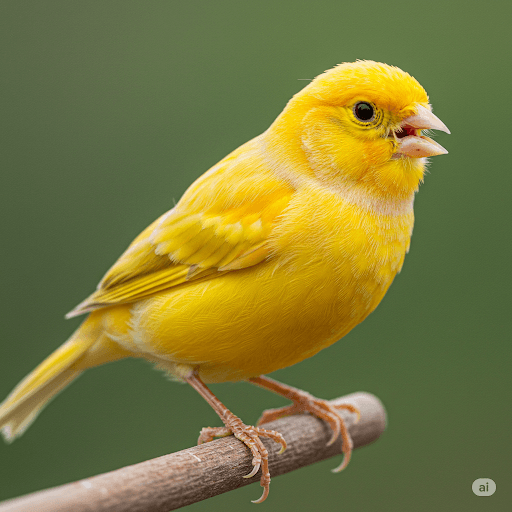
Canary (Serinus canaria)
Team(s) | Passeriformes | ||||||||
|---|---|---|---|---|---|---|---|---|---|
Family | Fringillidae | ||||||||
Natural Distribution | Madeira Azores Canary Islands | ||||||||
Average Length | 12–13 cm | ||||||||
Average Weight | 15–20 g | ||||||||
Diet(s) | small insects fruits Seeds | ||||||||
Breeding Season | January – July | ||||||||
Lifespan | 6–15 years (in captive populations) | ||||||||
Conservation Status | Least Concern | ||||||||
Canary (Serinus canaria) is a songbird species belonging to the finch family (Fringillidae). Its natural habitat is the Canary Islands, Azores, and Madeira in the Atlantic Ocean. This species was introduced to Europe in the 15th century, and through centuries of domestication, a domestic subspecies (Serinus canaria domestica) with various color and song characteristics has been developed. Canaries have been used both as model organisms in biological research and historically to detect gas leaks in coal mines.
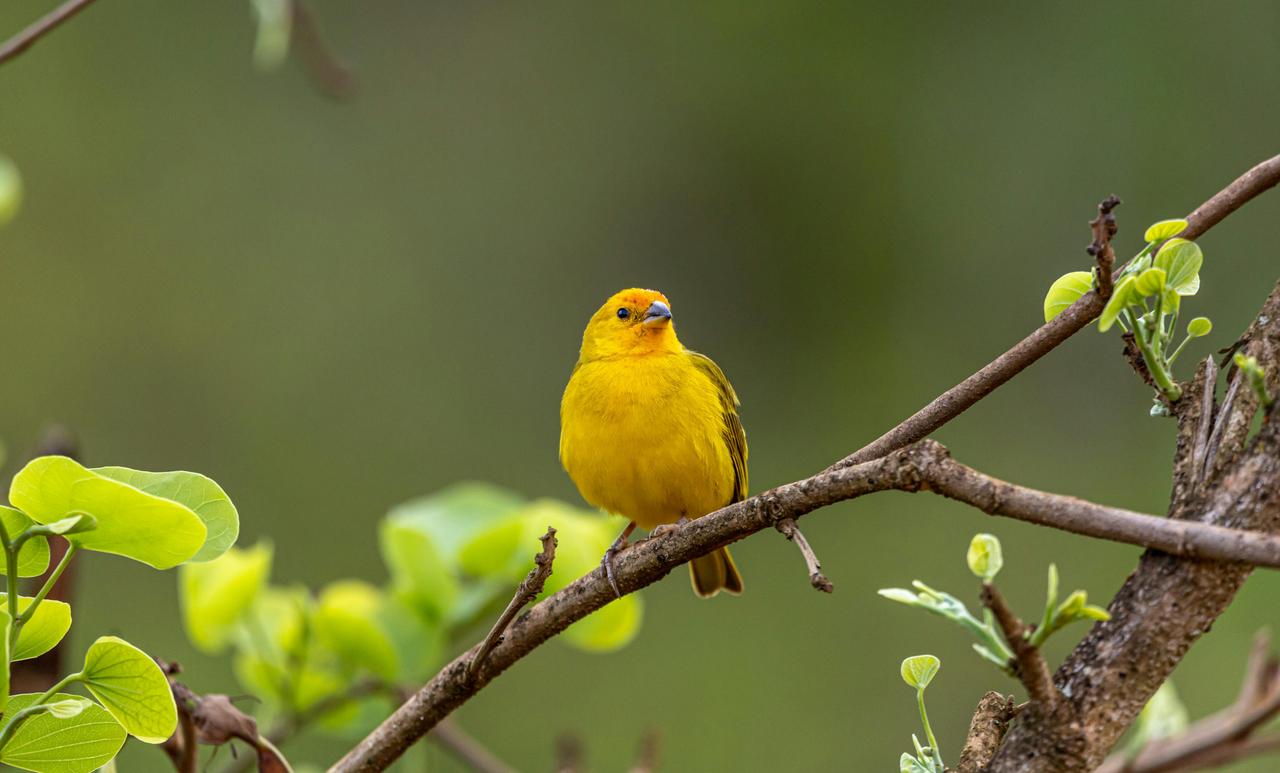
Canary ()
The canary (Serinus canaria) is a small finch. Natural individuals typically measure 12–13 cm in length and weigh 15–20 grams. Plumage in males is generally more vibrant, with yellowish-green tones, while females exhibit paler coloration. Domestic varieties, due to selective breeding, can display a wide range of color variations including red, white, orange, and mosaic patterns.
Related to their reproductive biology, brain structures in males such as the high vocal center (HVC) and the robust nucleus of the arcopallium (RA) are significantly more developed than in females. For instance, the HVC nucleus in males is approximately three times larger than in females. These structures are directly involved in song production and learning.
Canaries exhibit marked seasonal changes in brain volume and neural connectivity. Particularly during spring, when breeding and singing activity increase, the volume of the HVC and related nuclei expands. This growth occurs not only through increased synaptic density but also through adult neurogenesis—the addition of new neurons. This feature makes the canary a unique model for studying morphological plasticity. Additionally, during song production, both hemispheres of the canary’s brain can operate partially independently. As a result, the majority of song elements are generated solely by the left hemisphere, a phenomenon known as “left hemispheric dominance.”
The canary (Serinus canaria) occurs naturally only on the Canary Islands and Madeira in the Atlantic Ocean. Its primary breeding areas are the Canary Islands, belonging to Spain (particularly La Palma, El Hierro, and Tenerife), and the Madeira archipelago, belonging to Portugal. A small population has also been established on Bermuda, following human introduction. Although its geographic range is limited, population density within its range is high.
Canaries are highly adaptable and can be found in a variety of natural and semi-natural ecosystems. They inhabit lowland and montane evergreen forests, including both needleleaf (especially pine) and broadleaf forests, as well as laurel and heather shrublands, valleys with almond trees, and areas dominated by tamarisk scrub. They are also observed along agricultural edges, rural gardens, and semi-arid open areas. On the Desertas Islands off Madeira, they have even been recorded breeding in nearly vegetation-free semi-arid zones. This broad habitat diversity demonstrates the canary’s high capacity for environmental adaptation.
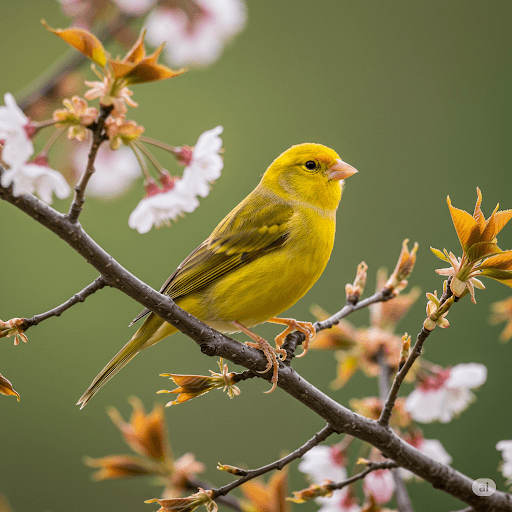
Canary - Serinus canaria (Generated by Artificial Intelligence.)
Canaries exhibit monogamous and territorial behavior. In their natural habitats, the breeding season occurs between January and July. Nests are compact structures built on the tips of tree branches or in the crowns of small shrubs. Nest materials include twigs, plant fibers, feathers, and wool. Females typically lay three to four eggs; incubation lasts approximately 13–14 days, and fledging occurs after 14–21 days.
In natural environments, canaries feed primarily on seeds of grasses, herbs, and other herbaceous plants. They also consume fresh buds, fruits, and to a lesser extent, insects. They inhabit semi-open areas, heathlands, forest edges, agricultural lands, and rural gardens. Domestic canaries are typically fed seed mixtures supplemented with fresh fruits and vegetables. In both natural and domestic settings, they tend to live in flocks.
Historically, canaries were used to detect toxic gases in coal mines. Due to their high sensitivity to airborne toxins, they served as early warning systems for miners. Additionally, canaries are popular as pets due to their singing ability and color variation.
In scientific research, they play a crucial role as model organisms in studies on vocal learning, neural plasticity, and neurogenesis. Canaries contribute significantly to understanding adult neurogenesis and neuronal renewal through their annually changing song repertoires and associated structural changes in the brain.
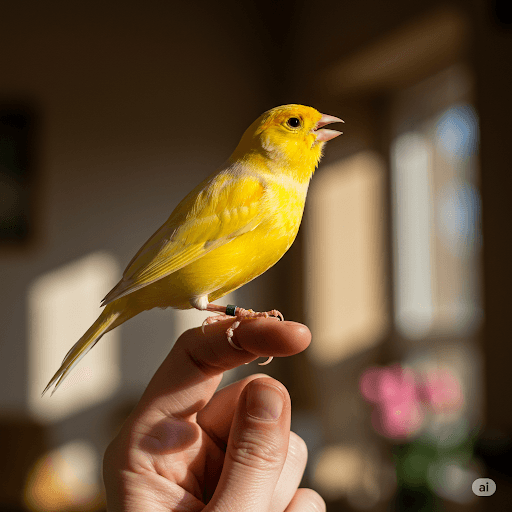
Canary’s Relationship with Humans (Generated by Artificial Intelligence.)
Natural populations are found only on the Canary Islands and Madeira, with an estimated total of 3 to 5 million breeding individuals in Europe. Although its distribution is limited, the population trend is stable and no significant decline has been observed. Therefore, the IUCN classifies Serinus canaria as “Least Concern.” No special conservation action plan or emergency measures are required for this species. However, protecting its habitats and monitoring wild populations remain important. The species is also widely bred globally as a pet.
BirdLife International. Serinus canaria. The IUCN Red List of Threatened Species. Accessed May 21, 2025. https://dx.doi.org/10.2305/IUCN.UK.2018-2.RLTS.T22720056A132137153.en
Catchpole, Clive K., and Peter J. B. Slater. Bird Song: Biological Themes and Variations. 2nd ed. Cambridge: Cambridge University Press, 2008.
Mederios, Jonh. “Kanarya JPG.” Pexels. Accessed May 21, 2025.
Nottebohm, Fernando. "The Neural Basis of Birdsong." *PLOS Biology* 3, no. 5 (2005): e164. Accessed May 21, 2025. https://doi.org/10.1371/journal.pbio.0030164
Zann, Richard A. The Zebra Finch: A Synthesis of Field and Laboratory Studies. Oxford: Oxford University Press, 1996.


Canary (Serinus canaria)
Team(s) | Passeriformes | ||||||||
|---|---|---|---|---|---|---|---|---|---|
Family | Fringillidae | ||||||||
Natural Distribution | Madeira Azores Canary Islands | ||||||||
Average Length | 12–13 cm | ||||||||
Average Weight | 15–20 g | ||||||||
Diet(s) | small insects fruits Seeds | ||||||||
Breeding Season | January – July | ||||||||
Lifespan | 6–15 years (in captive populations) | ||||||||
Conservation Status | Least Concern | ||||||||
No Discussion Added Yet
Start discussion for "Canary (Serinus canaria)" article
Morphological Characteristics
Distribution and Habitat
Behavior and Reproduction
Diet and Ecology
Human Interactions and Uses
Conservation Status