


This article was automatically translated from the original Turkish version.
+1 More
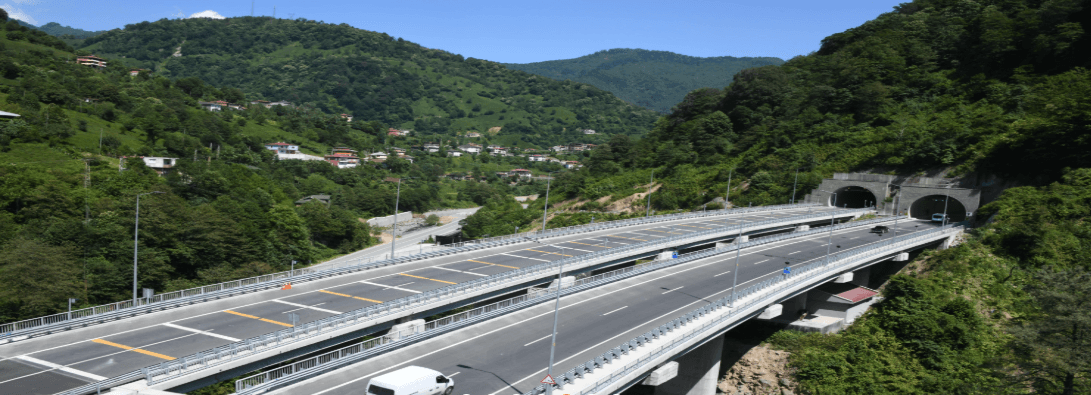
Cankurtaran Tunnel
Location | Hopa - Borçka/Artvin | ||||||||
|---|---|---|---|---|---|---|---|---|---|
Length(s) | 5.228 metres | ||||||||
Road Width | 2x2 double tube | ||||||||
Construction Process | 2005 - 2018 | ||||||||
Opening Date(s) | 1 March 2018 | ||||||||
Cankurtaran Tunnel is one of Turkey’s transportation projects connecting Black Sea Region to East and the Middle East. Constructed along the Hopa-Borçka route in place and designed to enhance driver safety during particularly harsh winter conditions, this tunnel was planned by the General Directorate of Highways. With a length of 5,228 metres, Cankurtaran Tunnel is Türkiye’s second-longest twin-tube tunnel and was opened to traffic on 1 March 2018. Upon completion of the project, travel distance in the region was reduced by 12 kilometres and traffic safety improved significantly.
The Cankurtaran Tunnel was constructed to facilitate transportation between the districts of Hopa and Borçka in Artvin. The Cankurtaran Pass, which frequently closed during winter months due to heavy snow precipitation, posed a major challenge for drivers. The construction of the new tunnel has led to the following benefits:
The technical specifications of the Cankurtaran Tunnel are as follows:
The tunnel, whose foundation was laid on 29 October 2010 by then Minister of Transport Binali Yıldırım, was completed in 2018 after prolonged construction phases and certain legal proceedings in courts.
With the opening of the Cankurtaran Tunnel, transportation costs between the Black Sea region and Eastern Anatolia have decreased.
The Cankurtaran Tunnel not only connects the Hopa-Borçka route but also forms part of a broader corridor linking the Black Sea to Eastern Anatolia and the Middle East.
The Cankurtaran Tunnel has become one of the most important projects modernizing regional transportation. Since its opening, traffic flow in the region has become safer and more reliable, and winter transportation challenges have been largely resolved. In the future, this route is expected to be further improved with additional viaducts and bridges.
Karayolları Genel Müdürlüğü. "Proje Detay - Cankurtaran Tüneli." Accessed March 18, 2025. https://www.kgm.gov.tr/Sayfalar/KGM/SiteTr/Projeler/ProjelerDetay.aspx?q=8.
Ortana. "Cankurtaran Tüneli Açıldı." Accessed March 18, 2025. http://www.ortana.com/new/index.php/tr/anasayfa/8-haberler.
T.C.Artvin Valiliği. "Hopa-Borçka Cankurtaran Tunnel Opened to Traffic." Accessed March 18, 2025. http://www.artvin.gov.tr/hopa-borcka-cankurtaran-tuneli-ulasima-acildi.
Yüksel Proje. "Cankurtaran Tüneli." Accessed March 18, 2025. https://www.yukselproje.com.tr/tr/projeler.

Cankurtaran Tunnel
Location | Hopa - Borçka/Artvin | ||||||||
|---|---|---|---|---|---|---|---|---|---|
Length(s) | 5.228 metres | ||||||||
Road Width | 2x2 double tube | ||||||||
Construction Process | 2005 - 2018 | ||||||||
Opening Date(s) | 1 March 2018 | ||||||||
General Information
Purpose and Significance of the Project
Technical Features and Construction Process
Economic and Environmental Contributions
Transportation and Connections