


This article was automatically translated from the original Turkish version.
+2 More
Wood is a traditional construction material widely used in the construction and furniture industries due to its natural appearance, aesthetic structure, and sustainability. However, its limited resistance to environmental factors, risk of biological degradation, and mechanical weaknesses restrict its use, particularly in load-bearing systems. To overcome these limitations, thermal treatment and composite reinforcement techniques have been developed to enhance the physical and mechanical performance of wood materials. In this context, carbon fiber-reinforced lamination stands out as a significant innovation in the production of high-performance wood composites.
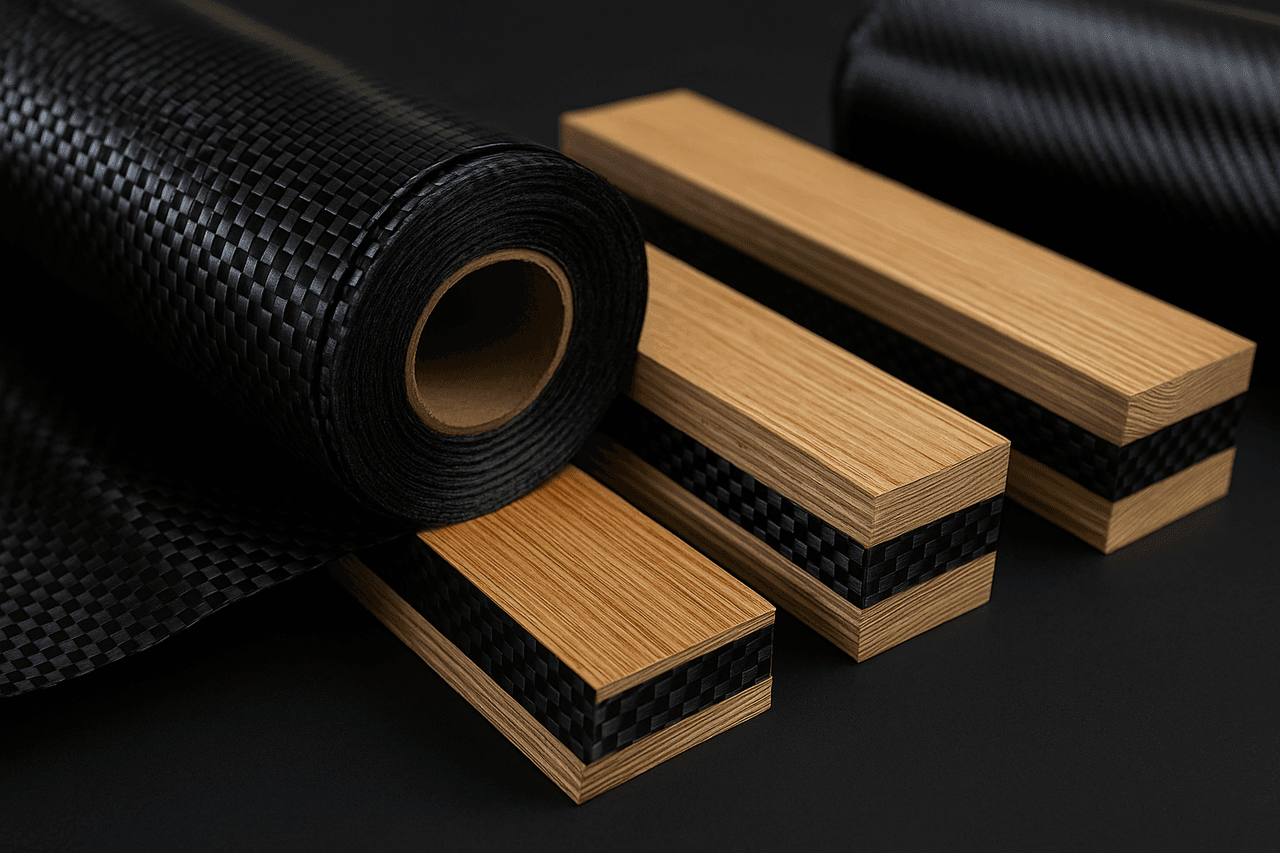
Example of Laminated Coating (Generated by Artificial Intelligence)
Thermal treatment is a physical process that modifies wood materials at temperatures between approximately 150–220 °C without the use of water or chemical additives. As a result of this process:
Conversely, mechanical properties such as modulus of rupture (MOR), modulus of elasticity (MOE), and compressive strength parallel to grain (CS//) decrease due to high temperatures. This reduction can limit the direct use of wood in load-bearing systems.
Lamination is a physical modification method that involves stacking wood veneers with adhesives and pressing them together. Through this method:
In LVL production, wood species such as oriental beech (Fagus orientalis Lipsky) or black pine (Pinus nigra) are commonly used, with phenol-formaldehyde (PF), polyurethane (PU), or polyvinyl acetate (PVAc) selected as adhesives.
Carbon fiber is used as a reinforcing element in wood lamination systems due to its high tensile strength and low density. The reinforcement process is carried out as follows:
Significant increases in modulus of rupture (MOR) and modulus of elasticity (MOE) were observed in carbon fiber-reinforced LVL samples:
This improvement reaches its maximum at 150 °C thermal treatment temperature, with partial reductions observed at higher temperatures. Compressive strength varies depending on the type of fiber and the thermal treatment temperature.
For example:
This indicates that although thermal treatment weakens the fiber structure, carbon fiber partially preserves the structural integrity. In all test groups, the bond strength of carbon fiber-reinforced samples was lower than that of unreinforced groups. This is due to the carbon fiber acting as a barrier that limits load transfer between layers.
Carbon fiber lamination is effectively used in the following areas:
Carbon fiber-reinforced laminated veneer lumber (LVL) is a high-performance composite material that compensates for the mechanical weaknesses of thermally treated natural wood and imparts new structural properties. Thanks to the increases it provides in both flexural strength and modulus of elasticity, it offers a sustainable and reliable alternative in modern structural systems. Its growing potential for application plays a significant role in the future of wood construction technologies.
Perçin, Osman. “Isıl İşlem Uygulanmış Karbon Fiber ile Güçlendirilmiş Lamine Kaplama Kerestenin (LVL) Hava Kurusu Yoğunluk ve Liflere Paralel Basınç Direncinin Belirlenmesi.” *Mobilya ve Ahşap Malzeme Araştırmaları Dergisi* 6, no. 1 (2023): 104–114. https://doi.org/10.33725/mamad.1268729
Çiğdem, Ercan, and Osman Perçin. “Karbon Fiber Ve Cam Fiber Ile güçlendirilmiş ısıl işlem uygulanmış Lamine Kaplama Kerestelerin (lvl) Bazı Fiziksel Ve Mekaniksel özellikleri”. Gazi Üniversitesi Mühendislik Mimarlık Fakültesi Dergisi 38, no. 2 (October 2022): 653-64.

No Discussion Added Yet
Start discussion for "Carbon Fiber Reinforced Laminated Veneer Lumber (LVL)" article
Thermal Treatment and Its Effects on Wood
Lamination and Composite Wood Structure
Reinforcement with Carbon Fiber
Mechanical Properties and Experimental Findings
Modulus of Rupture (MOR) and Modulus of Elasticity (MOE)
Application Areas