


This article was automatically translated from the original Turkish version.
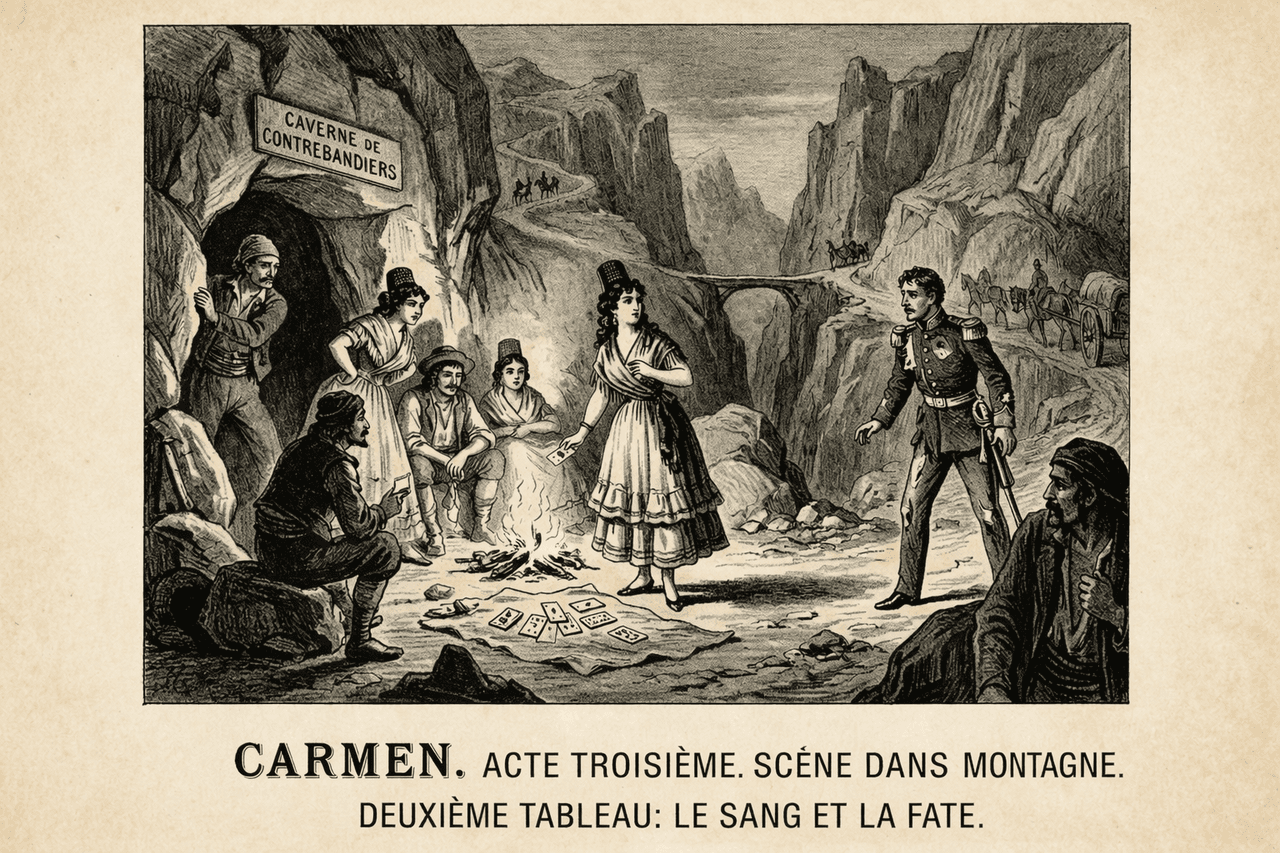
Carmen (Yapay Zekayla Oluşturulmuştur)
Number of Acts | 4 Acts | ||||||||
|---|---|---|---|---|---|---|---|---|---|
World Premiere | 3 March 1875, Opéra-Comique, Paris | ||||||||
Librettists | Henri Meilhac and Ludovic Halévy | ||||||||
Composer | Georges Bizet | ||||||||
Genre | Opéra Comique | ||||||||
Carmen is a four-act opera composed by French composer Georges Bizet with a libretto by Henri Meilhac and Ludovic Halévy.【1】 Although initially met with little enthusiasm upon its premiere in Paris in 1875, the work has since become one of the most frequently performed operas worldwide.
Recognized as one of the finest examples of French opera, Carmen holds historical importance as a precursor to the verismo movement in global opera literature.【2】 Adapted from the 1845 novella by Prosper Mérimée, the opera was coldly received by the bourgeois audience of its time when it premiered at Paris’s Opéra-Comique in 1875, deemed “immoral” and “too coarse.”【3】 However, Bizet’s bold approach of portraying characters from the lowest rungs of society with tragic intensity gained revolutionary acclaim shortly after his death. Today, Carmen is not merely a work of art but also one of the foundational pillars of modern opera, continuing to inspire academic studies and contemporary stage interpretations through its melodic richness and universal themes.【4】

Carmen (Rawpixel)
Although the narrative is based on Mérimée’s 1845 novella, Bizet and the librettists modified the literary text to enhance its dramatic depth. Bizet transformed the traditional “opéra comique” style, which was expected to be light and entertaining, by introducing dark elements such as murder and passion.【5】 To balance the characters, the figure of Micaëla, representing the pure and faithful fiancée, was invented for the opera and does not appear in the original novel. The contrast between Carmen’s free-spirited and rebellious nature and this new character strengthened the opera’s dramatic conflict.【6】 During the premiere, the orchestra and chorus struggled with the opera’s unconventional rhythmic structures and realistic character portrayals, demonstrating Bizet’s visionary artistic vision for his time.【7】
The narrative unfolds in four acts, tracing a tragic journey from the plazas of Seville to mountain hideouts and finally to a bullfighting arena. In the first act, Corporal Don José encounters the free-spirited Carmen outside a tobacco factory. After a brawl, Carmen convinces José to release her from custody, marking the first step in his detachment from duty and his former life.【8】 In the second act, Don José, imprisoned for Carmen’s sake, deserts the army to join a band of smugglers at Lillas Pastia’s tavern, where the bullfighter Escamillo is introduced, laying the groundwork for the fatal rivalry to come.【9】 The third act, set in a remote mountain encampment, gains a mystical atmosphere as Carmen reads her own death in fortune-telling cards. José’s jealousy and news of his mother’s illness prompt him to leave the camp with Micaëla, heightening the tension. In the final act, as Escamillo’s victory is celebrated in the Seville arena, Don José confronts Carmen outside and, unable to win back her love, stabs her to death, bringing the story to a tragic close.【10】
Georges Bizet’s score for Carmen not only contains some of the most famous melodies in opera history but also enacted an aesthetic revolution that pushed the boundaries of late Romantic music. The opera’s musical identity arises from the flawless fusion of rhythmic elements characteristic of Spanish and Romani cultures with the elegance of French opera; yet Bizet crafted these Spanish inflections without ever visiting Spain, drawing inspiration solely from extensive library research and the works of composers such as Sebastián Yradier.【11】 Employing the leitmotif technique with mastery to underscore emotional shifts and the theme of inevitable fate, Bizet repeatedly reminds the audience of the tragic conclusion through dark, ominous motifs associated with Carmen’s entrances, known as the “fate motif.” The contrast between the seductive rhythms of famous numbers such as the “Habanera” and “Seguidilla” and the heroic grandeur of the “Toreador Song” reveals Bizet’s orchestral genius and his ability to translate human psychology into musical notation.【12】 This musical legacy has cemented the opera’s unshakable place in popular culture while also serving as an inexhaustible resource for academic studies examining how musical language constructs social gender and class identities.
Carmen: "L'amour est un oiseau rebelle" (Elina Garanca) (Metropolitan Opera)
In today’s performing arts world, Carmen is no longer viewed solely as a 19th-century classic but as a living text that invites critical examination of social dynamics, power relations, and ethical values. Modern productions often remove the story from its original historical context, transplanting it into different political atmospheres such as 1970s Spain, allowing its themes of oppression, violence, and freedom to resonate with contemporary audiences.【13】 These modern interpretations reframe the relationship between Don José and Carmen not as an eternal love story but as a controlling obsession and destructive passion, transforming the final murder into a reflection of today’s social reality: femicide. Carmen is no longer merely a “femme fatale” but is repositioned as a symbol of resistance who defends her freedom at the cost of her life, challenging all forms of domination and social constraint.【14】 The opera retains its value as a critical source for analyzing how concepts such as gender roles, class division, and racial identity are constructed on the operatic stage, and each new production invites audiences to re-engage with these universal issues.【15】
Accessed November 26, 2025. https://www.aa.com.tr/tr/kultur/ahlatta-acilan-kurslarla-geleneksel-tas-isciligi-yasatiliyor/3116279.
English National Opera. “Carmen.” ENO. Accessed April 8, 2026. https://www.eno.org/operas/carmen/
McClary, Susan. "Georges Bizet: Carmen." Cambridge University Press, 1992. Fulcrum. Accessed April 8, 2026.
Metropolitan Opera. "Carmen: 'L'amour est un oiseau rebelle' (Elina Garanca)." YouTube. Accessed April 8, 2026. https://youtu.be/K2snTkaD64U?si=00JoIHWPvNRRElY0
Rawpixel. "Poster for an 1896 dramatic adaptation of Carmen, starring Rosabel Morrison, and under the management of Edward J. Abram." rawpixel.com. Accessed April 8, 2026. https://www.rawpixel.com/image/8324972/image-art-vintage-public-domain
The Metropolitan Opera. "Carmen: The Opera’s Plot and Creation." The Met Opera. Accessed April 8, 2026.
https://www.fulcrum.org/concern/monographs/k930bx44w
[1]
English National Opera, “Carmen,” ENO, Access date: 9 April 2026, https://www.eno.org/operas/carmen/
[2]
English National Opera, “Carmen,” ENO, Access date: 9 April 2026, https://www.eno.org/operas/carmen/
[3]
The Metropolitan Opera, “Carmen: The Opera’s Plot and Creation,” Access date: 9 April 2026,
https://www.metopera.org/discover/education/educator-guides/carmen/the-operas-plot-and-creation/
[4]
Susan McClary, ''Georges Bizet: Carmen,'' Cambridge University Press, 1992, Fulcrum, Access date: 9 April 2026, https://www.fulcrum.org/concern/monographs/k930bx44w
[5]
The Metropolitan Opera, “Carmen: The Opera’s Plot and Creation,” Access date: 9 April 2026,
https://www.metopera.org/discover/education/educator-guides/carmen/the-operas-plot-and-creation/
[6]
The Metropolitan Opera, “Carmen: The Opera’s Plot and Creation,” Access date: 9 April 2026,
https://www.metopera.org/discover/education/educator-guides/carmen/the-operas-plot-and-creation/
[7]
Susan McClary, ''Georges Bizet: Carmen,'' Cambridge University Press, 1992. Fulcrum. Access date: 9 April 2026, https://www.fulcrum.org/concern/monographs/k930bx44w
[8]
The Metropolitan Opera. “Carmen: The Opera’s Plot and Creation,” Access date: 9 April 2026,
https://www.metopera.org/discover/education/educator-guides/carmen/the-operas-plot-and-creation/
[9]
The Metropolitan Opera, “Carmen: The Opera’s Plot and Creation,” Access date: 9 April 2026,
https://www.metopera.org/discover/education/educator-guides/carmen/the-operas-plot-and-creation/
[10]
English National Opera, “Carmen,” ENO, Access date: 9 April 2026, https://www.eno.org/operas/carmen/
[11]
The Metropolitan Opera, “Carmen: The Opera’s Plot and Creation,” Access date: 9 April 2026,
https://www.metopera.org/discover/education/educator-guides/carmen/the-operas-plot-and-creation/
[12]
Susan McClary, ''Georges Bizet: Carmen,'' Cambridge University Press, 1992. Fulcrum. Access date: 9 April 2026.
[13]
English National Opera, “Carmen,” ENO, Access date: 9 April 2026, https://www.eno.org/operas/carmen/
[14]
The Metropolitan Opera, “Carmen: The Opera’s Plot and Creation,” Access date: 9 April 2026,
https://www.metopera.org/discover/education/educator-guides/carmen/the-operas-plot-and-creation/
[15]
Susan McClary, ''Georges Bizet: Carmen,'' Cambridge University Press, 1992. Fulcrum. Access date: 9 April 2026,


Carmen (Yapay Zekayla Oluşturulmuştur)
Number of Acts | 4 Acts | ||||||||
|---|---|---|---|---|---|---|---|---|---|
World Premiere | 3 March 1875, Opéra-Comique, Paris | ||||||||
Librettists | Henri Meilhac and Ludovic Halévy | ||||||||
Composer | Georges Bizet | ||||||||
Genre | Opéra Comique | ||||||||
Identity and Historical Significance
Literary Origins and Creative Process
Plot and Narrative Structure
Musical Language and Aesthetic Legacy
Modern Productions and Contemporary Perspectives