
This article was automatically translated from the original Turkish version.
+2 More
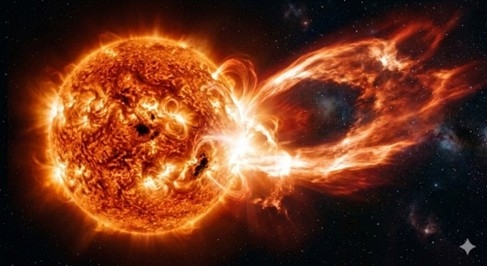
Carrington Olayı (Yapay Zeka İle Oluşturulmuştur.)
edit
A geomagnetic event that occurred on 1–2 September 1859 and is considered one of the most powerful solar storms ever recorded. The event resulted from the interaction of charged particles, emitted by a massive solar flare on the Sun, with Earth’s magnetosphere. Observed by British astronomer Richard Carrington, the event gained its name due to the widespread disruptions it caused in telegraph systems and the extraordinary auroras visible across the globe.

Richard Carrington (Generated by Artificial Intelligence)
The Carrington Event was detected on 1 September 1859 by Richard Carrington during a solar observation. He noted two unusually bright flashes of light on the Sun’s surface and recorded that magnetic disturbances on Earth followed shortly afterward. Other observers at the same time reported similar solar flares, and these observations became a crucial starting point for studies examining the relationship between solar flares and geomagnetic storms.

Solar Storm (Anadolu Agency)
The Carrington Event is associated with a powerful solar flare on the Sun followed by a coronal mass ejection. During this process, vast amounts of energy and charged particles were ejected into space. When these particles reached Earth, they interacted with the planet’s magnetic field, triggering an intense geomagnetic storm.
During geomagnetic storms, Earth’s magnetosphere is significantly disturbed, and changes in magnetic field lines can induce electric currents. In the 19th century, these currents caused powerful surges in telegraph lines, which were the dominant communication technology of the time, leading to widespread system failures.
One of the most striking effects of the Carrington Event was the widespread observation of intense auroras across the globe. Normally visible only at high latitudes, auroral displays were reported as far south as the tropics during this geomagnetic storm.
Significant disruptions also occurred in the telegraph networks of the time. Reports indicated abnormal increases in electrical currents along some lines, sparks flying from equipment, and even operators managing to briefly power telegraph machines without any external power source. This event is regarded as one of the earliest documented examples of the impact of geomagnetic storms on technological systems.

Carrington Event (Generated by Artificial Intelligence)
The Carrington Event is regarded today as a critical reference point in space weather research. If a similar solar storm were to occur today, it could severely disrupt satellite systems, power grids, and global communication infrastructure. As a result, scientific efforts are focused on monitoring solar-driven geomagnetic events and developing early warning systems to mitigate their potential impacts.

Carrington Olayı (Yapay Zeka İle Oluşturulmuştur.)
Observation and Discovery
Solar Activity and Formation Mechanism
Effects on Earth
Importance in the Context of Modern Technology