


This article was automatically translated from the original Turkish version.
Phineas Gage Case is one of the foundational studies in the history of neuroscience and psychology, encompassing the brain injury sustained by a 19th-century railroad worker and the subsequent changes in his personality. The case provides one of the earliest and most well-known pieces of evidence regarding the role of the brain—particularly the frontal lobes—in personality, social behavior, and decision-making processes.

Portrait of Gage Holding the Iron Rod That Injured Him (Sam Kean)
On 13 September 1848, 25-year-old Phineas P. Gage, working as a construction foreman for the Rutland and Burlington Railroad Company, suffered an accident near Cavendish, Vermont. His task involved blasting rocks to clear the way for railway construction. This process required drilling a hole into the rock, filling it with gunpowder, covering it with sand, and then compacting the sand with a metal tamping iron. Due to a momentary lapse in attention, Gage began compacting the sand before pouring it over the gunpowder. This caused the iron rod to strike the rock, producing a spark that ignited the gunpowder.
The explosion propelled a tamping iron weighing 13.25 pounds (approximately 6 kg), measuring 3 feet 7 inches (approximately 109 cm) in length, and 1.25 inches (approximately 3.2 cm) in diameter with a pointed end, directly through Gage’s head. The rod entered beneath his left cheekbone, passed behind his left eye, pierced his left frontal lobe, and exited through the top center of his skull.
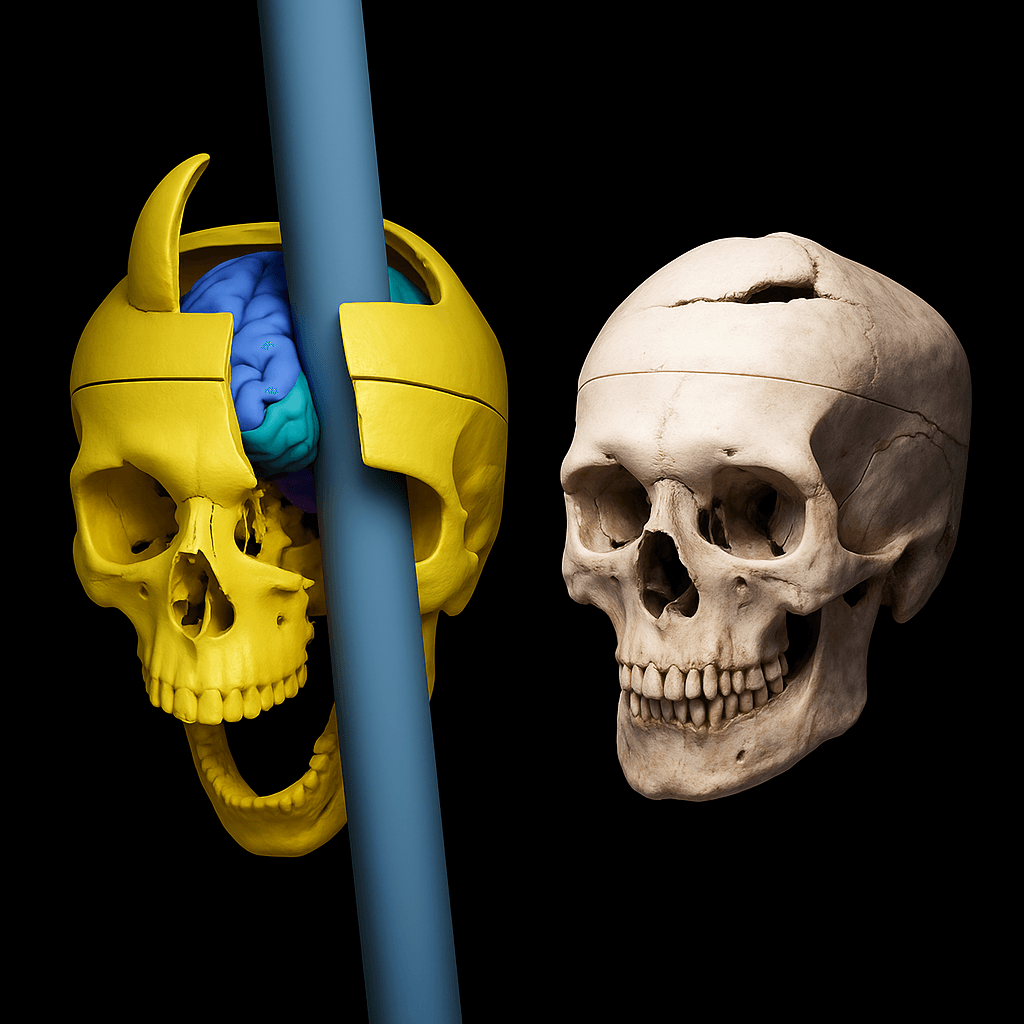
Digital Skull Reconstruction (Generated by Artificial Intelligence)
Despite the severity of the injury, Gage remained conscious and shortly afterward spoke and walked with assistance. He was transported by oxcart to a nearby inn about a mile away. Dr. John M. Harlow, the physician attending the case, documented that brain tissue and blood were flowing from the wound in Gage’s skull and that there were fragmented fractures in the cranial bones.
Following Harlow’s intervention, Gage entered a weeks-long recovery process. During this time he developed a fungal brain infection and fell into a coma, yet he survived. He permanently lost vision in his left eye.
The first report, published by Dr. Harlow in 1848, focused largely on the medical details of Gage’s survival. The case was initially met with skepticism within the medical community, as survival after such a severe injury was considered impossible. In 1849, Dr. Henry J. Bigelow from Harvard Medical School examined Gage and described him as “completely recovered” in terms of physical and mental faculties. However, Bigelow’s assessment, consistent with the standards of the time, included only basic sensory and motor function tests. This evaluation was used as evidence against the then-popular theory of phrenology, which held that specific brain regions had specialized functions.
The most fundamental source regarding Gage’s behavioral changes is Dr. Harlow’s second report, published in 1868, twenty years after the accident. In this report, Harlow noted that before the accident, Gage’s employers regarded him as “the most efficient and capable” foreman, but after the accident, “the change in his mind was so marked that they could not give him his former position.” According to Harlow, Gage had become “fitful, irreverent, indulging at times in the grossest profanity (which was not previously his custom), manifesting but little deference for his fellows, and impatient of restraint or advice when it conflicts with his desires.” His friends reportedly said he was “no longer Gage.” This report was noticed by British physiologist Dr. David Ferrier, who used the case to support the theory of cerebral localization—the idea that specific brain functions are localized in particular regions.
Over time, a narrative emerged portraying Gage as an “irresponsible, foul-mouthed, job-hopping, rowdy vagrant.” Researchers such as contemporary historian Malcolm Macmillan have argued that this popular account is largely exaggerated and fabricated, noting that primary evidence describing Gage’s behavioral changes amounts to no more than a few hundred words. It has been suggested that some scientists, through what has been termed a “scientific license,” retrospectively attributed symptoms observed in modern frontal lobe patients to Gage.
According to Harlow’s 1868 report, Gage exhibited himself and the iron rod for a time in New England after the accident. In 1852 he traveled to Chile, where he worked for seven years as a stagecoach driver between Valparaíso and Santiago. Macmillan theorized that the highly structured and routine nature of this job may have provided Gage with a framework to regain social skills and experience a form of social recovery. This theory is supported by the testimony of a physician in Chile who knew Gage and stated that “his mental faculties were unimpaired and his health was good.” Gage died in San Francisco in 1860 at the age of 36, likely from complications of epileptic seizures triggered by the injury.
At Dr. Harlow’s request, Gage’s skull and the tamping iron were exhumed and are now on display at the Warren Anatomical Museum at Harvard University. In the late 20th century, modern imaging techniques were applied to these remains.

Gage’s Skull and Tamping Iron (Flickr)
The Gage case is now regarded as a classic example of what is known today as “frontal lobe syndrome.” This syndrome describes a constellation of cognitive, emotional, and behavioral disturbances resulting from frontal lobe damage. Literature distinguishes three main types:
The Gage case laid the foundation for understanding the role of the prefrontal cortex in higher cognitive functions. This region is thought to be particularly involved in:
Damasio, Hanna, Thomas Grabowski, Randall Frank, Amy M. Galaburda, and Antonio R. Damasio. "The Return of Phineas Gage: Clues About the Brain from the Skull of a Famous Patient." *Science* 264, no. 5162 (1994): 1102–1105. Accessed July 3, 2025. http://www.antoniocasella.eu/dnlaw/Damasio_1994.pdf.
Kean, Sam. "Phineas Gage, Neuroscience’s Most Famous Patient." *Science* 11 (2014): 32. Accessed July 3, 2025. https://www.cse.iitk.ac.in/users/se367/14/Readings/kean-14_phineas-gage-most-famous-patient.pdf.
Neylan, Thomas C. "Frontal Lobe Function: Mr. Phineas Gage’s Famous Injury." *The Journal of Neuropsychiatry and Clinical Neurosciences* 11, no. 2 (1999): 280–281. Accessed July 3, 2025. https://psychiatryonline.org/doi/pdf/10.1176/jnp.11.2.280.
Pąchalska, Maria, Leszek Buliński, Olga Jauer-Niworowska, and Anna Rasmus. "Neuropsychological Functioning After Traumatic Injury to the Orbito-Frontal Area: A Polish Phineas Gage." *Acta Neuropsychologica* 12, no. 4 (2014). Accessed July 3, 2025. https://www.researchgate.net/publication/271489289_Neuropsychological_functioning_after_traumatic_injury_to_the_orbito-frontal_area_A_Polish_Phineas_Gage.
“Phineas Gage Skull and Rod Display.” *Flickr*. Photo: Jedimentat44. Accessed July 3, 2025. https://www.flickr.com/photos/jedimentat/7576762294.

No Discussion Added Yet
Start discussion for "Case of Phineas Gage" article
Definition and Details of the Case
The Accident
Initial Medical Intervention and Survival
Historical Development and Interpretations
Initial Assessments and Skepticism
Documentation of Personality Changes
Formation of the Myth and Criticism
Gage’s Later Years and the Theory of Rehabilitation
Reevaluation Using Modern Techniques
Theoretical Approaches and Neurological Foundations
Frontal Lobe Syndrome
Functions of the Prefrontal Cortex
Key Figures and Documents
Key Documents