

 Recently Added:
This article was automatically translated from the original Turkish version.
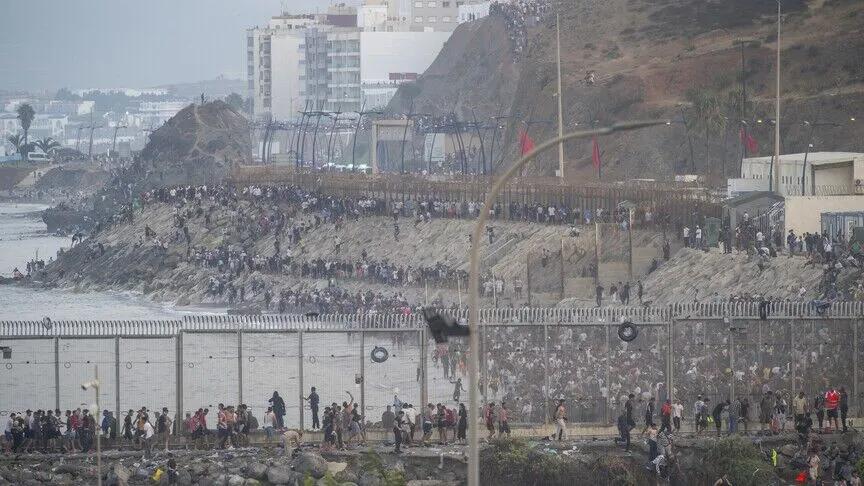
On July 31 2026 one of the largest irregular migration movements in recent years occurred from the Fenidek (Castillejos) coast in northern Morocco toward Spain's autonomous city of Ceuta in North Africa. Thousands of people attempted to cross the land border or swim across the sea to reach Ceuta resulting in a massive influx that significantly affected the city's population within a short time. Spanish authorities initially reported that tens of thousands of individuals had entered Ceuta within the previous 24 hours and later local administrations confirmed that the total number of crossings had reached approximately 60000. This figure corresponds to nearly 70 percent of Ceuta's population of about 83000 and has been regarded as one of the largest border movements Europe has witnessed in recent years.
A significant portion of the migrants attempted to reach Spanish territory by swimming from the Moroccan coast or climbing over breakwaters. Within minutes large crowds gathered on the streets of Ceuta overwhelming existing reception centers and security infrastructure. Spanish security forces initially struggled to control the density at the border as some migrants moved toward the city center while others were directed to temporary reception areas. Local sources reported that security personnel were insufficient to handle the scale of the mass crossing during the initial hours of the event.
Ceuta's President Juan Jesús Vivas described the developments as "definitely unsustainable." Vivas noted that the events placed serious pressure not only on migration management but also on public order health services housing capacity and urban infrastructure. The local administration urgently called on the central government to implement extraordinary measures.
In response to the rapid escalation of the migration influx the Spanish government implemented extraordinary measures to secure Ceuta. Prime Minister Pedro Sánchez announced that all state resources had been mobilized and additional Spanish Armed Forces police and Civil Guard units were deployed to the region. Patrols along the border were increased and comprehensive security operations were launched to control both maritime and land crossings.
Route of Swimming to Ceuta (July 31 2026) Anadolu Agency
The Spanish Ministry of the Interior stated that efforts were underway to return individuals who entered the country illegally as swiftly as possible under existing national and European Union legislation. However the process progressed under the shadow of a recent ruling by Spain's Supreme Court limiting the automatic return of irregular migrants arriving by sea. The government announced it was developing new practices to balance legal obligations with border security.
As the crisis intensified Prime Minister Pedro Sánchez visited the region to conduct on-site assessments. Sánchez characterized the mass crossing not merely as an irregular migration event but as a "violation of Spain's territorial integrity". He identified human smuggling networks as the primary culprits behind the incident stating that false hopes had been raised among migrants regarding easy access to Europe resulting in numerous deaths. He rejected any linkage between the crisis and Spain's migration policy asserting instead that the event originated from organized human smuggling activities.
In addition to strengthening security measures in Ceuta the Spanish government also enhanced precautions in Melilla another autonomous city in North Africa. The Beni Ensar Border Crossing between Morocco and Melilla was temporarily closed and security checks were tightened along both land and maritime routes. Authorities announced increased coordination with Moroccan officials and continuous operations in border areas to prevent new mass crossing attempts.
The mass irregular migration movement toward Ceuta was also assessed as a serious humanitarian crisis. Many people lost their lives and hundreds were injured as thousands simultaneously attempted to cross by sea or along the border. Initial reports on fatalities varied but later Ceuta's Autonomous Administration President Juan Jesús Vivas announced that the death toll had risen to 34. Some international media reported that the death toll had reached 41 during the events.
A significant number of those who died drowned while attempting to reach Ceuta's shores while others were crushed in overcrowded conditions at the border barriers along the Tarajal coastline. The accumulation of personal belongings life jackets and clothing along the shoreline demonstrated the extreme danger of the crossings. Human rights organizations and local authorities reported that many unaccompanied children and young migrants were also affected by the events.
The capacity of Ceuta's existing shelters was quickly exceeded. Thousands of irregular migrants were forced to spend the night in parks coastal strips and open areas while demand for food healthcare and temporary housing surged rapidly. Local security personnel and civil society organizations described the situation as a "serious humanitarian crisis" and emphasized extraordinary efforts to protect unaccompanied children meet basic needs and maintain public order.
Following the mass irregular migration attempt in Ceuta the Spanish government stated that its primary objectives were to restore border security and return individuals who entered the country illegally under national and international legal frameworks. Prime Minister Pedro Sánchez emphasized that the events were directed by organized human smuggling networks and that the government had mobilized all available resources.
Sánchez argued that human smuggling networks had misinterpreted the recent Supreme Court ruling concerning irregular migrants arriving by sea to spread propaganda suggesting that entry into Europe was easy. The government announced it would strengthen cooperation with Morocco and accelerate repatriation procedures to reestablish border security.
Following the onset of the mass migration movement Moroccan security forces implemented comprehensive security measures in the Fenidek area along the Ceuta border. Border routes were closed surveillance along the coastline was intensified and numerous irregular migrants attempting to swim to Ceuta were intercepted. Moroccan authorities deployed additional security personnel to control activity along the border.
Occasional clashes occurred between security forces and irregular migrants in the Fenidek and Bni Nsar areas. Security forces used tear gas warning shots and batons while some migrants reportedly threw stones and set fire to vehicles in the border zone. Many individuals suspected of involvement in the incidents were detained and migrants relocated away from the border were reported to have attempted to return to Ceuta.
In response to the mass irregular migration in Ceuta the European Union declared its readiness to support Spain. European Commission President Ursula von der Leyen stated that images from Ceuta were unacceptable and emphasized that protecting the EU's external borders was one of its top priorities. She also announced that Commissioner for Home Affairs and Migration Magnus Brunner would coordinate closely with Spanish authorities and that additional technical and operational support could be provided through Frontex.
The European Commission spokesperson also confirmed its readiness to provide Spain with additional financial technical and operational support. The Commission highlighted the critical importance of cooperation with Morocco in controlling irregular migration and stated that contacts with the Rabat administration continued to combat human smuggling networks and prevent irregular crossings.
The events in Ceuta have reignited debates in Europe on migration policy and Schengen border security. The Netherlands expressed support for Spain while Sweden called for rapid control of its borders. Finland announced its support for Italy's proposal to suspend Spain's Schengen membership and argued that protecting external borders is a fundamental obligation of the Schengen system.
German Chancellor Friedrich Merz stated that Spain must bring the situation in Ceuta under control as quickly as possible while French President Emmanuel Macron and Interior Minister Laurent Nuñez ordered increased controls along the France-Spain border. Overall European countries expressed support for protecting the EU's external borders and noted that the crisis has prompted renewed consideration of efforts to combat human smuggling and reassess irregular migration policies.
No official joint assessment has been made regarding the exact causes of the mass irregular migration toward Ceuta. The Spanish government argues that the migration surge was fueled by misinformation disseminated through social media by human smuggling networks. Prime Minister Pedro Sánchez stated that these networks had misinterpreted the Supreme Court's ruling on sea arrivals as propaganda to suggest that entry into Europe was easy.
In contrast some human rights organizations and civil society representatives argue that the mass migration movement cannot be explained solely by legal developments. According to these assessments structural factors such as economic hardship unemployment the long-standing existence of irregular migration routes and the desire to reach Europe also contributed to the crisis. Moroccan authorities have not provided a detailed explanation for the mass crossings focusing instead on restoring border security.
The sovereignty status of Ceuta and Melilla constitutes one of the longest-running diplomatic disputes between Spain and Morocco. Both cities are administered by Spain as autonomous cities located on the North African coast while Morocco asserts that these territories are historically part of its own land. As a result these two cities have periodically caused diplomatic tensions between the two countries independent of migration crises.
Tensions resurfaced when Moroccan Prime Minister Saadeddin El-Osmani stated that Ceuta and Melilla are Western Sahara "like Western Sahara part of Moroccan territory." El-Osmani indicated that Western Sahara remained his top priority but added that the issue of Ceuta and Melilla would also be revisited in the future. Madrid viewed this statement as a challenge to Spain's sovereignty and the Spanish Ministry of Foreign Affairs summoned Morocco's Ambassador to Madrid Karima Benyaich to request clarification. The Spanish government emphasized its expectation that all partner countries respect Spain's sovereignty and territorial integrity.
The Western Sahara issue has also been a significant element of this diplomatic tension. After the United States recognized Morocco's sovereignty over Western Sahara in 2020 a planned intergovernmental summit between Spain and Morocco was postponed and the Spanish press interpreted this decision as linked to the disagreements over Western Sahara. The status of Ceuta and Melilla has also been reintroduced to the international agenda during this period.
Anadolu Ajansı. “Fas'tan İspanya'nın Kuzey Afrika kıyısına düzensiz göç girişiminde 34 kişi hayatını kaybetti.” Accessed July 31, 2026.https://www.aa.com.tr/tr/dunya/fastan-ispanyanin-kuzey-afrika-kiyisina-duzensiz-goc-girisiminde-34-kisi-hayatini-kaybetti/4014496
Associated Press. “Spain’s PM blames trafficking gangs as 60,000 cross into Ceuta from Morocco, with 41 deaths.” Accessed July 31, 2026.https://apnews.com/article/spain-ceuta-migration-66839d113f24ba80d08b36d2b337201c
BBC News Türkçe. “İspanya'nın Afrika'daki toprağı Ceuta'ya bir günde 60 bin göçmen girdi.” Accessed July 31, 2026.https://www.bbc.com/turkce/articles/cz97klj5x98o
Euronews Türkçe. “İspanya'da göç krizi: 24 saatte 40 binden fazla düzensiz göçmen Ceuta'ya geçti.” Accessed July 31, 2026.https://tr.euronews.com/my-europe/2026/07/31/ispanyada-goc-krizi-24-saatte-40-binden-fazla-duzensiz-gocmen-ceutaya-gecti
France 24. “Some 25,000 migrants return to Morocco after thousands cross border into Spain.” Accessed July 31, 2026.https://www.france24.com/en/europe/20260731-eu-races-to-contain-new-migrant-crisis-as-thousands-cross-into-spanish-territory-of-ceuta
TRT Haber. “İspanya ile Fas arasında diplomatik kriz.” Accessed July 31, 2026.https://www.trthaber.com/haber/dunya/ispanya-ile-fas-arasinda-diplomatik-kriz-540076.html

Ceuta, Spain's autonomous city in North Africa, faced one of the largest irregular migration movements in recent years toward the end of July 2026. Tens of thousands of migrants arrived in the city via land and sea routes from Morocco, resulting in dozens of deaths during the events. While the Spanish government deployed military and additional security forces to the region, the European Union announced it was ready to provide further operational assistance including support from Frontex. The crisis reignited debates in Europe over border security and migration policies and also revived sovereignty disputes between Spain and Morocco over the status of Ceuta and Melilla.
No Discussion Added Yet
Start discussion for "Ceuta Migration Wave (July 2026)" article
July 31, 2026
Spain's Security Measures and Emergency Response
July 31, 2026
Loss of Life and Deepening Humanitarian Crisis
July 31, 2026
Spanish Government Statements and Return Policy
July 31, 2026
Morocco's Border Security Measures and Interventions
July 31, 2026
European Union's Approach to the Crisis and Frontex Support
July 31, 2026
Reactions from European Countries
July 31, 2026
Assessments of the Causes of the Migration Wave
July 31, 2026
Ceuta Tensions and the Map Crisis