
badge icon

This article was automatically translated from the original Turkish version.

Article

Charter Law

Physics

+2 More

Adobe Express - file (44).jpg

Yapay zeka yardımıyla oluşturulmuştur.

Charles's Law
Discovery
Jacques Charlesaround 1787
Experimental Validation
Joseph Gay-Lussac1802
Validity Conditions
Constant pressureconstant amount of gasideal gas approximation

Charles’s Law is a fundamental gas law that describes the relationship between the volume and temperature of a gas at constant pressure. In the late 18th century, scientific efforts to explain the behavior of gases gained momentum. During this period, balloon flights and growing interest in atmospheric phenomena made it essential to understand how gases respond to changes in temperature and pressure. In particular, experimental balloon studies had drawn attention to the expansion or contraction of gases with temperature changes.


French scientist Jacques Charles turned to systematic experiments based on these observations. In his work, he noticed that when the pressure of a gas is held constant, its volume changes with temperature. The primary motivation behind Charles’s formulation of this law was the need to predict gas behavior in practical applications. Understanding how gas volume varies with temperature was crucial for controlling balloons.

Definition and Mathematical Expression

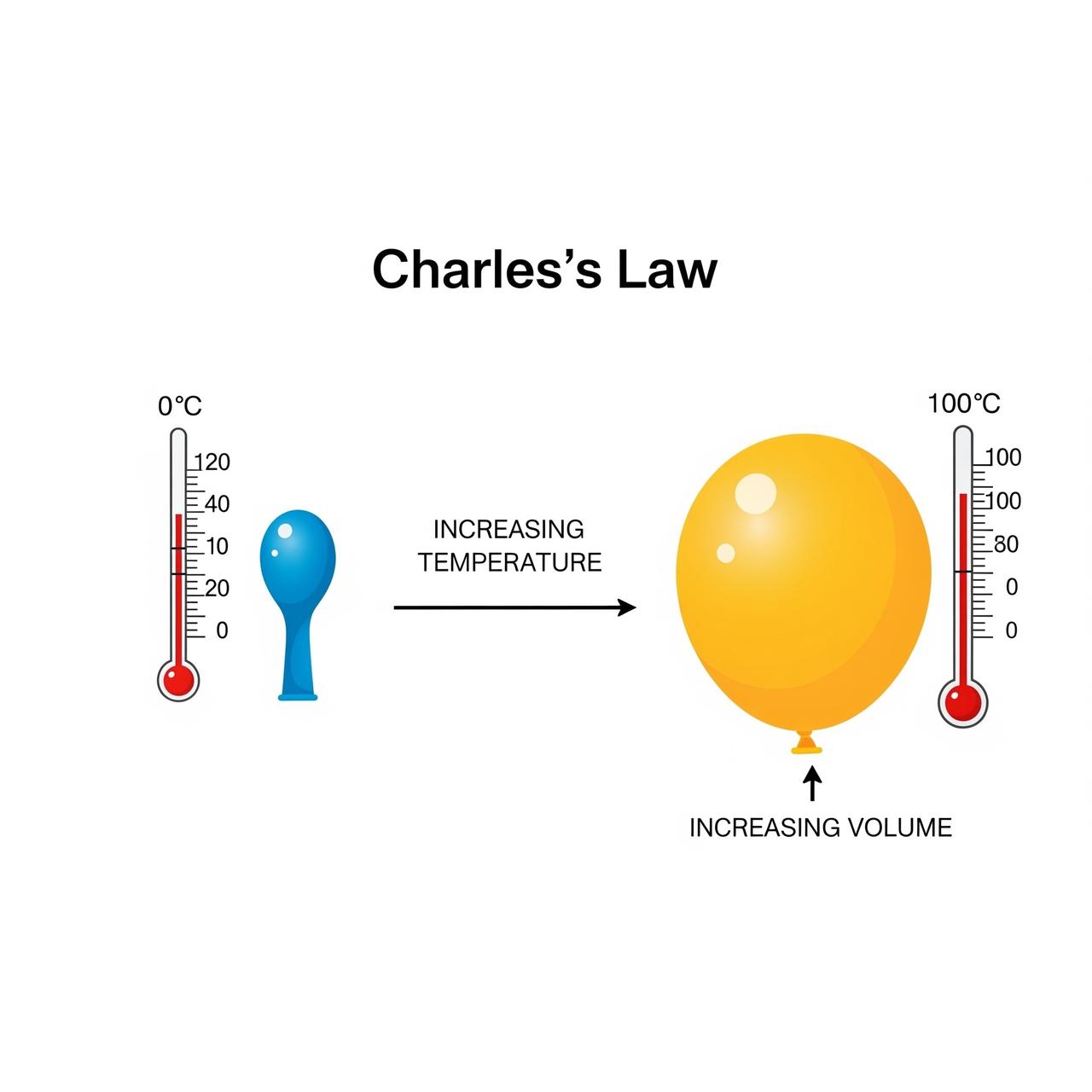
Charles’s Law states that at constant pressure, the volume of a gas is directly proportional to its absolute temperature. This relationship is expressed as:


<span class="katex"><span class="katex-html" aria-hidden="true"><span class="base"><span class="strut" style="height:1.2173em;vertical-align:-0.345em;"></span><span class="mord"><span class="mopen nulldelimiter"></span><span class="mfrac"><span class="vlist-t vlist-t2"><span class="vlist-r"><span class="vlist" style="height:0.8723em;"><span style="top:-2.655em;"><span class="pstrut" style="height:3em;"></span><span class="sizing reset-size6 size3 mtight"><span class="mord mtight"><span class="mord mathnormal mtight" style="margin-right:0.13889em;">T</span></span></span></span><span style="top:-3.23em;"><span class="pstrut" style="height:3em;"></span><span class="frac-line" style="border-bottom-width:0.04em;"></span></span><span style="top:-3.394em;"><span class="pstrut" style="height:3em;"></span><span class="sizing reset-size6 size3 mtight"><span class="mord mtight"><span class="mord mathnormal mtight" style="margin-right:0.22222em;">V</span></span></span></span></span><span class="vlist-s">​</span></span><span class="vlist-r"><span class="vlist" style="height:0.345em;"><span></span></span></span></span></span><span class="mclose nulldelimiter"></span></span><span class="mspace" style="margin-right:0.2778em;"></span><span class="mrel">=</span><span class="mspace" style="margin-right:0.2778em;"></span></span><span class="base"><span class="strut" style="height:0.6944em;"></span><span class="mord mathnormal" style="margin-right:0.03148em;">k</span></span></span></span>


Where:


  • V = Volume of the gas
  • T = Absolute temperature (in Kelvin)
  • k = Constant value (at constant pressure and constant amount of gas)


For two different conditions, the equation is written as:


<span class="katex"><span class="katex-html" aria-hidden="true"><span class="base"><span class="strut" style="height:1.3335em;vertical-align:-0.4451em;"></span><span class="mord"><span class="mopen nulldelimiter"></span><span class="mfrac"><span class="vlist-t vlist-t2"><span class="vlist-r"><span class="vlist" style="height:0.8884em;"><span style="top:-2.655em;"><span class="pstrut" style="height:3em;"></span><span class="sizing reset-size6 size3 mtight"><span class="mord mtight"><span class="mord mtight"><span class="mord mathnormal mtight" style="margin-right:0.13889em;">T</span><span class="msupsub"><span class="vlist-t vlist-t2"><span class="vlist-r"><span class="vlist" style="height:0.3173em;"><span style="top:-2.357em;margin-left:-0.1389em;margin-right:0.0714em;"><span class="pstrut" style="height:2.5em;"></span><span class="sizing reset-size3 size1 mtight"><span class="mord mtight">1</span></span></span></span><span class="vlist-s">​</span></span><span class="vlist-r"><span class="vlist" style="height:0.143em;"><span></span></span></span></span></span></span></span></span></span><span style="top:-3.23em;"><span class="pstrut" style="height:3em;"></span><span class="frac-line" style="border-bottom-width:0.04em;"></span></span><span style="top:-3.4101em;"><span class="pstrut" style="height:3em;"></span><span class="sizing reset-size6 size3 mtight"><span class="mord mtight"><span class="mord mtight"><span class="mord mathnormal mtight" style="margin-right:0.22222em;">V</span><span class="msupsub"><span class="vlist-t vlist-t2"><span class="vlist-r"><span class="vlist" style="height:0.3173em;"><span style="top:-2.357em;margin-left:-0.2222em;margin-right:0.0714em;"><span class="pstrut" style="height:2.5em;"></span><span class="sizing reset-size3 size1 mtight"><span class="mord mtight">1</span></span></span></span><span class="vlist-s">​</span></span><span class="vlist-r"><span class="vlist" style="height:0.143em;"><span></span></span></span></span></span></span></span></span></span></span><span class="vlist-s">​</span></span><span class="vlist-r"><span class="vlist" style="height:0.4451em;"><span></span></span></span></span></span><span class="mclose nulldelimiter"></span></span><span class="mspace" style="margin-right:0.2778em;"></span><span class="mrel">=</span><span class="mspace" style="margin-right:0.2778em;"></span></span><span class="base"><span class="strut" style="height:1.3335em;vertical-align:-0.4451em;"></span><span class="mord"><span class="mopen nulldelimiter"></span><span class="mfrac"><span class="vlist-t vlist-t2"><span class="vlist-r"><span class="vlist" style="height:0.8884em;"><span style="top:-2.655em;"><span class="pstrut" style="height:3em;"></span><span class="sizing reset-size6 size3 mtight"><span class="mord mtight"><span class="mord mtight"><span class="mord mathnormal mtight" style="margin-right:0.13889em;">T</span><span class="msupsub"><span class="vlist-t vlist-t2"><span class="vlist-r"><span class="vlist" style="height:0.3173em;"><span style="top:-2.357em;margin-left:-0.1389em;margin-right:0.0714em;"><span class="pstrut" style="height:2.5em;"></span><span class="sizing reset-size3 size1 mtight"><span class="mord mtight">2</span></span></span></span><span class="vlist-s">​</span></span><span class="vlist-r"><span class="vlist" style="height:0.143em;"><span></span></span></span></span></span></span></span></span></span><span style="top:-3.23em;"><span class="pstrut" style="height:3em;"></span><span class="frac-line" style="border-bottom-width:0.04em;"></span></span><span style="top:-3.4101em;"><span class="pstrut" style="height:3em;"></span><span class="sizing reset-size6 size3 mtight"><span class="mord mtight"><span class="mord mtight"><span class="mord mathnormal mtight" style="margin-right:0.22222em;">V</span><span class="msupsub"><span class="vlist-t vlist-t2"><span class="vlist-r"><span class="vlist" style="height:0.3173em;"><span style="top:-2.357em;margin-left:-0.2222em;margin-right:0.0714em;"><span class="pstrut" style="height:2.5em;"></span><span class="sizing reset-size3 size1 mtight"><span class="mord mtight">2</span></span></span></span><span class="vlist-s">​</span></span><span class="vlist-r"><span class="vlist" style="height:0.143em;"><span></span></span></span></span></span></span></span></span></span></span><span class="vlist-s">​</span></span><span class="vlist-r"><span class="vlist" style="height:0.4451em;"><span></span></span></span></span></span><span class="mclose nulldelimiter"></span></span></span></span></span>


This expression shows that as temperature increases, volume increases, and as temperature decreases, volume decreases.

Experimental Verification

The law formulated by Charles was experimentally confirmed in 1802 by Joseph Gay-Lussac. Gay-Lussac observed that various gases behaved similarly when heated at constant pressure. As a result, Charles’s observations moved beyond individual experiments to become a universal physical law.


Experimental findings showed that gas volumes increase linearly with temperature, and these linear relationships intersect the temperature axis at −273.15 °C. This point was later defined as "absolute zero."

Scientific Significance

Charles’s Law is not merely a description of gas behavior; it also:


  1. Contributed to the development of the concept of absolute temperature. It became clear that Celsius temperature alone was insufficient to describe volume-temperature relationships.
  2. Forms part of the combined ideal gas law. It integrates with other laws such as Boyle’s Law and Avogadro’s Law to provide a broader framework for explaining gas behavior.
  3. Is directly applied in engineering and medical practices. In particular, the effects of temperature changes on gas volume during storage, transport, and use are calculated using this law.

Applicability to Real Gases

Charles’s Law is based on the ideal gas assumption. Real gases, however, may deviate from this behavior due to intermolecular forces. Nevertheless, under conditions of low pressure and high temperature, intermolecular interactions diminish and gases behave more ideally, making Charles’s Law highly accurate under these conditions.


Under dense conditions (high pressure, low temperature), gas volume is smaller than predicted because intermolecular attractive forces cause contraction. For this reason, real gas equations are used in engineering, but Charles’s Law remains the foundational approach.

Applications and Examples

The effects of Charles’s Law are observable in daily life and various technologies:


  • Balloons: A balloon expanding in a warm environment and contracting in a cold one is a direct consequence of Charles’s Law.
  • Engineering Systems: Changes in gas volume in storage tanks are calculated using this law.
  • Medicine and Health: In respiratory physiology, the behavior of gases in the lungs is analyzed based on this law.


For example, if a gas with a volume of 2.0 L at 300 K is heated to 600 K at constant pressure, its volume becomes 4.0 L. This simple calculation clearly demonstrates the direct proportionality between gas volume and temperature.

Author Information

Avatar
AuthorZeynep AhmetbeyoğluDecember 1, 2025 at 9:57 AM

Tags

Discussions

No Discussion Added Yet

Start discussion for "Charter Law" article

View Discussions

Contents

  • Definition and Mathematical Expression

  • Experimental Verification

  • Scientific Significance

  • Applicability to Real Gases

  • Applications and Examples

Ask to Küre