

This article was automatically translated from the original Turkish version.
+1 More
Geography | Central Mexican lake systems and wetlands | ||||||||
|---|---|---|---|---|---|---|---|---|---|
Origin(s) | Pre-Spanish Mesoamerica (Especially the Aztecs) | ||||||||
Name(s) | Chinampa (Floating Gardens) | ||||||||
Date(s) | Pre-Columbian period (Especially 14th–16th centuries CE) | ||||||||
Purpose/Function | To achieve intensive plant production, to increase food production | ||||||||
Basic Feature | Artificial agricultural islands created in lakes and marshlands | ||||||||
Type(s) | Intensive wetland agricultural system agro-ecological production system | ||||||||
Chinampa is an elevated field farming system developed in the wetlands of the Basin of Mexico, derived from the Nahuatl word chinamitl, meaning “area enclosed by reeds or fences.” Also known as “floating gardens,” these structures consist of narrow, elongated agricultural plots raised above the water level of shallow lakes and marshes. Chinampas became widespread around Tenochtitlan, Xochimilco, and Chalco during the Aztec Empire and attracted attention for their high productivity relative to their time; they continue to exist today on a limited scale in the Xochimilco region.
Although agricultural activity in the Basin of Mexico dates back to around 1500 BCE, the systematic construction of chinampas is estimated to have begun approximately 2,000 years ago. Archaeological evidence suggests that the earliest examples of this system may be linked to the rise of the Teotihuacan state in the first and second centuries CE. Archaeological data from the Xaltocan region and radiocarbon dating indicate that chinampa agriculture began in the pre-Aztec period but intensified between 1200 and 1350 CE during the Late Classic period, when Xaltocan reached the peak of its political power.【1】
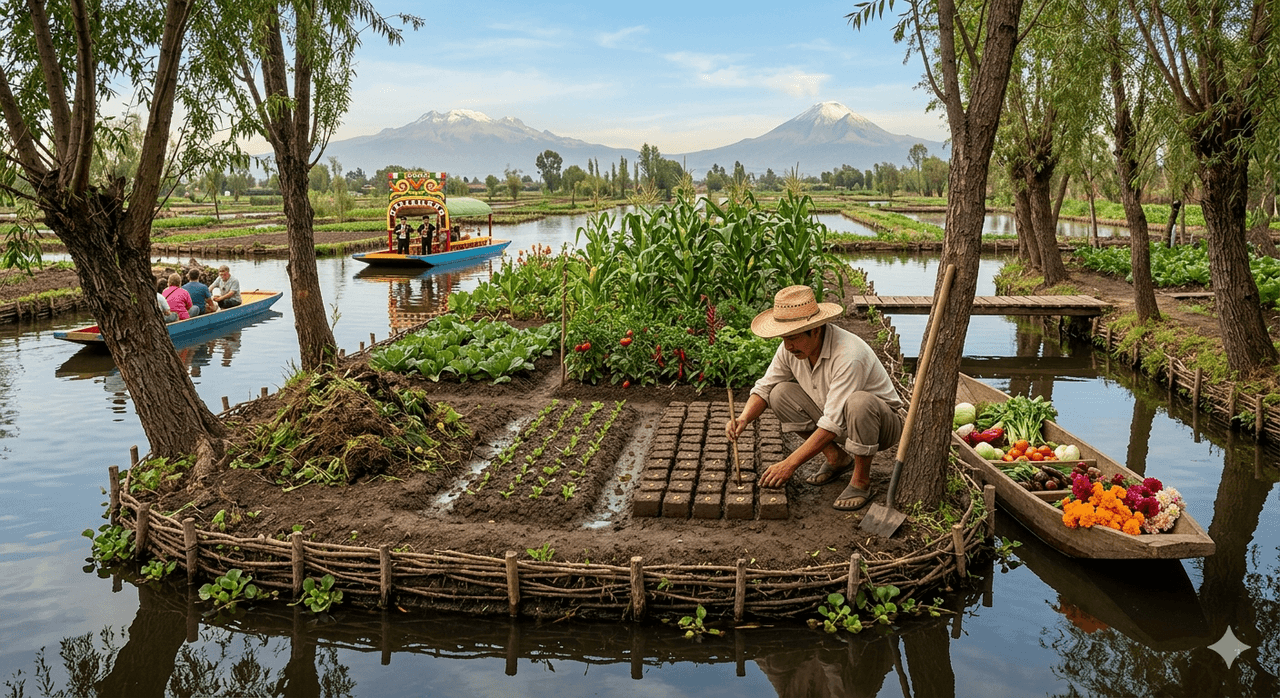
Chinampa Farming System (Generated by Artificial Intelligence)
Following the formation of the Aztec Triple Alliance around 1428, the conquest of southern settlements led to a significant expansion of the chinampa system. During the Aztec period, these areas covered approximately 9,500 to 12,000 hectares and became the fundamental economic structure supporting the food needs of densely populated centers such as Tenochtitlan.
After the Spanish conquest, the system declined due to the draining of lakes and the imposition of new taxation systems; the “floating” islands were replaced by fixed land parcels.【2】
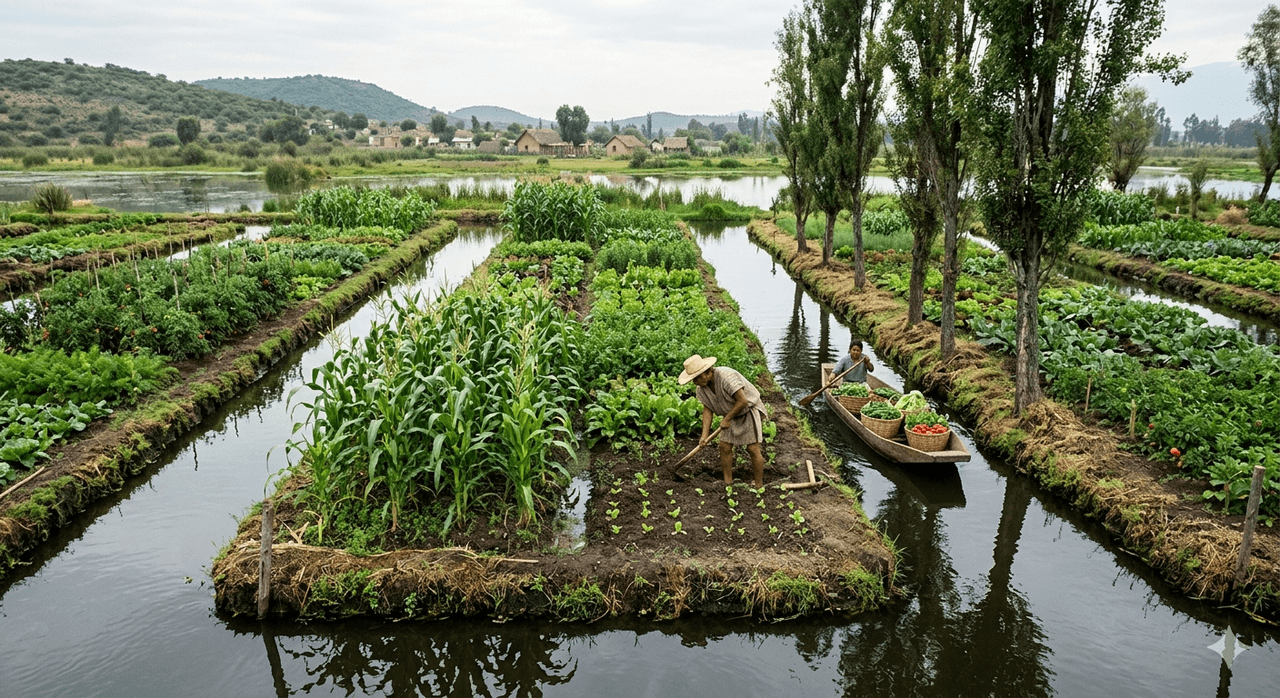
Chinampa Farming System (Generated by Artificial Intelligence)
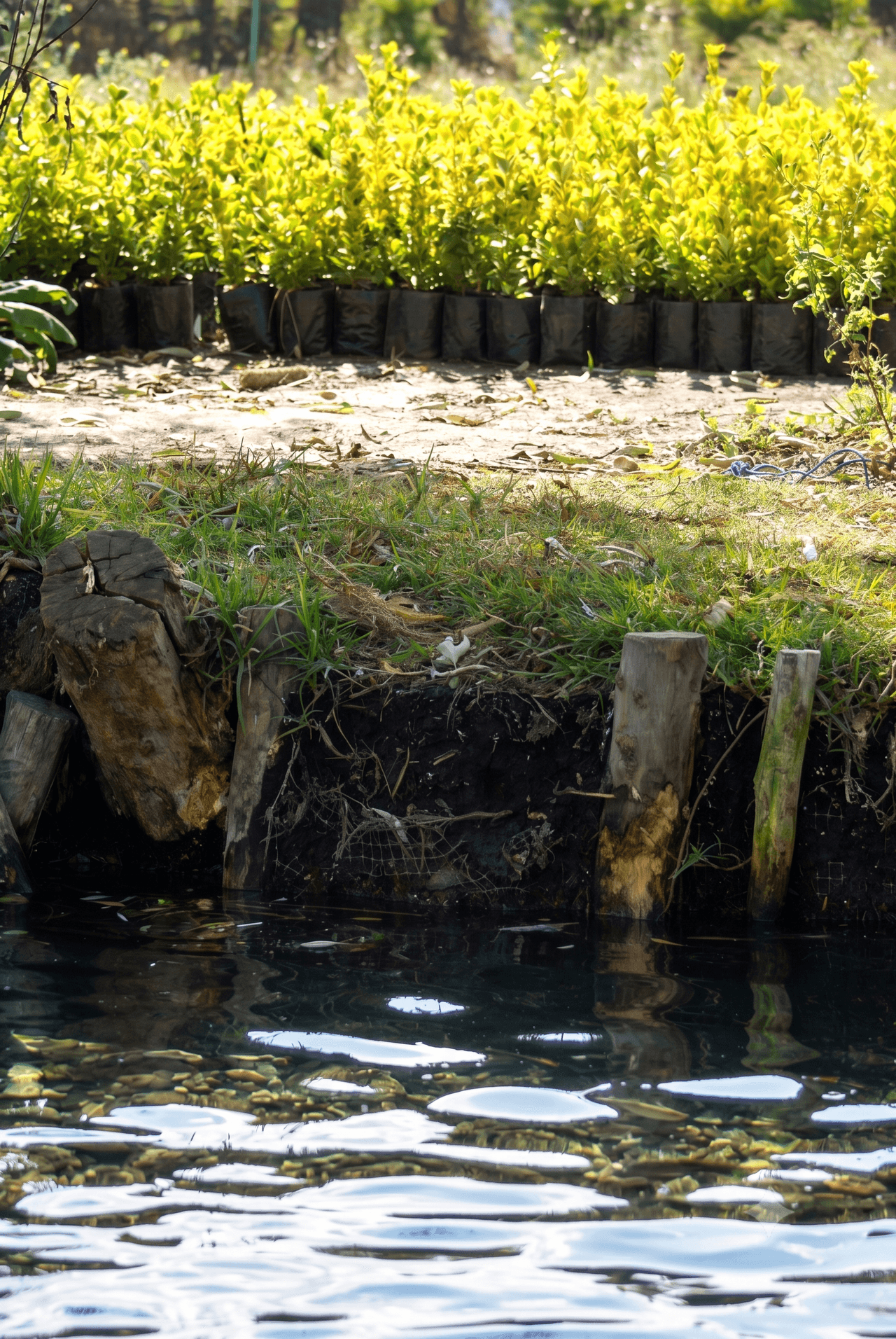
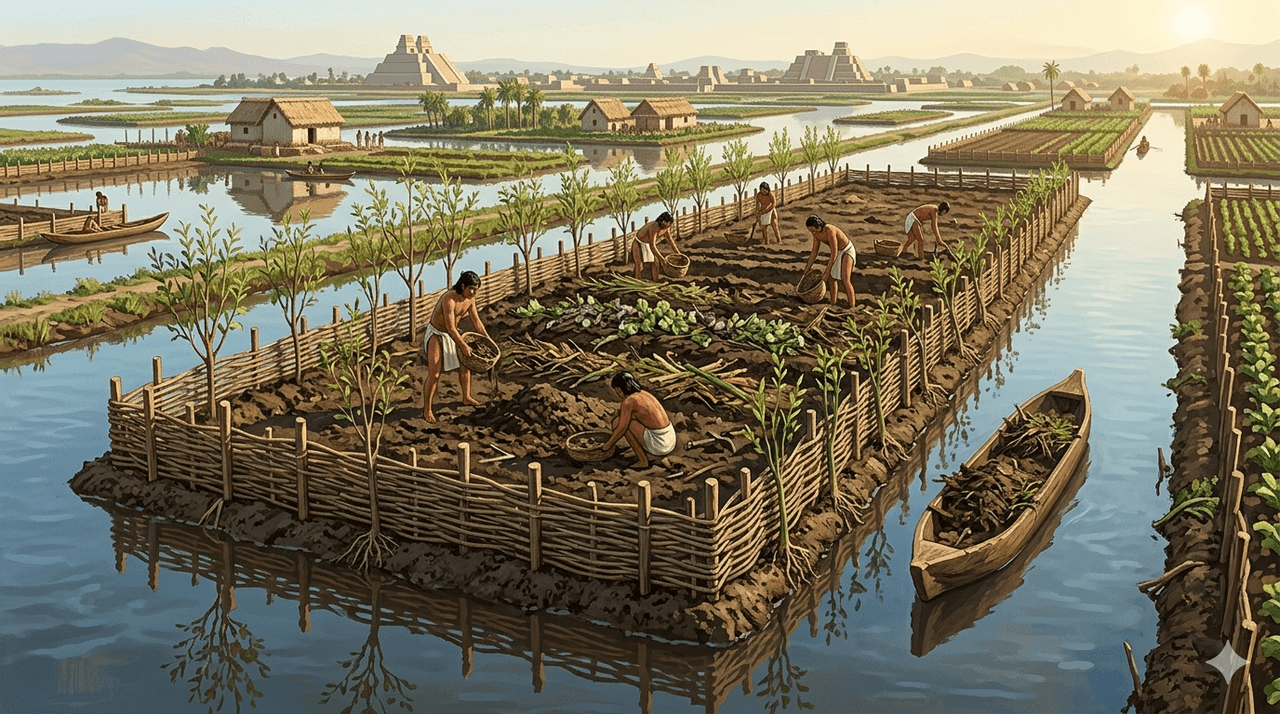
The construction of chinampas begins with identifying a stable base in shallow lake areas. After marking the corners of plots with stakes, the edges are enclosed by a fence system made of woven willow branches and reeds. To prevent erosion and stabilize the structure, a local willow species known as ahuejote is planted along the edges. These trees, with their fast-growing roots, hold the soil in place while also serving as windbreaks and providing shade.
The interior of the platforms is filled by layering mud excavated from the lakebed with organic sediments, aquatic plants, and plant waste. A typical chinampa plot is rectangular in shape, with a width ranging from 2 to 10 meters and a length reaching up to 100 meters. The surface of the plot is maintained approximately 45 to 70 centimeters above the water level. This narrow and low structure allows water from the surrounding canals to seep into the soil and reach the plant roots.【3】
The success of the chinampa system relies on a natural mechanism known as subsurface irrigation. The high organic content of the soil and its capillary action enable water to rise from the canals to the root zones of plants. Thanks to this system, crops can access consistent moisture independent of seasonal rainfall. Additionally, a network of primary, secondary, and tertiary canals surrounding the system facilitates transportation and regulates the balanced distribution of water between plots.
Chinampas - Floating Gardens (Generated by Artificial Intelligence)
Chinampas are highly productive systems capable of yielding multiple harvests per year without fallow periods. Using traditional methods, up to seven harvests can be obtained annually from a single plot. Major crops include maize, beans, amaranth, tomatoes, peppers, and various ornamental flowers. In addition, fish are caught in the canals within the system, and waterfowl are hunted.
One of the most important techniques for accelerating the agricultural cycle is the almácigo method of seedling nurseries. Farmers sow seeds into small mud blocks called chapines, made from canal mud. Once the seedlings sprout, they are transplanted to their final positions in the main plots. This method saves time by allowing one crop to be harvested while another is growing.
Ancient Aztec Floating Gardens - Chinampas (Leaf of Life)
The surplus food produced by chinampas played a critical role in the development of state structures in Mesoamerica. Calculations based on the Xaltocan case show that the chinampa system could produce more than 67 percent of the local population’s maize requirements. This surplus supported local nobility, funded military expenses, financed religious ceremonies, and sustained the tribute system. During the Aztec Empire, chinampa lands were classified into three categories: communal lands owned by calpulli, lands assigned to officials, and privately owned plots.
Today, chinampa agriculture faces serious threats from urban expansion, pollution, and declining water resources. In the Xochimilco region, cultivated areas decreased by more than 60 percent during the second half of the 20th century. Since the 1950s, the system has been sustained by treated wastewater due to the drying up of natural water sources. This has led to soil salinization and heavy metal contamination. Nevertheless, the system continues to provide important ecosystem services, including carbon sequestration, preservation of biodiversity, and regulation of urban heat balance.
Coe, Michael D. "The Chinampas of Mexico." *Scientific American* 211, no. 1 (1964): 90–98. Accessed April 7, 2026. https://www.academia.edu/36419113/Chinampas_pdf.
Ebel, Roland. "Chinampas: An Urban Farming Model of the Aztecs and a Potential Solution for Modern Megalopolis." *HortTechnology* 30, no. 1 (2019): 13–19. Accessed April 7, 2026. https://journals.ashs.org/view/journals/horttech/30/1/article-p13.xml?utm_source=chatgpt.com&tab_body=pdf.
Morehart, Christopher T. "Chinampa Agriculture, Surplus Production, and Political Change at Xaltocan, Mexico." *Ancient Mesoamerica* 27 (2016): 183–196. Accessed April 7, 2026. https://www.jstor.org/stable/pdf/26301996.pdf?refreqid=fastly-.
Rey-Hernández, Catalina, and Inge Bobbink. "Chinampas Agriculture and Settlement Patterns: The Contemporary Relevance of Aztec Floating Gardens." *Blue Papers* 1, no. 2 (2022): 90–99. Accessed April 7, 2026. https://www.researchgate.net/publication/369227523_Chinampas_Agriculture_and_Settlement_Patterns_The_Contemporary_Relevance_of_Aztec_Floating_Gardens
Robles, Braulio, Jorge Flores, Jose Luis Martínez, and Patricia Herrera. "The Chinampa: An Ancient Mexican Sub-Irrigation System." *Irrigation and Drainage* (2018). Accessed April 7, 2026. https://www.researchgate.net/publication/329561509_The_Chinampa_An_Ancient_Mexican_Sub-Irrigation_System.
[1]
Ebel, Roland. “Chinampas: An Urban Farming Model of the Aztecs and a Potential Solution for Modern Megalopolis.” HortTechnology 30, no. 1, 2019: 13–19. Accessed 7 April 2026. p. 13. https://journals.ashs.org/view/journals/horttech/30/1/article-p13.xml?utm_source=chatgpt.com&tab_body=pdf.
[2]
Morehart, Christopher T. “Chinampa Agriculture, Surplus Production, and Political Change at Xaltocan, Mexico.” Ancient Mesoamerica 27, 2016: 183–196. Accessed 7 April 2026. p. 185. https://www.jstor.org/stable/pdf/26301996.pdf?refreqid=fastly-default%3A42e464afa7991f8b0ff89de6d94afd39&ab_segments=&initiator=&acceptTC=1.
[3]
Ebel, Roland. “Chinampas: An Urban Farming Model of the Aztecs and a Potential Solution for Modern Megalopolis.” HortTechnology 30, no. 1, 2019: 13–19. Accessed 7 April 2026. p. 14. https://journals.ashs.org/view/journals/horttech/30/1/article-p13.xml?utm_source=chatgpt.com&tab_body=pdf.


Geography | Central Mexican lake systems and wetlands | ||||||||
|---|---|---|---|---|---|---|---|---|---|
Origin(s) | Pre-Spanish Mesoamerica (Especially the Aztecs) | ||||||||
Name(s) | Chinampa (Floating Gardens) | ||||||||
Date(s) | Pre-Columbian period (Especially 14th–16th centuries CE) | ||||||||
Purpose/Function | To achieve intensive plant production, to increase food production | ||||||||
Basic Feature | Artificial agricultural islands created in lakes and marshlands | ||||||||
Type(s) | Intensive wetland agricultural system agro-ecological production system | ||||||||
Historical Development
Construction Techniques and Structural Features
Water Management and Subsurface Irrigation
Agricultural Production and Productivity
Crop Diversity and Seedling Nursery Technique
Political Economy and Social Structure
Current Status and Ecological Challenges