


This article was automatically translated from the original Turkish version.
+2 More
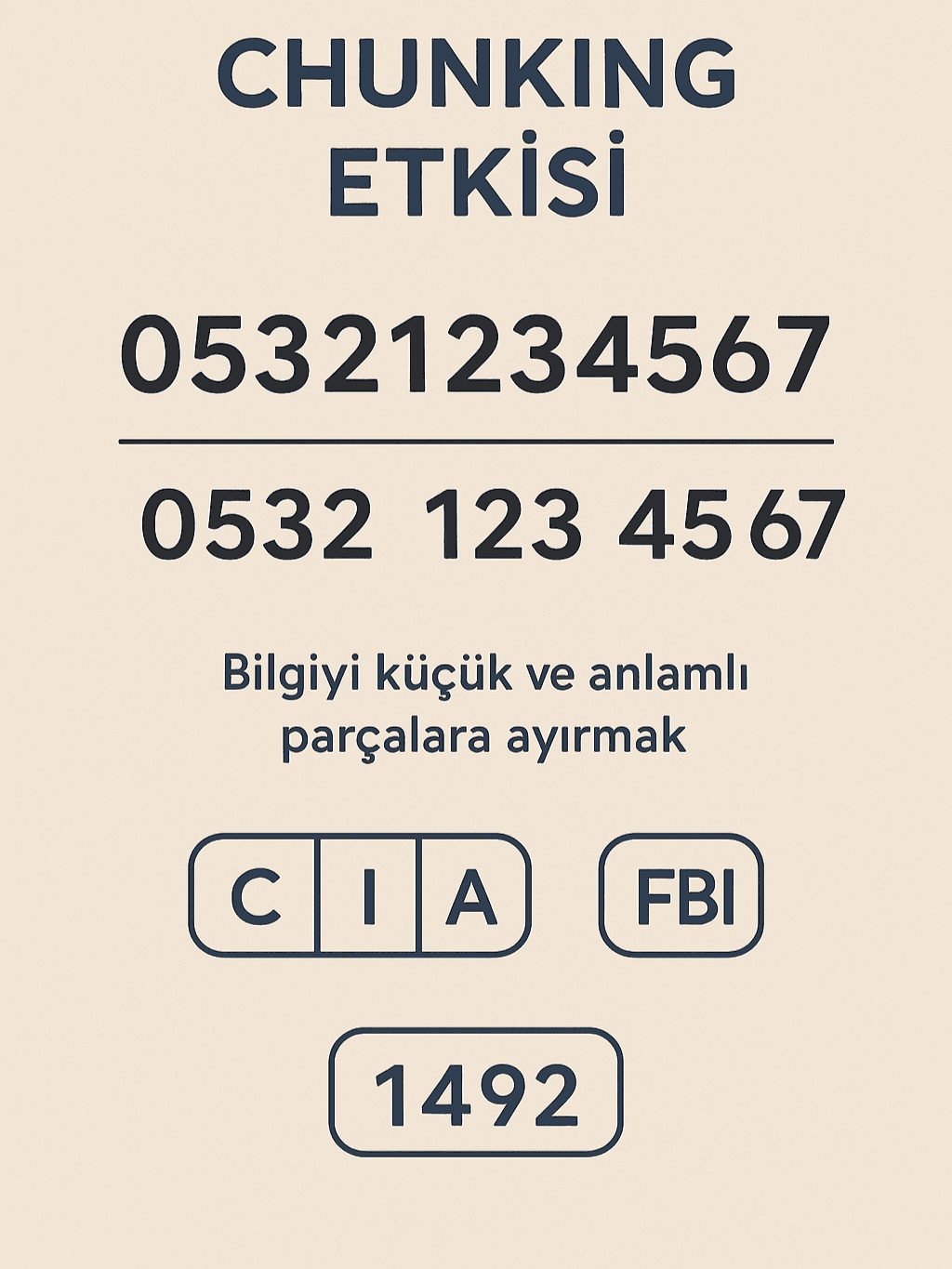
Chunking Effect
Discoverer(s) | George A. Miller | ||||||||
|---|---|---|---|---|---|---|---|---|---|
Year of Discovery(ies) | 1956 | ||||||||
Definition(s) | A cognitive strategy that facilitates easier recall by dividing information into smaller meaningful groups (chunks). | ||||||||
Area(s) of Use | Education Daily life Memory techniques Language learning | ||||||||
Chunking is a concept in human cognitive psychology and learning theories that enables information to be stored more efficiently in short-term memory by dividing it into larger, meaningful units called chunks. Since the human brain’s short-term memory has limited capacity, it can typically hold only a few items per unit. Therefore, chunking plays a significant role in psychology as a strategy that allows individuals to access and process information more effectively and efficiently. In short, chunking helps overcome the limited capacity of memory by organizing information.
The concept of chunking was first introduced in 1956 by psychologist George Miller in his paper titled "The Magical Number Seven, Plus or Minus Two," in which he proposed that humans can retain approximately 7±2 units of information. This finding established a critical benchmark for the capacity of short-term memory. However, Miller argued that this limitation could be overcome by breaking information down into smaller, meaningful groups, thereby enhancing recall. In this way, information units are transformed into small groups known as "chunks," allowing more information to be remembered.
Chunking establishes a relationship between short-term memory and long-term memory. Short-term memory is a temporary storage system capable of holding only a limited number of items, but this constraint can be mitigated through chunking. Individuals group individual pieces of information into larger units by forming meaningful and contextual associations. This process plays a crucial role especially during learning and recall. For instance, remembering a sequence of numbers or words may be difficult, but dividing them into familiar, meaningful groups makes recall easier.
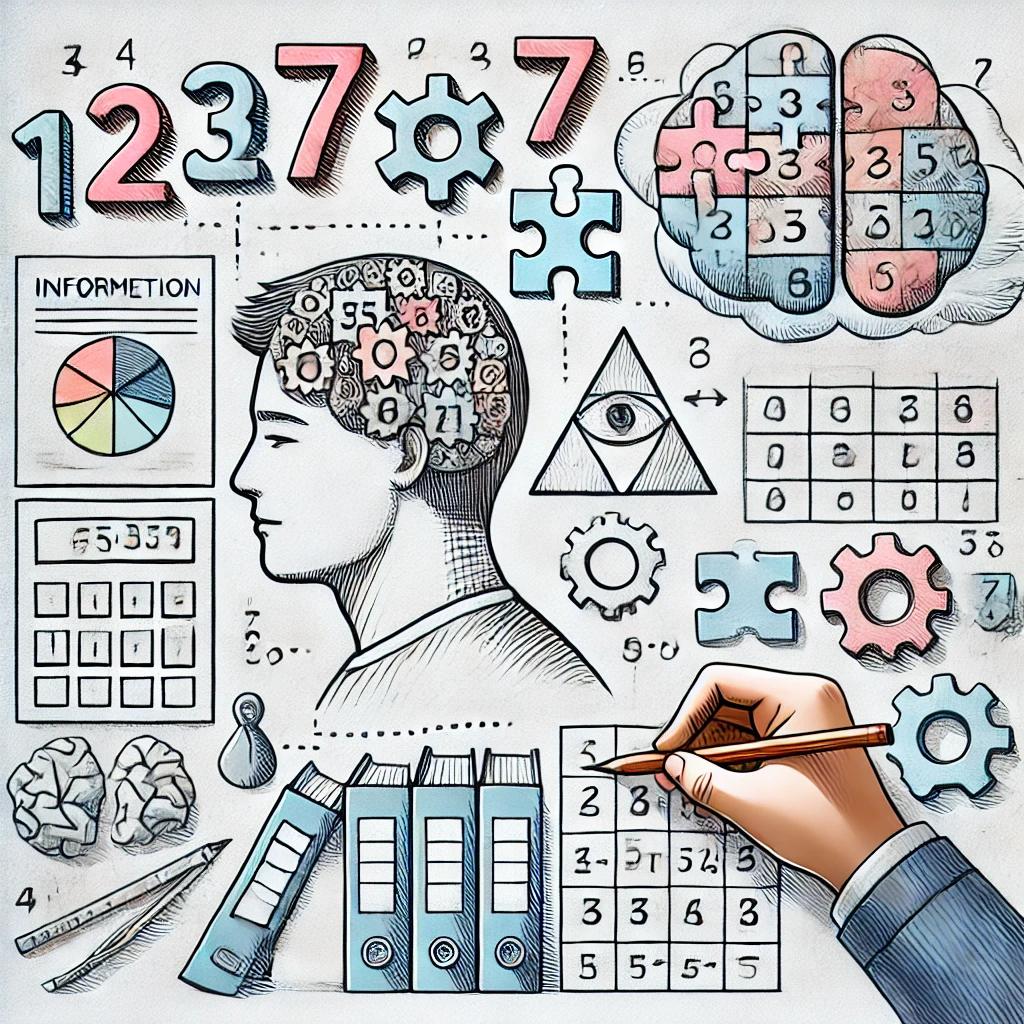
Generated with the assistance of artificial intelligence.
Chunking works by breaking information into smaller units and organizing them into meaningful groups. The human brain constructs these groups based on previously learned information within a specific language or cultural context. This allows individuals to exceed the 7±2 unit capacity limit and retain more information. For example, when remembering a telephone number, digits are typically grouped into threes and fours: 555-123-4567. This method enables more information to be remembered easily by dividing it into manageable groups.
Chunking is not only an academic or psychological phenomenon but also a common occurrence in daily life:
Chunking is an effective strategy in education and learning processes. When dealing with complex or long information, breaking it down into meaningful segments simplifies the recall process. Educators can present learning materials using chunking to make information more rapidly acquired and better retained. For instance, when summarizing a lengthy text, grouping key concepts and themes helps students understand the material more easily.
Chunking also holds significant importance in language learning. When acquiring a new language, grammatical structures and vocabulary are learned as small, meaningful units. This enables the transfer of learned information into long-term memory.
Human memory systems demonstrate the importance of chunking in information processing and storage. Working memory, a more active form of short-term memory, involves the immediate processing of information. The chunking method enhances the efficiency of this memory system. Particularly, working memory, which has limited capacity, allows more information to be processed by dividing it into meaningful units.
Baddeley, Alan D. "The Episodic Buffer: A New Component of Working Memory?" *Trends in Cognitive Sciences* 4, no. 11 (2000): 417–423. https://doi.org/10.1016/S1364-6613(00)01538-2.
Miller, George A. *The Magical Number Seven, Plus or Minus Two: Some Limits on Our Capacity for Processing Information*. *Psychological Review* 63, no. 2 (1956): 81–97. https://doi.org/10.1037/h0043158.
Sweller, John, Jeroen J. G. van Merriënboer, and Fred Paas. "Cognitive Architecture and Instructional Design." Educational Psychologist 54, no. 3 (2019): 177–200.

Chunking Effect
Discoverer(s) | George A. Miller | ||||||||
|---|---|---|---|---|---|---|---|---|---|
Year of Discovery(ies) | 1956 | ||||||||
Definition(s) | A cognitive strategy that facilitates easier recall by dividing information into smaller meaningful groups (chunks). | ||||||||
Area(s) of Use | Education Daily life Memory techniques Language learning | ||||||||
No Discussion Added Yet
Start discussion for "Chunking Effect (Chunking Method)" article
History
Psychological Foundations of Chunking
Principle of Chunking
Use of Chunking in Everyday Life
The Importance of Chunking in Education
Chunking and Memory