


This article was automatically translated from the original Turkish version.
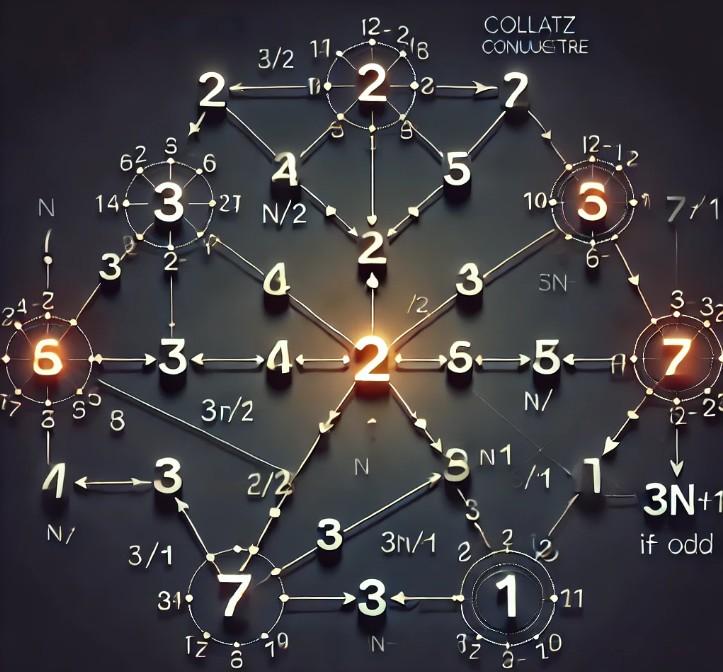
Collatz Conjecture
Collatz Conjecture | The Collatz Conjecture is a mathematical hypothesis that proposes that any sequence generated from an arbitrary positive integer according to a specific rule will always reach 1. It was proposed in 1937 by German mathematician Lothar Collatz. | ||||||||
|---|---|---|---|---|---|---|---|---|---|
Benford’s Law | Benford's Law is a statistical law that shows the distribution of digits in many natural datasets follows a specific mathematical rule. First observed in 1881 by Simon Newcomb and systematically examined in 1938 by Frank Benford this law reveals that the leading digit of numerical data follows a particular logarithmic distribution. According to Benford's Law in naturally occurring numerical data the digit 1 appears as the leading digit approximately 30 percent of the time while the digit 9 appears with a probability of about 4.6 percent. Histograms of the leading digits in sequences generated by the Collatz Conjecture conform to Benford's Law for larger numbers. | ||||||||
The Collatz conjecture is one of the unsolved important problems in mathematics. First proposed in 1937 by the German mathematician Lothar Collatz, this conjecture makes a general observation about a sequence defined by a simple rule. It asserts that any positive complete integer, when the specified operations are repeatedly applied, will eventually reach 1.
The Collatz conjecture examines a sequence based on the following rules:
Given a positive integer n:
According to the Collatz conjecture, regardless of the starting value, these operations will eventually lead to 1.
For example, a sequence starting with 6 proceeds as follows:
6→3→10→5→16→8→4→2→1
For a starting value of 11:
11→34→17→52→26→13→40→20→10→5→16→8→4→2→1
Although the Collatz conjecture has not been proven mathematically, experimental studies on various numbers have shown that all tested values eventually reach 1.
The Collatz conjecture remains unproven yet and is among the most famous unsolved problems in mathematics place. Despite its simple formulation, proving or disproving its truth is extremely difficult. Mathematicians continue to analyze this problem using Problem, modular arithmetic, and algebraic methods. Solving the conjecture would represent a major importance not only in number theory but also in the fields of computational complexity and algorithmic mathematics such as.
Conway, J. H. (1972). "Unpredictable Iterations." In Proceedings of the Number Theory Conference (pp. 49-52).
Heath-Brown, D. R. (1983). "Random Walks and the 3x+1 Problem." Acta Arithmetica, 39(3), 307-320.
Lagarias, J. C. (2010). The Ultimate Challenge: The 3x+1 Problem. American Mathematical Society.
Terras, R. (1976). "A Stopping Time Problem on the Positive Integers." Acta Arithmetica, 30(3), 241-252.
Wirsching, G. J. (1998). The Dynamical System Generated by the 3n+1 Function. Springer-Verlag

Collatz Conjecture
Collatz Conjecture | The Collatz Conjecture is a mathematical hypothesis that proposes that any sequence generated from an arbitrary positive integer according to a specific rule will always reach 1. It was proposed in 1937 by German mathematician Lothar Collatz. | ||||||||
|---|---|---|---|---|---|---|---|---|---|
Benford’s Law | Benford's Law is a statistical law that shows the distribution of digits in many natural datasets follows a specific mathematical rule. First observed in 1881 by Simon Newcomb and systematically examined in 1938 by Frank Benford this law reveals that the leading digit of numerical data follows a particular logarithmic distribution. According to Benford's Law in naturally occurring numerical data the digit 1 appears as the leading digit approximately 30 percent of the time while the digit 9 appears with a probability of about 4.6 percent. Histograms of the leading digits in sequences generated by the Collatz Conjecture conform to Benford's Law for larger numbers. | ||||||||
No Discussion Added Yet
Start discussion for "Collatz Conjecture: The Simplest Problem Still Unsolved" article
Collatz Conjecture Rule
Examples
Mathematical and Computational Investigations
General Status and Efforts Toward a Solution