


This article was automatically translated from the original Turkish version.
+1 More
Definition(s) | A branch of engineering that studies the motion and interactions of fluids using numerical methods. | ||||||||
|---|---|---|---|---|---|---|---|---|---|
English Equivalent | Computational Fluid Dynamics (CFD) | ||||||||
Basic Principle(s) | Conservation of Mass Energy Equations) Continuity Momentum and Energy (Navier-Stokes | ||||||||
Application Area(s) | Space Biomedical Agriculture Energy Air Conditioning Automotive Aerospace | ||||||||
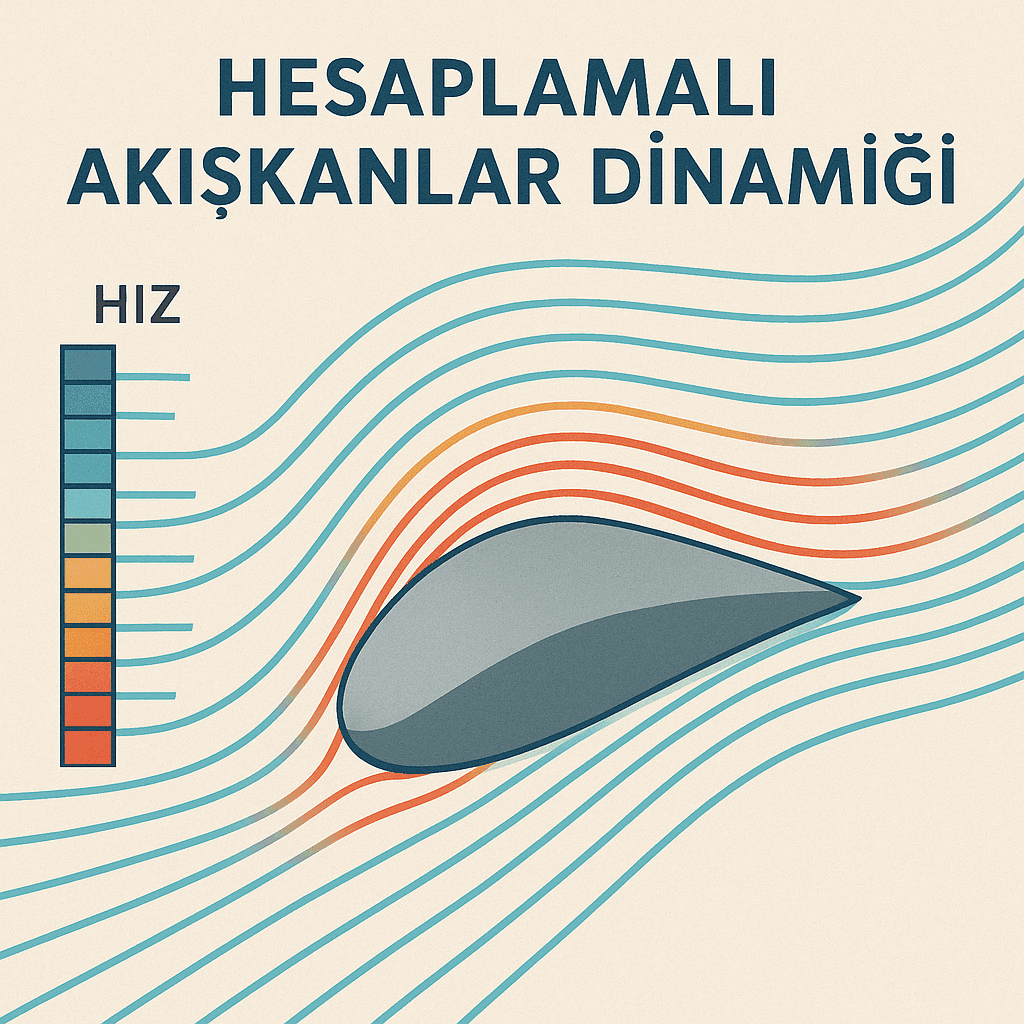
Computational Fluid Dynamics (HAD) is an engineering discipline that uses numerical methods to analyze the motion of fluids and the effects of this motion on physical environment. This method, based on mathematical models and numerical solution techniques, enables the simulation of fluid behavior in a computer environment, allowing both the testing of theoretical knowledge and the validation of engineering designs.
CFD is a multidisciplinary analysis field widely used in computer-aided engineering (CAE) applications, particularly in fluid mechanics, heat transfer, turbulence, mass transfer, and the modeling of chemical reactions.
In situations where physical experiments are costly, hazardous, or impractical, CFD methods provide the ability to predict system behavior through virtual prototyping. CFD simulations are applied in numerous fields including air and liquid flows, internal combustion engines, aerodynamic wing profiles, HVAC systems, and agricultural dryers such as. In aerospace engineering specifically, CFD enables the modeling of flow fields around rotors and the analysis of induced velocities and fly vortices on rotor disks. These analyses provide critical inputs that guide the design process by influencing rotor performance.
CFD analyses are fundamentally based on three main conservation laws: conservation of mass (continuity equation), conservation of momentum (Navier-Stokes equations), and conservation of energy. Since direct analytical solutions to these equations are generally not feasible, numerical approaches such as the finite volume method (FVM) are commonly employed. Various turbulence models, such as the k-ε model, are used to resolve turbulent fluid behavior, and the solution process is carried out using sequential or coupled solvers. In these processes, the SIMPLE algorithm, Gauss-Seidel iteration, and multiple numerical mesh techniques are frequently applied methods.
One of the most critical factors affecting the accuracy and efficiency of CFD simulations is the computational mesh (mesh) structure. Basic mesh types include hexagonal, tetragonal, and polyhedral meshes place. While hexagonal meshes offer the highest quality, their application in complex geometries is challenging. Therefore, in most applications, less regular but more practical triangular (tetragonal) or polyhedral mesh structures are preferred. Mesh quality is measured by criteria such as the shape, size, and arrangement of mesh elements. A high-quality mesh structure reduces simulation time and improves analysis accuracy. However, as mesh density increases, computational time and hardware requirements also increase.
CFD provides significant contributions to the validation, improvement, and optimization of engineering designs. Information that would be difficult or impossible to obtain through traditional methods can be acquired via CFD, reducing the need for physical prototype prototypes and accelerating product development cycles speed.
However, for CFD analyses to be reliable, boundary conditions must be accurately defined, an appropriate mesh structure must be selected, and the mathematical models used must reflect physical reality. Furthermore, to ensure the validity of results, they must be compared with experimental data and a verification and validation approach must be adopted error.
Al, S., and M. Usta. “İleri Uçuşta Rotor İz Bölgesi Modellenmesi: HAD Tabanlı Bir Yaklaşım.” Politeknik Dergisi 25, no. 5 (2022): 1541–1550. https://doi.org/10.2339/politeknik.993569.
Gürel, A. “CFD Uygulamalarında Kullanılan Mesh Yapıları ve Mesh Kalitesinin Sonuçlara Etkisi.” *Uluslararası Bilimsel ve Mesleki Çalışmalar Dergisi (IBAD)*, no. 9 (2020): 138–154. https://doi.org/10.35378/gujs.610491.
Yıldız, S. “CFD Yöntemiyle Bir Akışkanın Hacimsel ve Yüzeysel Isı Transferlerinin İncelenmesi.” *Uluslararası Bilimsel Araştırmalar Dergisi* 3, no. 1 (2018): 73–84. https://dergipark.org.tr/tr/pub/ijisef/issue/36401/412113.

Definition(s) | A branch of engineering that studies the motion and interactions of fluids using numerical methods. | ||||||||
|---|---|---|---|---|---|---|---|---|---|
English Equivalent | Computational Fluid Dynamics (CFD) | ||||||||
Basic Principle(s) | Conservation of Mass Energy Equations) Continuity Momentum and Energy (Navier-Stokes | ||||||||
Application Area(s) | Space Biomedical Agriculture Energy Air Conditioning Automotive Aerospace | ||||||||
No Discussion Added Yet
Start discussion for "Computational Fluid Dynamics (CFD)" article
Application Areas and Importance of CFD
Numerical Methods and Equations
Computational Mesh Structure
Contribution to Engineering Processes