


This article was automatically translated from the original Turkish version.
+2 More
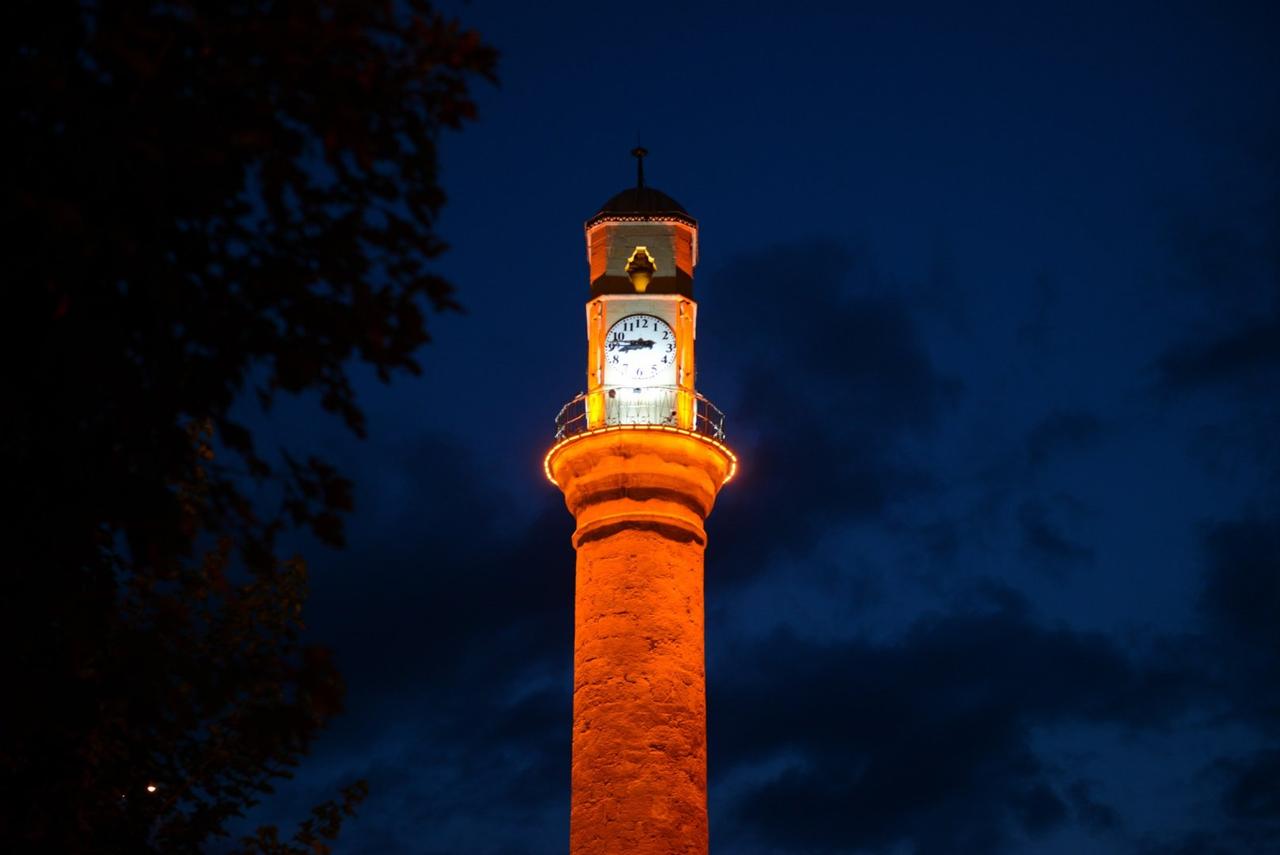
Çorum Clock Tower was commissioned in 1894 by Beşiktaş Guard Çorumlu Yedi Sekiz Hasan Paşa during the Ottoman period. The tower is located in the center of Çorum province in Türkiye’s Black Sea Region, situated in one of the city’s most densely populated areas.
The Çorum Clock Tower is architecturally designed in the form of a minaret. Its base is octagonal with a diameter of 5.3 meters, and the total height of the tower is 27.5 meters. The main body has 24 sides with a diameter of 3.9 meters. The building material used for each side, measuring 2.1 meters in length, is yellow cut sandstone.
From the octagonal base, the main body is accessed via a Turkish triangle motif-shaped plinth. The tower is crowned with a lead-covered dome. Each of the four façades features a clock face. Access to the gallery is achieved through a round-arched door facing south, reached by a staircase of 81 steps.

Çorum Clock Tower (Çorum Municipality)
The marble inscription above the tower’s entrance door is dated to 1312 Hijri (1894 CE). This eight-line inscription, separated by ruled lines, states that the tower was constructed as a charitable endowment by Hasan Paşa bihemta under the imperial decree of Sultan II. Abdülhamid. The inscription reads:
“By the command of the sovereign of the age, the noble Sultan Abdülhamid Han,
Hasan Paşa bihemta dedicated all his wealth to revive good deeds;
May the Lord grant success to his every endeavor.
This clock tower, from among the noble acts,
Was built with divine favor to revive this city.
Its date was inscribed at the gate during a most auspicious moment.
This magnificent timepiece was erected by Lütfi Hasan Paşa, 1312.”
The last two lines of the inscription record the tower’s construction date.
Clock towers first appeared in the Ottoman Empire from the 16th century onward. However, their widespread construction across Anatolia occurred in the 1890s following imperial decrees issued by Sultan II. Abdülhamid to commemorate the 25th anniversary of his accession to the throne. During this period, these towers served not only as time indicators but also as barometers, compasses, and wind vanes, and were sometimes used as fire watchtowers or public meeting points. In the Republican era, plazas were established around clock towers in Anatolian cities.
Of the 144 clock towers built during the Ottoman period, 52 have survived to the present day. The Çorum Clock Tower is one of these surviving structures.
In its early years, the tower’s bell system produced a sound powerful enough to be heard even in villages connected to the center. Over time, however, repeated striking of the bell hammer at the same point caused a deep groove to form in the metal, resulting in a reduction in sound volume. Additionally, urbanization, new construction, and noise pollution have further hindered the bell’s audibility over long distances.

Çorum Clock Tower Restoration Work (Çorum Municipality)
The Çorum Clock Tower remained standing for many years without any maintenance. In 2019, Çorum Municipality initiated a comprehensive restoration and repair project. As part of these efforts, the clock faces were restored to their original design, the tower was equipped with nighttime lighting, and its original aesthetic appearance was revived.
Under permissions granted by the Monuments Board, restoration work addressed malfunctions in the clock mechanism and renewed the tower’s paint. According to Çorum Municipality, the tower is also known locally as the “Bell Clock” and holds a symbolic place in the city’s identity.
Türkiye Kültür Portalı. "Çorum Saat Kulesi - Çorum." T.C. Kültür ve Turizm Bakanlığı. Accessed May 31, 2025. https://www.kulturportali.gov.tr/turkiye/corum/gezilecekyer/corum-saat-kulesi.
Çorum Belediyesi. "Tarihi Saat Kulesi İhtişamıyla Göz Dolduruyor." Accessed May 31, 2025. https://www.corum.bel.tr/haberler/tarihi-saat-kulesi-ihtisamiyla-goz-dolduruyor.
Çorum Municipality. "Tarihi Saat Kulesi Bakıma Alındı." Çorum Belediyesi. Accessed May 31, 2025. https://www.corum.bel.tr/haberler/tarihi-saat-kulesi-bakima-alindi.
Çorum/Merkez-Yatılı Bölge Ortaokulu. "Saat Kulesi." T.C. Millî Eğitim Bakanlığı. Accessed May 31, 2025. https://merkezybo.meb.k12.tr/icerikler/saat-kulesi_15135374.html.

Architectural Features
Inscription
Function and Historical Context
Technical Details and Acoustic Properties
Restoration and Conservation Efforts