

This article was automatically translated from the original Turkish version.
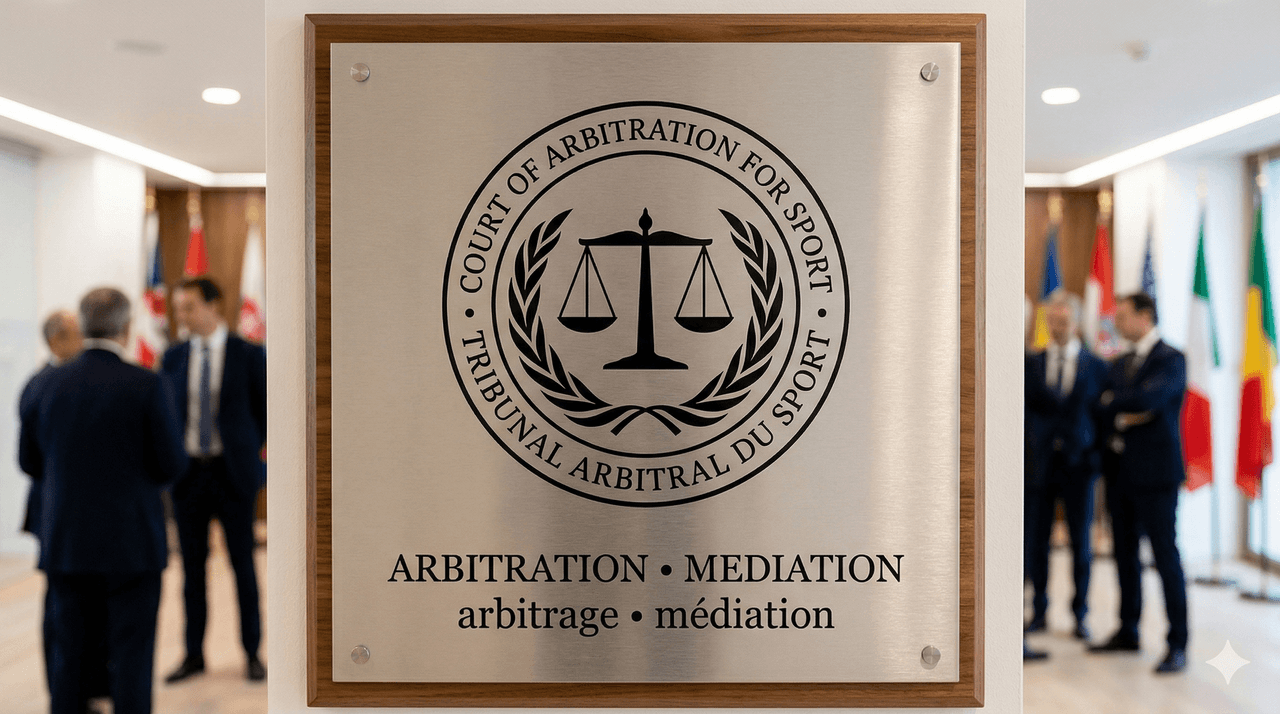
Spor Tahkim Mahkemesi Logosu (Yapay zeka ile oluşturuldu)
Sports Arbitration Court (French: Tribunal Arbitral du Sport - TAS; English: Court of Arbitration for Sport - CAS) is an international and independent judicial body established to resolve legal disputes arising in the world of sport through arbitration or mediation. The institution is headquartered in Lausanne, Switzerland and provides services globally through its offices in Sydney, New York and Lausanne.
The idea for establishing the court emerged in the early 1980s due to the need to resolve international sports disputes quickly and at low cost through a specialized body rather than general courts. The proposal presented in 1981 by Juan Antonio Samaranch, President of the International Olympic Committee (IOC), was adopted in 1983 and the court officially began operations in 1984.
In its early years, the court was funded by the IOC and its administrative structure was closely intertwined with the IOC, raising questions about its independence. Following the Gundel Case heard before the Swiss Federal Court in 1993, CAS was confirmed as a genuine arbitral tribunal but structural changes were deemed necessary to fully establish its independence. In this context, the "Agreement on the Reform of International Sports Arbitration" signed in Paris in 1994 established the International Council of Arbitration for Sport (ICAS), which assumed responsibility for the court’s governance and financing. Through this reform, CAS became fully administratively and financially autonomous from the IOC.
CAS operates under the supervision of ICAS and comprises a panel of at least 300 expert arbitrators. Its adjudicative activities are primarily carried out by the following units:
For a CAS proceeding to commence, the parties must have entered into a written arbitration agreement or the relevant sports organization’s statutes must contain a clause recognizing CAS jurisdiction.
CAS has established a legal framework that responds to the unique dynamics of sport (speed, expertise and confidentiality). As the institution leading the development of global principles known as "Lex Sportiva" (Sports Law), it aims to ensure that sport is conducted on a fair and impartial basis, free from political and commercial pressures. All major international sports federations and the World Anti-Doping Agency (WADA) recognize the jurisdiction of CAS.
Akil, Cenk. "Genel Olarak Milletlerarası Spor Tahkim Mahkemesi (CAS) ve Bu Mahkemede Uygulanan Tahkim Çeşitleri." *Dokuz Eylül Üniversitesi Hukuk Fakültesi Dergisi* 13, no. 2 (2011): 71–105. Accessed April 9, 2026. https://hukuk.deu.edu.tr/dosyalar/dergiler/dergimiz13-2/cenkakil.pdf
Court of Arbitration for Sport. "How CAS Works". Accessed April 9, 2026. https://www.tas-cas.org/en/general-information/how-cas-works
Özcan, Cem. "Spor Tahkim Mahkemesi'nin Kuruluşu ve İşleyişi." *İstanbul Aydın Üniversitesi Dergisi* 1, no. 3 (2009): 151-170. Accessed April 9, 2026. https://dergipark.org.tr/tr/pub/iaud/article/324462

Spor Tahkim Mahkemesi Logosu (Yapay zeka ile oluşturuldu)
No Discussion Added Yet
Start discussion for "Court of Arbitration for Sport (CAS)" article
Historical Development and Structural Reforms
Organizational Structure and Units
Procedure and Nature of Decisions
Institutional Significance