This article was automatically translated from the original Turkish version.
+2 More
Technical Name | Critical Path Method (CPM) | ||||||||
|---|---|---|---|---|---|---|---|---|---|
Basic Components | Critical Path Float Late Start/Finish Early Start/Finish Dependencies (precedence relationships) Duration estimates Activities (work packages) | ||||||||
Calculation Steps | Identify critical path Calculate floats Perform backward pass (calculate late dates) Perform forward pass (calculate early dates) Draw network diagram Determine durations List all activities and dependencies | ||||||||
Software Support | Microsoft Project, Primavera P6, Asana, Smartsheet | ||||||||
Critical Path Method (CPM) is defined as a technique used in project management to calculate the minimum duration required to complete a project and to assess flexibility within the project schedule.
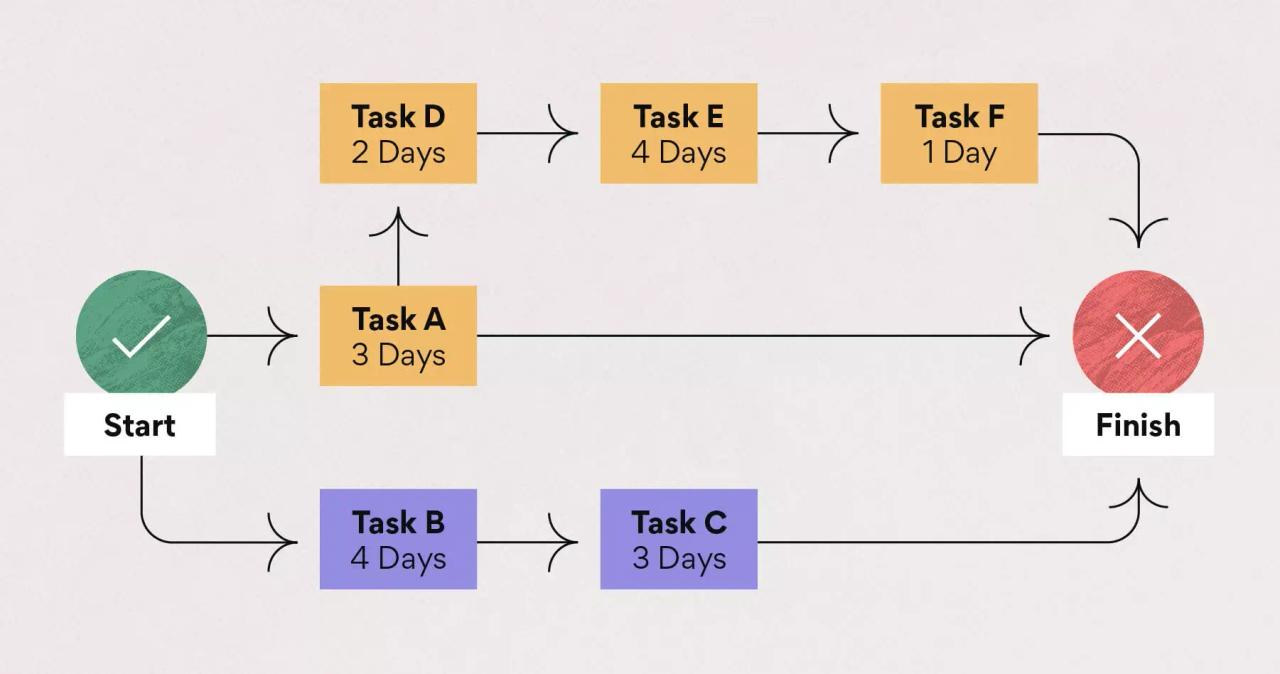
According to the PMBOK Guide, CPM is “a method used to estimate the shortest possible project duration and to determine the amount of scheduling flexibility on the logical paths within the schedule model.” In other words, CPM identifies the longest sequence of dependent activities—the critical activities that determine project completion—in a network of tasks with defined precedence and duration estimates. Any delay in any activity on this critical path directly extends the project’s completion date.
For activities outside the critical path in the schedule, a specific period of flexibility (float) exists; even if these activities are delayed, they do not affect the project’s end date. CPM analysis calculates for each activity the early start, early finish, late start, and late finish dates to determine these flexibility periods. Total float indicates how much an activity can be delayed from its early start date without delaying the project’s completion, while free float represents the portion of this delay that can occur without delaying the early start of any immediately following activity. CPM is typically applied using activity-on-node (AON) diagrams, where each activity is represented by a node and dependencies between activities are shown by arrows. The resulting project network diagram visualizes the logical flow of activities and identifies the critical path.
The Critical Path Method was developed in the late 1950s. It was first created by Morgan R. Walker and E. W. (James E.) Kelley Jr. at DuPont for planning maintenance projects, and simultaneously by Kelley and Winter H. Orr at Remington Rand Univac for the Polaris missile program. The method aims to determine the minimum project duration by identifying the longest sequence of dependent activities. In the 1960s, the construction industry adopted CPM; for example, one of its earliest applications was during the construction of the Humber Bridge in England. With the advancement of computer technology in the 1970s, CPM transitioned to software applications; one of the first major programs was Primavera Systems, which has been widely used in the construction sector since the 1980s. Today, CPM is enhanced by modern techniques such as integration with BIM (Building Information Modeling) and cloud-based tools, further strengthening project planning. PMI’s PMBOK Standards also recognize and define CPM as a fundamental tool for project schedule analysis.
The core components of CPM are as follows:
CPM calculations typically use a forward-backward pass method: starting from the beginning of the network diagram, early finish dates are calculated; then, moving backward, late start dates are determined. This process clarifies all dates and float values.
Applying the critical path method requires a step-by-step and meticulous approach. The general process includes the following stages:
These steps enable the successful creation of a CPM schedule and establish a solid foundation for project planning. Throughout the process, CPM analysis can be used to realistically optimize the project calendar and support proactive risk management.
The critical path method can be easily implemented using modern project management software. Tools such as Microsoft Project and Oracle Primavera automatically perform CPM calculations; project managers can immediately view early and late dates and float values after entering tasks, durations, and dependencies. For example, Primavera Systems, developed in the 1980s, is one of the first computer-based CPM planning software programs and remains widely used today. Currently, CPM is also integrated into 4D BIM and cloud-based projects; 4D BIM refers to linking a building model with its schedule for analysis. Software support offers advantages such as easy creation of complex diagrams, multiple scenario simulations, and real-time updates. However, automated calculations must not be used without a thorough understanding of fundamental CPM concepts, as software tools require a solid grasp of critical path analysis principles.
The Critical Path Method provides numerous advantages in project planning:
Project Duration Control: CPM identifies the longest sequence of activities (the critical path), revealing the shortest possible project completion time. This clarifies which tasks directly impact the schedule and allows them to be prioritized for timely completion.
These advantages position CPM as the leading method for complex projects with numerous interdependent tasks. PMBOK also identifies CPM as one of the key tools for effective schedule management during the planning process.
Like any method, CPM has limitations. Key constraints include:
Asana. “Critical Path Method: How to Calculate Critical Path.” Asana Resources. Accessed June 22, 2025. https://asana.com/resources/critical-path-method.
Leaders and Projects. "Proje Yönetiminde Kritik Yol Metodu." Accessed June 22, 2025. https://liderlerveprojeler.com.tr/proje-yonetiminde-kritik-yol-metodu/.
Project Management Institute. "Basics of CPM and Scheduling Software from Axon." Accessed June 22, 2025. https://www.pmi.org/learning/library/basics-cpm-scheduling-software-axon-8170.
Project Management Institute. “Critical Path Method Calculations and Scheduling.” Accessed June 22, 2025. https://www.pmi.org/learning/library/critical-path-method-calculations-scheduling-8040.
Project Management Institute. “Origins of CPM: A Personal History.” Accessed June 22, 2025. https://www.pmi.org/learning/library/origins-cpm-personal-history-3762.

Technical Name | Critical Path Method (CPM) | ||||||||
|---|---|---|---|---|---|---|---|---|---|
Basic Components | Critical Path Float Late Start/Finish Early Start/Finish Dependencies (precedence relationships) Duration estimates Activities (work packages) | ||||||||
Calculation Steps | Identify critical path Calculate floats Perform backward pass (calculate late dates) Perform forward pass (calculate early dates) Draw network diagram Determine durations List all activities and dependencies | ||||||||
Software Support | Microsoft Project, Primavera P6, Asana, Smartsheet | ||||||||
No Discussion Added Yet
Start discussion for "Critical Path Method (CPM)" article
History
Core Components
Implementation Process
Software Support and Integration
Advantages
Limits and Considerations