


This article was automatically translated from the original Turkish version.
DC-DC Converter
Property | Converter | ||||||||
|---|---|---|---|---|---|---|---|---|---|
Application Area(s) | DC-DC converter | ||||||||
Structure(s) | 1 switch 1 diode 2 capacitors 2 inductors | ||||||||
Advantage(s) | efficient conversion sensitive power applications Low noise | ||||||||
The Cuk converter is a DC-DC converter that can both increase (boost) and decrease (buck) the input voltage. It operates on the principle of capacitive energy transfer, and the output voltage has opposite polarity to the input voltage.
Compared to a buck-boost converter, it has several advantages:
Due to these characteristics, it is preferred in sensitive power applications, circuits requiring low noise, and systems needing more efficient DC-DC transformation conversion.
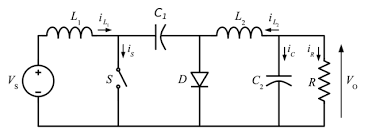
Compared to buck, boost, and buck-boost converters, the Cuk converter has a higher number of components. The Cuk converter consists of two inductors, two capacitor, one diode, and one switch. It combines buck and boost configurations in an isolated inverted manner, where the input side resembles a boost converter and the output side resembles a buck converter, connected via a capacitor as shown in such as. The output voltage of the Cuk converter is inverted relative to the input voltage. Figure 1 shows the topology of the Cuk converter.

Figure 1. Cuk Converter (Source: Wikiwand)
The operation of the Cuk converter can be analyzed in four stages.
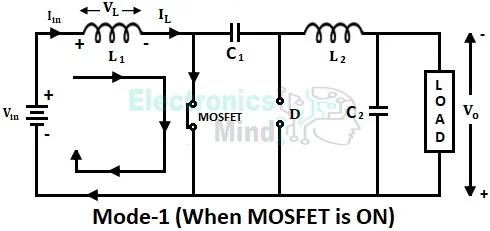
Figure 2. Cuk Converter State 1 (Source: Electronics Mind)
In Figure 2, when MOSFET turns on, the input voltage Vin passes through inductor L1 and returns to the input via the MOSFET. During this phase, the inductor current begins to rise, establishing a polarity in the direction of current flow. In this mode, no current flows to the load.
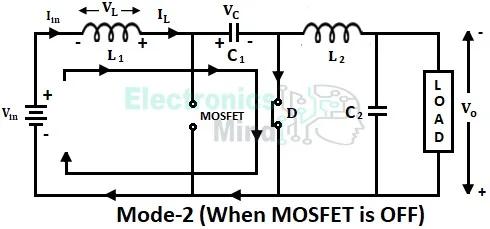
Figure 3. Cuk Converter State 2 (Source: Electronics Mind)
When the MOSFET is turned off, the sudden drop in current through the inductor causes its polarity to reverse. L1 now begins to discharge. Current flows from the source into the inductor, so the input voltage adds to the inductor voltage. The capacitor C1 is charged through the inductor.
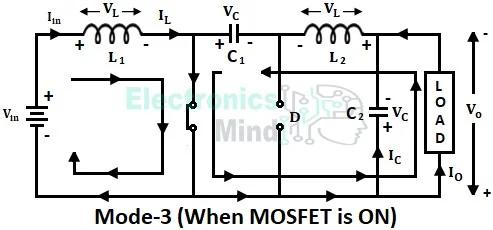
Figure 4. Cuk Converter State 3 (Source: Electronics Mind)
When the MOSFET turns on again, inductor L1 begins to charge once more. During this time, capacitor C1, which was charged in the previous state, discharges and transfers its energy to the load circuit. The discharge of C1 creates a current path through the MOSFET, capacitor C2, the load, and inductor L2. Simultaneously, the energy from C1 charges inductor L2, but due to the reverse current direction, the diode remains reverse-biased and stays in the OFF state.
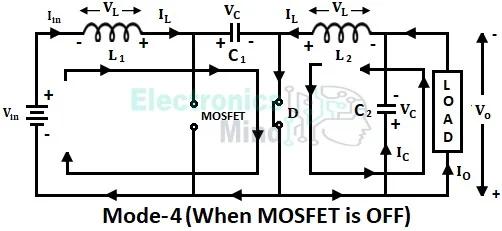
Figure 5. Cuk Converter State 4 (Source: Electronics Mind)
When the MOSFET turns off again, State 2 repeats, and capacitor C1 is charged by the energy from the inductor. During this phase, the diode becomes forward-biased and turns on. Additionally, inductor L2, which was charged in State 3, begins to discharge in the reverse direction, transferring energy to the load circuit through the diode.
By examining these four work modes, we conclude: when the MOSFET is ON, inductor L1 is charged while capacitor C1 supplies energy to the load. When the MOSFET is OFF, capacitor C1 is charged while inductor L2 delivers energy to the load. In this process, capacitor C1 acts as a fundamental connection element that transfers energy from the source to the load.
Accessed November 26, 2025.
Boualem, B. (2024). "An Experimental Investigation Design of a Bidirectional DC-DC Buck-Boost Converter for PV Battery Charger System." International Journal of Power Electronics and Drive Systems (IJPEDS).
Güngör, O., & Yüksek, H. İ. (2020). "Modeling of Boost and Cuk Converters and Comparison of Performance in Maximum Power Point Tracking." Sigma Journal of Engineering and Natural Sciences, 11(1), 83–101
Nair, S. (2025). "A Novel High Gain Non-Isolated Three-port Converter for Stand-Alone PV Applications." DYNA ENERGIA Y SOSTENIBILIDAD.
Paul, A. R., Bhattacharya, A., & Chatterjee, K. (2021). "A Novel SEPIC-Ćuk Based High Gain Solar Micro-Inverter for Grid Integration." arXiv preprint arXiv:2106.01733.

DC-DC Converter
Property | Converter | ||||||||
|---|---|---|---|---|---|---|---|---|---|
Application Area(s) | DC-DC converter | ||||||||
Structure(s) | 1 switch 1 diode 2 capacitors 2 inductors | ||||||||
Advantage(s) | efficient conversion sensitive power applications Low noise | ||||||||
Cuk Converter Topology
How Does the Cuk Converter Work?
State 1: Switch is ON (Conduction)
State 2: Switch is OFF (Cut-off)
State 3: Switch is ON (Conduction)
State 4: Switch is OFF (Cut-off)