This article was automatically translated from the original Turkish version.
Fundamental Issues | Road Transport Quotas and Visa Barriers Inability to Participate in Decision-Making Mechanisms Incompatibility with Free Trade Agreements (FTAs) | ||||||||
|---|---|---|---|---|---|---|---|---|---|
Scope(s) | Processed Agricultural Products Industrial Products | ||||||||
Modernization Agenda | Services Sector, Public Procurement, Expansion of Agricultural Concessions, Digital Trade and Green Accord | ||||||||
Implementation Tools | A.TR Circulation Certificate, CE Marking (Technical Conformity), Common Trade Policy | ||||||||
Institutional Mechanisms | Turkey-EU Partnership Council, Customs Union Joint Committee (CUJC), Customs Cooperation Committee | ||||||||
Expected Goals | Full Membership, Economic Integration, Addition of a Single Market | ||||||||
Fundamental Principles | Elimination of Customs Duties, Removal of Quantitative Restrictions (Quotas), Application of the Common Customs Tariff (CCT), Harmonization of Legislation | ||||||||
Legal Basis | 12 September 1963 (Ankara Agreement), 1 January 1996 (Decision No. 1/95) | ||||||||
The Customs Union Agreement between Türkiye and the European Union is the agreement that represents the most advanced stage of economic integration between the two parties, with its foundations laid by Türkiye’s first association application in 1959 and its legal framework established by the Ankara Agreement of 1963. Initially conceived as a strategic milestone on the path toward full membership, this process progressed through three phases—preparation, transition, and final stage—and reached its definitive form on 1 January 1996 with the complete elimination of customs barriers on industrial goods. Today, this structure constitutes a comprehensive economic partnership model that integrates Türkiye into the EU single market and requires both parties to adopt a common trade policy toward third countries.
Türkiye’s application, then known as the European Economic Community (EEC), submitted in July 1959, gained official status with the signing of the Ankara Agreement on 12 September 1963. This agreement outlined a three-stage roadmap to achieve economic integration with Europe and set full membership as its ultimate goal. 【1】
During the preparation phase, the first stage of the association regime, Türkiye’s economic competitiveness was targeted for enhancement through unilateral concessions granted by the Community. The transition phase, initiated by the Additional Protocol effective in 1973, established a 22-year timetable for the gradual reduction of customs duties on industrial goods and for legislative harmonization. 【2】
The final stage of the process was formalized by the Joint Council Decision No. 1/95 of 6 March 1995. As stipulated by this decision, the Customs Union entered into force on 1 January 1996, eliminating tariffs and quotas on industrial goods. Türkiye aligned itself with the European Union’s Common Customs Tariff (CCT), thereby becoming part of the common trade policy. 【3】
Under the Customs Union, industrial goods and processed agricultural products enjoy the status of “free circulation.” For a product to qualify for free circulation, it must either be produced in Türkiye or the EU, or have had customs duties paid upon import from third countries. The A.TR Circulation Document, which serves as the official certificate for this trade, is the primary instrument enabling goods to move between the parties without payment of customs duties. 【4】
One of the most critical elements of the system’s operation is Türkiye’s alignment with the EU’s Common Customs Tariff (CCT) on imports from third countries. This requires parity in external trade policy. Türkiye is obligated to align with the Free Trade Agreements (FTAs) signed by the EU, ensuring a single customs regime applies across the Union’s external borders. 【5】
To ensure the sustainability of the system, Türkiye incorporates the EU’s product standards, technical regulations, and intellectual property laws into its domestic legal framework. Mechanisms such as the Customs Union Joint Committee meet periodically to oversee this complex process, manage technical discrepancies, and coordinate legislative updates to resolve commercial disputes. 【6】
The impacts of the Customs Union on Türkiye have been extensive, spanning from economic structure and legal systems to industrial production and consumer behavior. These effects can be examined under key headings, highlighting both the advantages it has conferred and the challenges it has introduced.
Prior to the Customs Union, Türkiye’s industry operated under a protectionist economic model. Since 1996, domestic producers have been forced to compete directly with Europe’s advanced manufacturers. This compelled local firms to modernize technology and improve efficiency. Compliance with EU technical regulations—such as the CE marking—elevated the quality of Turkish products to international standards, opening doors not only to European markets but to global export opportunities as well. 【7】
With the Customs Union, the European Union became Türkiye’s most important trading partner. The elimination of customs duties on industrial goods transformed the composition of exports, shifting from agriculture-dominated trade to higher-value industrial products such as automobiles, white goods, textiles, and machinery. Today, Türkiye is among the EU’s largest trading partners.【8】
By guaranteeing Türkiye’s tariff-free access to the EU single market, the Customs Union has transformed Türkiye into a “production and logistics hub” for international investors. The establishment of production facilities by global automotive companies in Türkiye, from which goods are exported worldwide, is a direct result of the secure and integrated legal infrastructure provided by the Customs Union.
The easing of imports and removal of customs duties have enabled Turkish consumers to access higher-quality products at more competitive prices. Increased competition has weakened domestic monopolies and paved the way for the adoption of EU consumer protection standards in Türkiye.
Alongside its positive effects, the Customs Union has created certain asymmetric challenges for Türkiye. Although Türkiye is not a party to the Free Trade Agreements (FTAs) that the EU signs with third countries, it is required under the Customs Union to lower its tariffs on goods from those countries. However, those same countries are not obligated to grant Türkiye automatic tariff-free access. This situation, known as the “asymmetry problem,” complicates Türkiye’s efforts to protect its commercial interests. 【9】
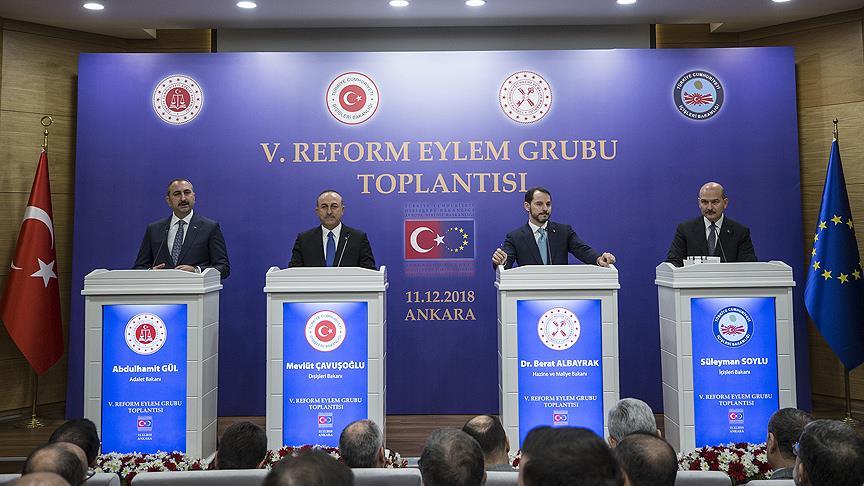
Gümrük Birliği Hakkında Açıklama Yapılırken (Anadolu Ajansı)
The process of updating the Customs Union stems from the need to adapt the existing structure, established in 1996, to today’s digitalized and evolving global trade conditions. The narrow scope of the current arrangement and the accumulation of structural issues have generated a shared need for “modernization” among both Türkiye and the EU.
The current Customs Union covers only industrial goods and processed agricultural products. However, modern trade is increasingly centered on services, e-commerce, and public procurement. Moreover, Türkiye’s inability to directly join the FTAs signed by the EU, alongside visa barriers and transport quotas faced by Turkish exporters accessing the EU market, remain key asymmetric challenges undermining the system’s effectiveness.
The updated Customs Union is expected to expand its scope to include the following areas:
The European Commission requested authorization from the EU Council on 21 December 2016 to initiate negotiations on updating the Customs Union. However, this process has at times been suspended or slowed due to political considerations. Türkiye’s fundamental position is that this update should not serve as an alternative to full membership but rather as a supportive step that deepens economic integration. 【11】
If modernized, the Customs Union is expected to significantly boost Türkiye’s GDP. Opening services and public procurement markets will create new investment opportunities, enhance participation in decision-making mechanisms, and strengthen Türkiye’s global competitiveness by resolving asymmetric issues such as FTA alignment. 【12】
Anadolu Ajansı. "Türkiye ve AB Gümrük Birliği 30 Yaşında." Accessed March 5, 2026. https://www.aa.com.tr/tr/ekonomi/turkiye-ve-ab-gumruk-birligi-30-yasinda/3501505.
Anadolu Ajansı. “Gümrük Birliği Müzakerelerinin Başlaması AB ve Türkiye'nin Yararına Olacak.” Accessed March 5, 2026. https://www.aa.com.tr/tr/ekonomi/gumruk-birligi-muzakerelerinin-baslamasi-ab-ve-turkiyenin-yararina-olacak/1335416.
Anadolu Ajansı. “Türkiye ile AB Arasındaki Gümrük Birliği 28 Yaşında.” Accessed March 5, 2026. https://www.aa.com.tr/tr/gundem/turkiye-ile-ab-arasindaki-gumruk-birligi-28-yasinda/2837451.
Arat, Tuğrul. “Avrupa Birliği ile Türkiye Arasındaki İlişkiler ve Gümrük Birliğinin Yeri.” Ankara Üniversitesi Hukuk Fakültesi Dergisi. https://dergipark.org.tr/en/download/article-file/629556.
Kalaycı, Cemalettin, and Cem Küçükali. “Türkiye Avrupa Birliği İlişkilerinin Geleceği: Gümrük Birliği’nin Güncellenmesi.” *İşletme ve İktisat Çalışmaları Dergisi* 6, no. 3 (2018): 13–23. https://dergipark.org.tr/en/download/article-file/842522.
Kurter, Osman. “Avrupa ve Türkiye Arasında Yürürlükte Olan Ortak Gümrük Birliği Antlaşması Güncellenmesi Üzerine Bir Araştırma.” *International Journal of Arts & Social Studies (ASSTUDIES)* 3, no. 5 (December 2020). https://dergipark.org.tr/tr/download/article-file/1341915.
Ministry of Foreign Affairs of the Republic of Türkiye, Directorate General of European Union. "Gümrük Birliği." Accessed March 5, 2026. https://www.ab.gov.tr/gumruk-birligi_46234.html.
Ministry of Foreign Affairs of the Republic of Türkiye. "Turkey-EU Customs Union." Accessed March 5, 2026. https://www.mfa.gov.tr/turkiye-ab-gumruk-birli-gi.tr.mfa
Narta, Ela Çolpan. “Gümrük Birliği’nin Türkiye’nin Dış Ticareti Üzerine Etkileri: Panel Veri Analizi.” *Journal of Yaşar University* 5, no. 17 (2010): 2874–2885. https://dergipark.org.tr/en/download/article-file/179262.
Şeker, Ata Ufuk. “AB, Kamu İhalelerine 'Made in EU' Şartı Getirecek.” Anadolu Ajansı. Accessed March 5, 2026. https://www.aa.com.tr/tr/dunya/ab-kamu-ihalelerine-made-in-eu-sarti-getirecek/3850089.
[1]
T.C. Dışişleri Bakanlığı,“Türkiye-AB Gümrük Birliği: Türkiye-AB Gümrük Birliği'nin tamamlanmasına giden yol”, erişim 5 Mart 2026. https://www.mfa.gov.tr/turkiye-ab-gumruk-birligi.tr.mfa#:~:text=Tan%C4%B1m%20olarak%20g%C3%BCmr%C3%BCk%20birli%C4%9Fi%3B%20taraf,ayn%C4%B1%20ticaret%20politikas%C4%B1n%C4%B1%20uygulamalar%C4%B1%20anlam%C4%B1ndad%C4%B1r.
[2]
T.C. Dışişleri Bakanlığı,“Türkiye-AB Gümrük Birliği: Türkiye-AB Gümrük Birliği'nin tamamlanmasına giden yol”, erişim 5 Mart 2026. https://www.mfa.gov.tr/turkiye-ab-gumruk-birligi.tr.mfa#:~:text=Tan%C4%B1m%20olarak%20g%C3%BCmr%C3%BCk%20birli%C4%9Fi%3B%20taraf,ayn%C4%B1%20ticaret%20politikas%C4%B1n%C4%B1%20uygulamalar%C4%B1%20anlam%C4%B1ndad%C4%B1r.
[3]
T.C. Dışişleri Bakanlığı,“Türkiye-AB Gümrük Birliği: Türkiye-AB Gümrük Birliği'nin tamamlanmasına giden yol”, erişim 5 Mart 2026. https://www.mfa.gov.tr/turkiye-ab-gumruk-birligi.tr.mfa#:~:text=Tan%C4%B1m%20olarak%20g%C3%BCmr%C3%BCk%20birli%C4%9Fi%3B%20taraf,ayn%C4%B1%20ticaret%20politikas%C4%B1n%C4%B1%20uygulamalar%C4%B1%20anlam%C4%B1ndad%C4%B1r.
[4]
T.C. Dışişleri Bakanlığı Avrupa Birliği Başkanlığı,“Gümrük Birliği”, erişim 5 Mart 2026. https://www.ab.gov.tr/gumruk-birligi_46234.html
[5]
T.C. Dışişleri Bakanlığı,“Türkiye-AB Gümrük Birliği: Üçüncü ülkelerle ilişkiler”, erişim 5 Mart 2026. https://www.mfa.gov.tr/turkiye-ab-gumruk-birligi.tr.mfa#:~:text=Tan%C4%B1m%20olarak%20g%C3%BCmr%C3%BCk%20birli%C4%9Fi%3B%20taraf,ayn%C4%B1%20ticaret%20politikas%C4%B1n%C4%B1%20uygulamalar%C4%B1%20anlam%C4%B1ndad%C4%B1r.
[6]
T.C. Dışişleri Bakanlığı Avrupa Birliği Başkanlığı,“Gümrük Birliği”, erişim 5 Mart 2026. https://www.ab.gov.tr/gumruk-birligi_46234.html
[7]
T.C. Dışişleri Bakanlığı,“Türkiye-AB Gümrük Birliği: Gümrük Birliği'nin Sanayi Ürünleri ve Teknik Mevzuat Uyumu Üzerindeki Etkileri”, erişim 5 Mart 2026. https://www.mfa.gov.tr/turkiye-ab-gumruk-birligi.tr.mfa#:~:text=Tan%C4%B1m%20olarak%20g%C3%BCmr%C3%BCk%20birli%C4%9Fi%3B%20taraf,ayn%C4%B1%20ticaret%20politikas%C4%B1n%C4%B1%20uygulamalar%C4%B1%20anlam%C4%B1ndad%C4%B1r.
[8]
T.C. Dışişleri Bakanlığı,“Türkiye-AB Gümrük Birliği: Gümrük Birliği'nin Ekonomik Etkileri”, erişim 5 Mart 2026. https://www.mfa.gov.tr/turkiye-ab-gumruk-birligi.tr.mfa#:~:text=Tan%C4%B1m%20olarak%20g%C3%BCmr%C3%BCk%20birli%C4%9Fi%3B%20taraf,ayn%C4%B1%20ticaret%20politikas%C4%B1n%C4%B1%20uygulamalar%C4%B1%20anlam%C4%B1ndad%C4%B1r.
[9]
T.C. Dışişleri Bakanlığı,“Türkiye-AB Gümrük Birliği: Üçüncü ülkelerle ilişkiler”, erişim 5 Mart 2026. https://www.mfa.gov.tr/turkiye-ab-gumruk-birligi.tr.mfa#:~:text=Tan%C4%B1m%20olarak%20g%C3%BCmr%C3%BCk%20birli%C4%9Fi%3B%20taraf,ayn%C4%B1%20ticaret%20politikas%C4%B1n%C4%B1%20uygulamalar%C4%B1%20anlam%C4%B1ndad%C4%B1r.
[10]
T.C. Dışişleri Bakanlığı Avrupa Birliği Başkanlığı,“Gümrük Birliği: Gümrük Birliği'nin Güncellenmesi”, erişim 5 Mart 2026 https://www.ab.gov.tr/gumruk-birligi_46234.html
[11]
T.C. Dışişleri Bakanlığı Avrupa Birliği Başkanlığı,“Gümrük Birliği: Gümrük Birliği'nin Güncellenmesi ve Üyelik Perspektifi”, erişim 5 Mart 2026. https://www.ab.gov.tr/gumruk-birligi_46234.html
[12]
T.C. Dışişleri Bakanlığı Avrupa Birliği Başkanlığı,“Gümrük Birliği: Gümrük Birliği'nin Güncellenmesi ve Beklenen Ekonomik Etkiler”, erişim 5 Mart 2026. https://www.ab.gov.tr/gumruk-birligi_46234.html

Fundamental Issues | Road Transport Quotas and Visa Barriers Inability to Participate in Decision-Making Mechanisms Incompatibility with Free Trade Agreements (FTAs) | ||||||||
|---|---|---|---|---|---|---|---|---|---|
Scope(s) | Processed Agricultural Products Industrial Products | ||||||||
Modernization Agenda | Services Sector, Public Procurement, Expansion of Agricultural Concessions, Digital Trade and Green Accord | ||||||||
Implementation Tools | A.TR Circulation Certificate, CE Marking (Technical Conformity), Common Trade Policy | ||||||||
Institutional Mechanisms | Turkey-EU Partnership Council, Customs Union Joint Committee (CUJC), Customs Cooperation Committee | ||||||||
Expected Goals | Full Membership, Economic Integration, Addition of a Single Market | ||||||||
Fundamental Principles | Elimination of Customs Duties, Removal of Quantitative Restrictions (Quotas), Application of the Common Customs Tariff (CCT), Harmonization of Legislation | ||||||||
Legal Basis | 12 September 1963 (Ankara Agreement), 1 January 1996 (Decision No. 1/95) | ||||||||
No Discussion Added Yet
Start discussion for "Customs Union Agreement between Türkiye and the European Union" article
Establishment of the Partnership and the Ankara Agreement
Preparation and Transition Phases
Decision and Implementation of the Customs Union
Free Circulation and the A.TR Circulation Document
Common Customs Tariff and Trade Policy
Technical Legislation Harmonization and Partnership Institutions
Impacts of the Agreement on Türkiye
Industrial Transformation and Quality Improvement
Expansion of Trade Volume and Market Integration
Increase in Foreign Direct Investment
Consumer Welfare and Product Variety
Structural Challenges and Exclusion from Decision-Making Mechanisms
Recent Updates to the Agreement
Reasons for Update and Structural Challenges
Scope and Expectations of the Update Process
Negotiation Process and Current Status
Potential Impacts of Modernization