


This article was automatically translated from the original Turkish version.
+1 More
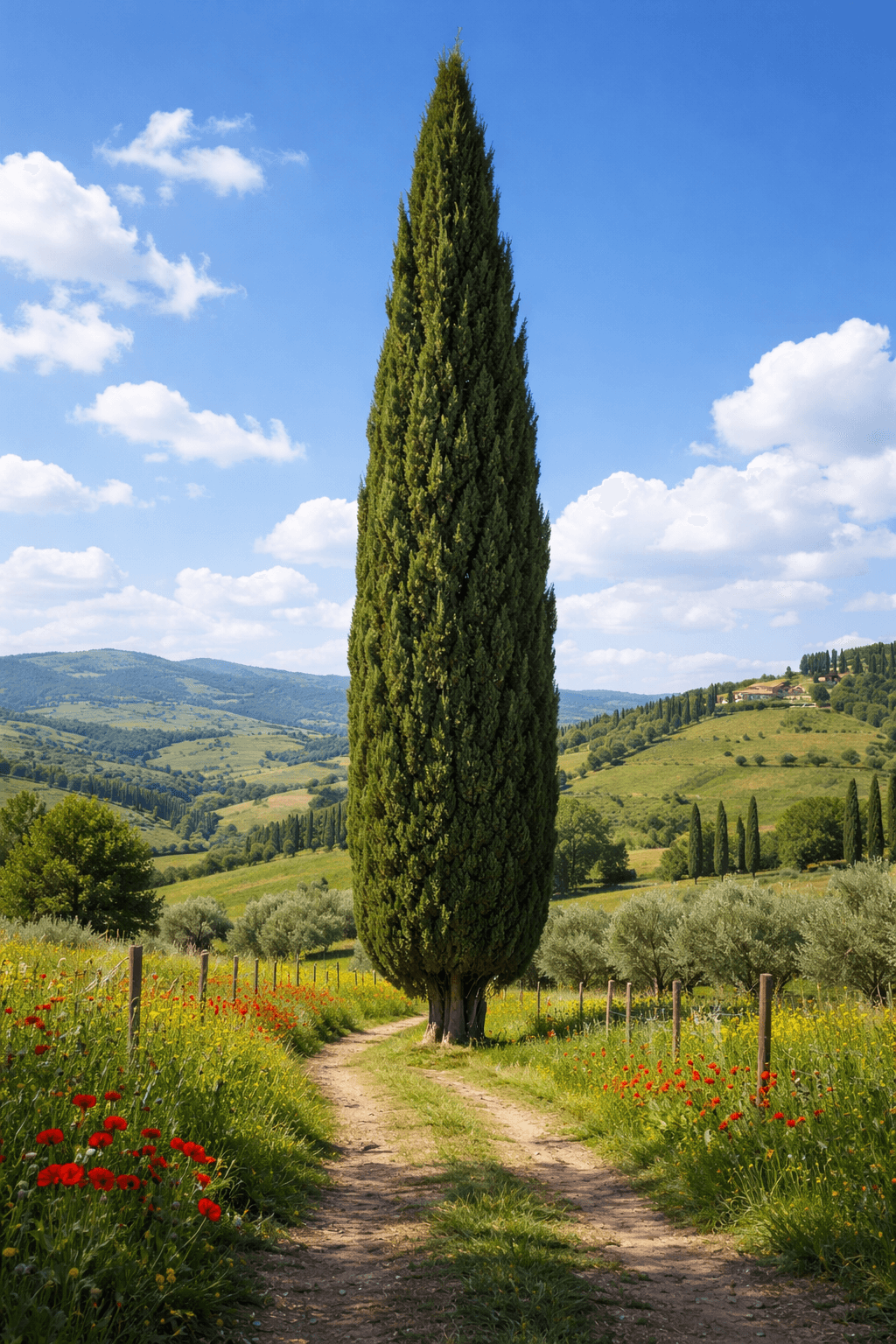
Servi Ağacı
(Yapay Zeka ile Oluşturulmuştur)
Servi Ağacı (Cupressus sempervirens), Cupressaceae (Cypress family) genus tree species characterized by evergreen foliage. Its scientific name derives from Cyparissus of Greek mythology, as recorded in Carl Linnaeus’s 1753 work Species Plantarum. Globally, approximately 20 species of cypress exist, with the servi being especially common in the Mediterranean and temperate climates.
Servi trees are plants that can reach heights of 30 to 35 metres depending on species and growing conditions, developing in columnar, pyramidal, rounded, or pendulous forms. The bark of young individuals is reddish in tone but turns grayish-brown with age, developing fine longitudinal cracks. Leaf structure varies with developmental stage: initially needle-like, leaves later become scale-like and tightly adhere to branches. Leaves remain green and do not shed throughout the four seasons.
The plant is monoecious, with male and female flowers located on separate branches of the same tree. Male flowers are small and cylindrical, while female flowers form cones composed of numerous overlapping scales. These cones are round or oval in shape and have a woody texture; they begin green and turn brown as they mature, producing hard-shelled seeds by the end of the second year. Under suitable ecological conditions, servi trees have been found to live up to 2000 years.
The native range of the servi tree encompasses a broad region including Türkiye, southern Europe, Italy, northern Iran, Syria, Palestine, northern Africa, western Asia, and the islands of Rhodes and Crete. In Türkiye, it naturally occurs primarily in the Mediterranean and western Anatolia regions, forming mixed or pure forests alongside Turkish pine.
The servi is an ecologically tolerant species capable of growing in loose, sandy, calcareous, or clayey soils, and can even thrive in poor, highly calcareous sites where other tree species fail. It has moderate light requirements and develops well in areas with direct sunlight. Although highly resistant to drought, it is sensitive to low temperatures and severe frosts. For specimens cultivated indoors, ambient temperatures should not fall below 7°C.
The most common and well-known species is the Mediterranean cypress (Cupressus sempervirens), which is divided into two main varieties: C. sempervirens var. sempervirens, with a narrow pyramidal form commonly used as an ornamental plant, and C. sempervirens var. horizontalis (Horizontal Cypress), characterized by a broad, spreading crown. In addition, other important species frequently chosen for landscaping include the “Lemon Cypress” (Cupressus macrocarpa ‘Goldcrest’), whose leaves emit a lemony scent when brushed by wind or touch and have bright yellow-green coloration, and the “Arizona Cypress” (Cupressus arizonica), which exhibits exceptional drought tolerance and a grayish-blue hue.
The wood of the servi tree is highly resistant to decay, insects, and moisture due to its resinous nature. Historically, it has been used in shipbuilding, bridge piers, piers, and coffin construction; today it is valued in furniture making, door and window joinery, and especially in the production of trousseau chests and wardrobes due to its distinctive fragrance.
In landscape architecture, its narrow and tall form makes it an effective windbreak and boundary marker. Additionally, essential oils extracted by distillation from its leaves and branches are in demand in aromatherapy, cosmetics, and perfumery industries for their calming and refreshing properties.
Because of its evergreen nature and upright, spire-like form, the servi tree has been imbued with profound symbolic meanings across many cultures, representing eternal life, rebirth, and unity (the oneness of God).
In cemeteries, its widespread use is due both to these symbolic associations and to the fact that its deep-rooted system does not damage burial structures, while its resinous scent helps suppress other odors. In Turkish architecture and decorative arts, the servi is frequently employed as a decorative motif in mosque courtyards and tombstones, recognized as a cultural heritage element evoking reflections on life and death.
Due to its botanical composition, the servi tree contains high levels of resin and natural oils, making it a fire-sensitive species. Dried branches and leaves have a high potential to carry flames rapidly and are classified in fire literature as “Class A fires.” To reduce the risk of crown fires in areas near human settlements, standard protective measures include pruning lower branches up to a height of approximately 1.5 to 2 metres above ground and clearing flammable materials from around the tree base.
Atatürk Orman Çiftliği Müdürlüğü. “Servi.” Üretimlerimiz. Accessed February 20, 2026. https://www.aoc.gov.tr/Portal/BitkiselUretimler/servi/75.
Hep Bilgi. "Servi Ağacı." *Hep Türkçe.* 2023. Accessed February 20, 2026. https://hepturkce.com/servi-agaci/
Manescu, C., N. Hamamouch, C. Maios, A. Harfouche, A. G. Doulis, and F. A. Aravanopoulos. 2011. “Linkage Mapping of the Mediterranean Cypress, *Cupressus sempervirens*, Based on Molecular and Morphological Markers.” *Genetics and Molecular Research* 10, no. 3: 1891–1909. Accessed February 20, 2026. doi:10.4238/vol10-3gmr1179
Orman Genel Müdürlüğü. “Servi (Akdeniz Servisi).” Haftanın Ağacı. Accessed February 20, 2026. https://www.ogm.gov.tr/tr/yararli-bilgiler/haftanin-agaci/servi.
Sönmez Palmiye. “Servi.” Ürünlerimiz. Accessed February 20, 2026. https://www.sonmezpalmiye.com.tr/selvi.html
Weick, Cynthia W., Naela Aamir, and Jayme Reichart. 2023. “The Ethnobotanical Evolution of the Mediterranean Cypress (Cupressus sempervirens).” Economic Botany 77: 203–221. Accessed February 20, 2026. https://doi.org/10.1007/s12231-023-09570-1

Servi Ağacı
(Yapay Zeka ile Oluşturulmuştur)
No Discussion Added Yet
Start discussion for "Cypress Tree (Cupressus sempervirens)" article
Morphological Structure
Ecological Requirements and Geographic Distribution
Taxonomic Diversity and Varieties
Industrial, Landscaping and Aromatic Uses
Cultural Symbolism and Architectural Influence
Fire Sensitivity and Protective Measures