
 Recently Added:
This article was automatically translated from the original Turkish version.
2026 Dakar Rally is an endurance rally-raid event spanning multiple days. The 48th edition will take place in Saudi Arabia between 3 and 17 January 2026. The start and finish line is in the city of Yanbu. The route, including liaison sections, covers approximately 8,000 kilometres in total, with the timed special stages amounting to roughly 5,000 kilometres.
Dakar Desert Race Trailer (Dakar)
The 2026 Dakar Rally will be held in Saudi Arabia for the seventh consecutive year. This is the 48th edition of the rally.
The total distance including liaison sections is close to 8,000 kilometres, with the timed special stages summing to approximately 5,000 kilometres. The event spans 14 days with a mid-race rest day.
The rally originated from an idea by Thierry Sabine. On 26 December 1978, 182 vehicles gathered at Place du Trocadéro in Paris and began a journey of approximately 10,000 kilometres. Of these, 74 reached Dakar, with Cyril Neveu, riding a Yamaha 500 XT, listed as the first edition’s winner. In its early years, the rally was perceived by the public as an event where individuals with limited budgets pushed their limits in desert conditions, with diverse vehicle types competing on the same route.
The 2008 edition was cancelled due to security concerns, a decision made in light of prevailing terrorist threats and the organisers’ risk assessment. Originally held on the African continent, the rally moved to South America in 2009 and transitioned to a Saudi Arabia-based structure by 2020. Thus, the Dakar Rally has followed a geographically diverse route throughout its history.
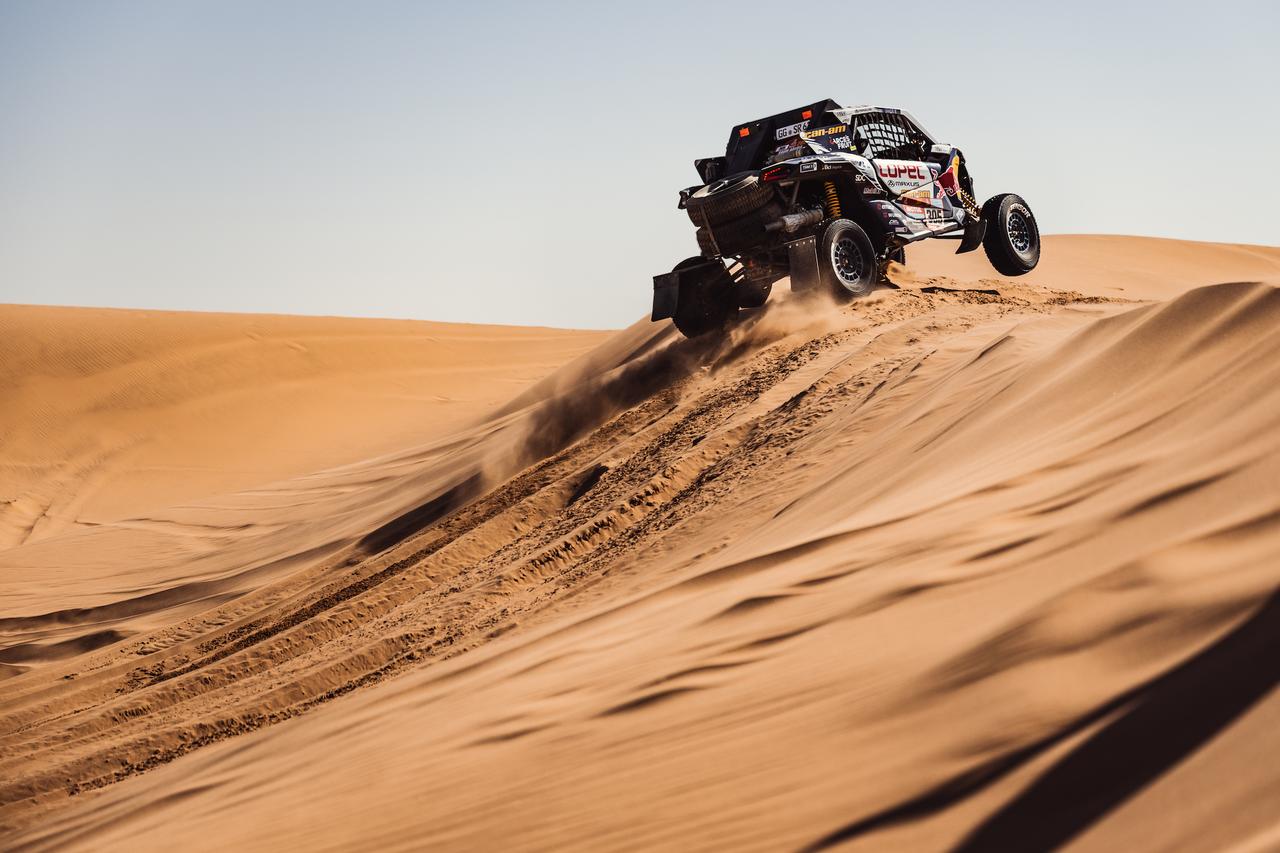
Dakar 2022 (Flickr)
The start camp for the 2026 edition is located in Yanbu. After technical inspections, the rally will begin on 3 January with a prologue stage. This short stage determines the initial starting order and launches the overall competition. The early days feature gravel and rugged terrain as defining features of the route.
A rest day is scheduled in Riyadh at the midpoint of the route. This day, falling on 10 January, serves as a natural break in the stage sequence.
Each stage does not consist solely of special stages. There are liaison sections on public roads connecting the camp areas with the start points. On some days the total route distance significantly exceeds the length of the timed special stage. For example, on stage 6 the total distance reached 920 kilometres while the special stage itself was only 331 kilometres long.
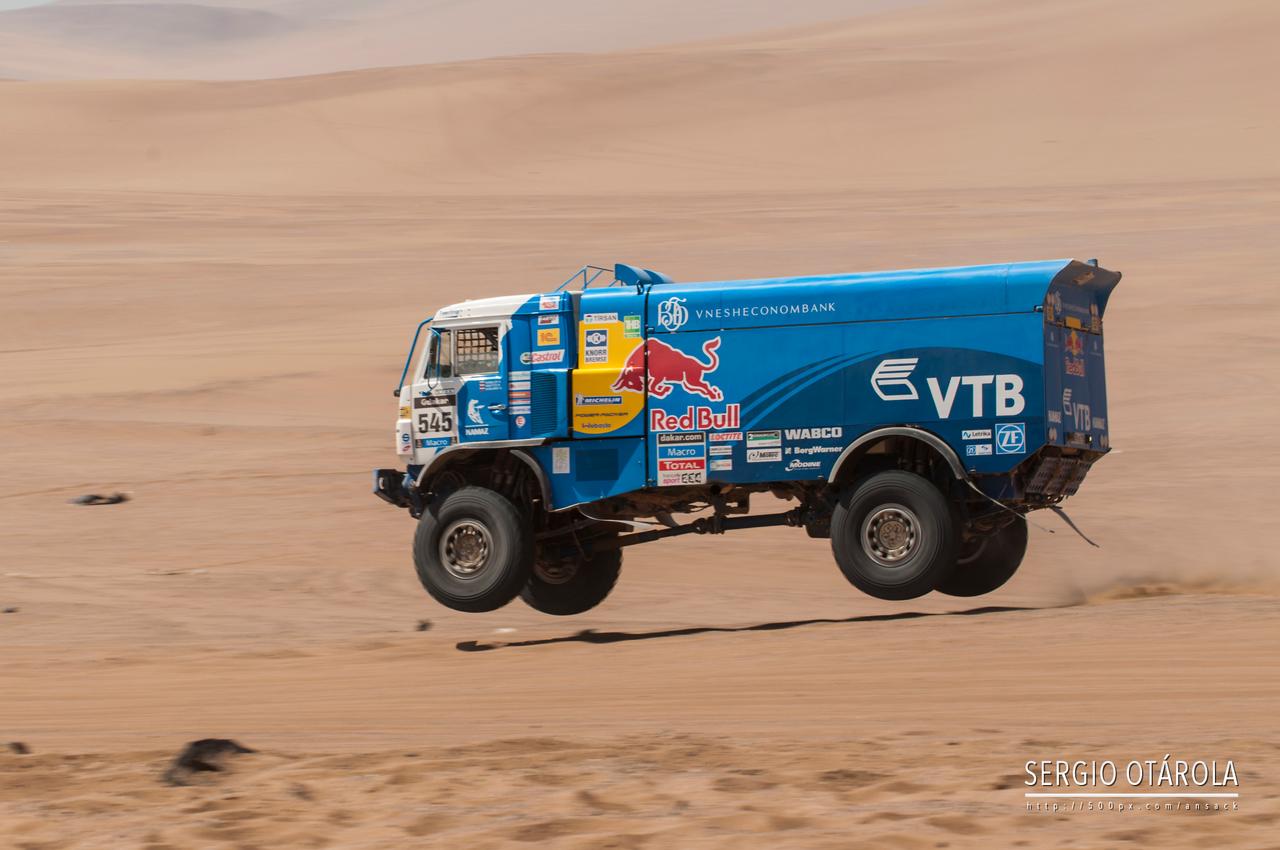
Dakar 2014 (Flickr)
The 2026 format includes two two-day Marathon–Bivouac stages. This structure combines the previously separate marathon and 48-hour chrono stages. Support from outside teams is restricted; competitors must rely solely on their own resources and mutual assistance. Accommodation is provided in the desert using only basic equipment supplied by the organisers.
The route includes four separate stages designated for two-wheel and four-wheel vehicles. This arrangement enhances safety for motorcyclists and makes navigation more decisive for car and truck classes. In stages without motorcycle tracks, navigation errors can directly lead to time losses.
After each stage, the convoy travels via public roads to the next camp site. Camp sites are equipped as mobile service parks with mechanical support, catering, showers and caravans. During marathon stages, competitors camp in the desert without external support vehicles.
Competitors reach the start of special stages via public roads. Starting order is typically determined by the results of the previous day. Competitors who fail to arrive at the start on time are penalised with time deductions.
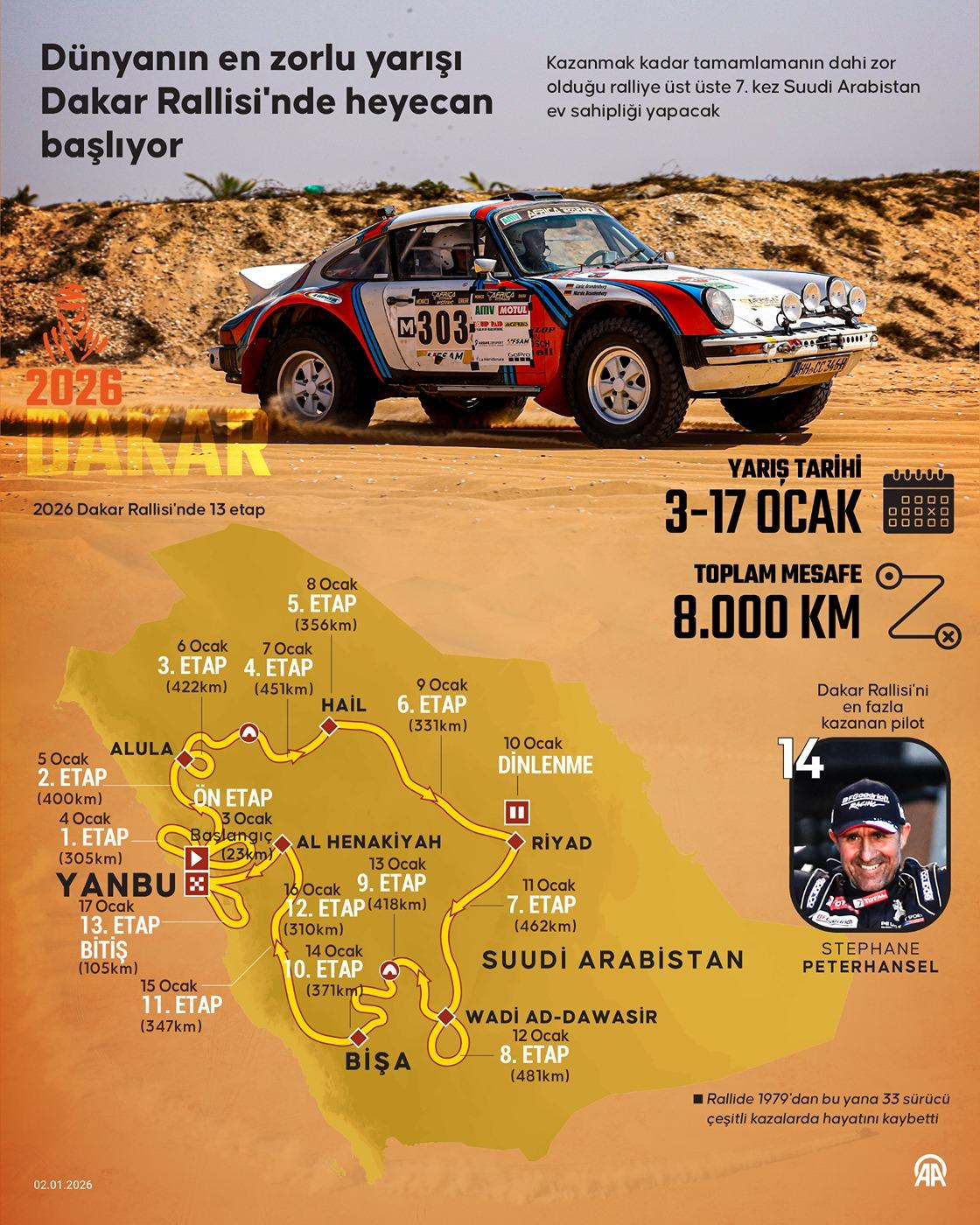
Dakar Rally (2026) Infographic (AA)
The Dakar Rally began with car, motorcycle and truck categories and later expanded to include ATV and UTV classes, evolving into a multi-category competition.
The top tier of the car category is called the “Ultimate” class and features specially built vehicles. The “Stock” category includes production-based vehicles.
In the Ultimate class of the 2026 edition, notable competitors include Carlos Sainz, Nasser Al-Attiyah, Sébastien Loeb, Seth Quintero and last year’s champion Yazeed Al-Rajhi. These drivers compete in vehicles such as the Ford Raptor T1+, Dacia Sandrider and Toyota Hilux. Stéphane Peterhansel, Carlos Sainz, Nasser Al-Attiyah, Seth Quintero and Sébastien Loeb all compete within the same car category pool.
In the motorcycle category, Daniel “Chucky” Sanders competes with the Red Bull KTM Factory Racing team. Luciano Benavides and Edgar Canet are also part of the same team. Other participants include Kevin Benavides, Ricky Brabec and Tosha Schareina.
In the Stock category, the team competing with the Land Rover Defender Dakar D7X-R includes Stéphane Peterhansel, Rokas Baciuška and Sara Price. This class provides a distinct competitive arena for production-based vehicles.
Route details are kept secret until the roadbook is distributed on race day. Although GPS devices are permitted, the primary navigation tool remains the roadbook. This guide uses symbols to indicate waypoints, distances and hazards, and experienced competitors make detailed annotations directly on the roadbook.
The transition between terrain types—from rocky outcrops to sandy plains—makes it difficult to maintain the correct line. On stages without motorcycle tracks, the absence of visible trails increases the decisive role of navigation for car and truck classes.
About the Dakar Rally Digital Roadbook (Red Bull Rally)
Since its inception in 1979, 33 drivers have lost their lives in various accidents during the rally. When including organisers, journalists and spectators, the total number of fatalities approaches 50. Not all incidents are fully documented, making it impossible to determine an exact figure.
Thierry Sabine, the founder of the Dakar Rally, died in a helicopter crash during the 1986 edition. This event is regarded as one of the most significant turning points in the rally’s history.
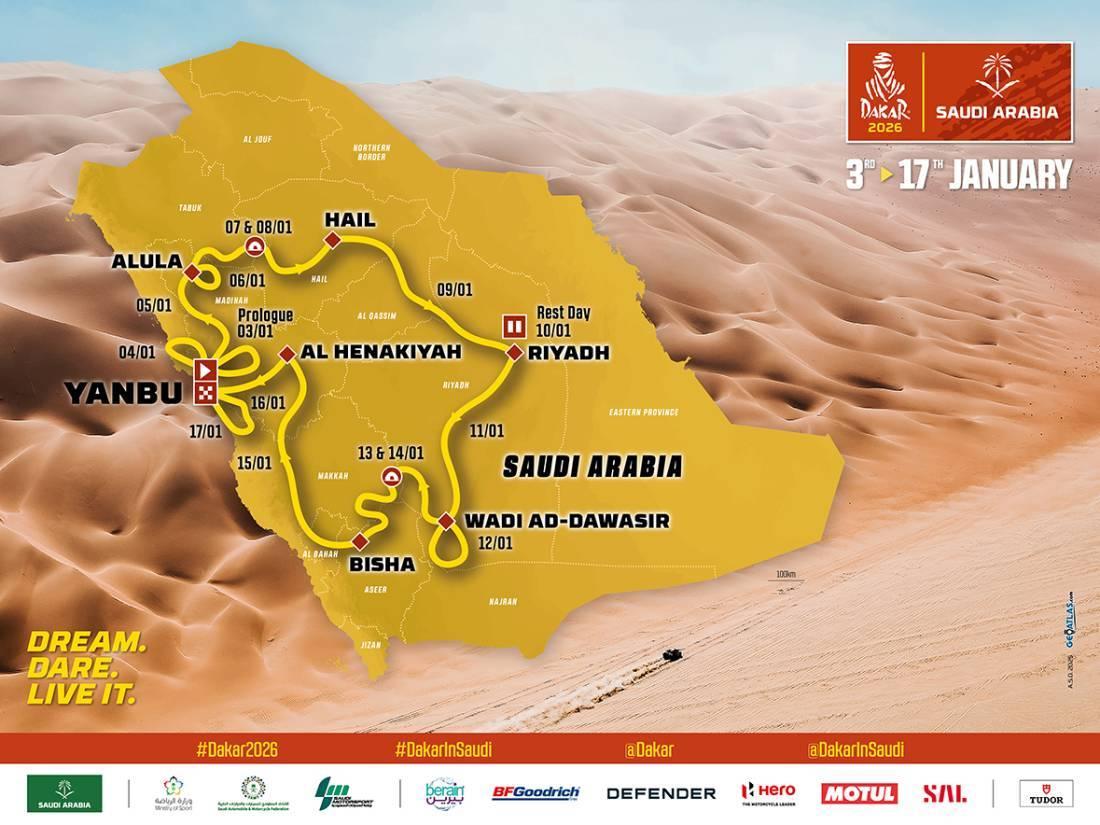
Dakar Rally (2026) Route (Dakar)
The 2026 edition is planned across vast desert regions of Saudi Arabia. The Rub’ al Khali (Empty Quarter) is one of the most prominent areas on the route. The route connects inland regions along the axis of Yanbu, Al-Ula, Hail and Riyadh.
The rally begins and ends in Yanbu. The initial stages, including the prologue, are held around Yanbu, and the finish line is again reached in Yanbu on 17 January. Thus, the rally completes a circular overall route.
Anadolu Ajansı. "Dünyanın en zorlu yarışı Dakar Rallisi'nde heyecan başlıyor." Accessed January 2, 2026. https://www.aa.com.tr/tr/dunyadan-spor/dunyanin-en-zorlu-yarisi-dakar-rallisinde-heyecan-basliyor/3787415
Dakar. "Historic Book." Accessed January 2, 2026. https://storage.googleapis.com/lequipe-aso-prod-netstorage-gcs/ASO/motorSports_dak/DAK23-GuideHistorique-UK-V2-3_compressed.pdf
Dakar. "History." Accessed January 2, 2026. https://www.dakar.com/en/historical
Flickr. "Dakar Iquique 2014." Sergio Otarola, Accessed January 2, 2026. https://www.flickr.com/photos/ansack/11982474045/in/photolist-jfRj56-gm1LQY-kj9t-2mWxb2q-QeijeM-7rZMUv-jfSXLK-kiqm-5Sv2Qq-exv711-amm4vX-dMey17-kiZ1-baFr1R-kifq-2mWxbgo-dMjEVK-dg6vV5-kivC-bbzheF-5UGzKY-bbzhnv-5T2qju-2mYoRAi-jooYxf-jokLdR-jfRvJi-kjpa-7tEFeU-2mWDSpu-22Ez2sK-5UH7iC-jfT6UZ-Qeijv8-jfSVLx-jfVAVJ-jfVFfA-2dUZNmy-5ULfso-97LhV9-2cQeSgR-kiHn-2khLBvS-2g4WnXV-jfRqBK-bbzhk6-j4j2u8-knCe-2mV8HeA-joneFn
Flickr. "EKS Dakar 2022 - Stage 8." EKSRX, Accessed January 2, 2026. https://www.flickr.com/photos/eksrx/51814686195/in/photolist-2mWFP1x-r7t5f4-kndB-9gGb82-Layj7Q-23soGuR-kjBi-5ToY5z-fGH2aR-5UGzx1-RVNTVu-2mW2kJ2-bc2ECX-bcwU52-PEd9-2mW1Ldn-bbXBMp-2mW2kVE-xPFU9N-2iL1mTk-2dZdKd9-7dDXbj-Q3gcut-o4QpgY-2mYqPuS-xtenmF-2r5UpVb-65L6A9-2mYn5cG-2cFrPjZ-2kp3Xmb-dLpZtD-cvL3Yj-TCtP37-2mU55SR-xqANwD-7rZN8a-2e3QC9E-2kp8ncU-9NYtsQ-2mU1Qpa-2kp8nm1-D4dMV3-2dZe2i5-wt1c6j-4YXetj-QiyRjD-9gKgns-9gKgsA-9bbaQb
RacingNews365. "2026 Dakar Rally Route – All Stages." Accessed January 2, 2026. https://racingnews365.com/route-dakar-rally-2026-all-stages
Red Bull. "2026 Dakar Rallisi Hakkında Bilmen Gereken Her Şey." Accessed January 2, 2026. https://www.redbull.com/tr-tr/dakar-rallisi-hakkinda-bilmen-gerekenler
YouTube. "How to read a Dakar Rally Digital Road Book." Red Bull Rally, Accessed January 2, 2026. https://www.youtube.com/watch?v=vvNjAx17bss
YouTube. "Movie Trailer Dakar: Race against the desert." Accessed January 2, 2026. https://www.youtube.com/watch?v=U3SvSomNjVQ
2026 Dakar Rally, held in Saudi Arabia, concluded with its 13th and final stage in Yanbu. The final day of the event determined the overall standings in both the car and motorcycle categories. With the results of this final stage, the champions of the 48th Dakar Rally were officially crowned and the race came to a close.
The 2026 Dakar Rally, hosted in Saudi Arabia, concluded with Stage 13 in the city of Yanbu. This final stage marked both the sporting and chronological end of the event. The stage results finalized the overall rankings in both the car and motorcycle categories. The rally was completed after a total of 13 special stages.
Stage 13 in the car category was won by Swedish driver Mattias Ekström, competing for the Ford M-Sport team. Ekström completed the stage in 46 minutes and 14 seconds. Despite securing the stage victory, the overall lead remained unchanged.
In the overall classification, Qatari driver Nasser Al-Attiyah, driving a Dacia Sandrider, finished first with a total time of 48 hours 56 minutes and 53 seconds. This result marked Al-Attiyah’s sixth Dakar Rally championship title. Spaniard Nani Roma of Ford Racing finished second in the overall standings, while Mattias Ekström placed third.
The final stage in the motorcycle category was won by Spanish rider Edgar Canet of the Red Bull KTM team. Canet completed Stage 13 in 49 minutes and 3 seconds. The stage results directly determined the outcome of the overall classification battle.
In the motorcycle overall classification, Argentine rider Luciano Benavides claimed first place with a total time of 49 hours and 41 seconds. This achievement marked Benavides’ first overall Dakar Rally championship title. American rider Ricky Brabec of Monster Energy Honda finished second, just two seconds behind, while Spanish rider Tosha Schareina of the same team completed the overall standings in third place.
BEST OF DAKAR 2026 (Youtube)
Anadolu Ajansı. "2026 Dakar Rally's Third Stage Completed First by Guthrie in Car, Schareina on Motorcycle." Accessed January 19, 2026. https://www.aa.com.tr/tr/dunyadan-spor/2026-dakar-rallisinin-ucuncu-etabini-otomobilde-guthrie-motosiklette-schareina-ilk-sirada-tamamladi/3791364
TRF1. “2026 Dakar Rally Victory Changed Hands on Final Stage.” TRF1, Accessed January 19, 2026. https://trf1.net/dakar-rally/2026-dakar-rallisinde-zafer-son-etapta-el-degistirdi/50104/#google_vignette
YouTube. "BEST OF DAKAR 2026." Red Bull Motorsports, Accessed January 19, 2026. https://www.youtube.com/watch?v=jeBryjvkprM

The Dakar Rally began in 1979 with a route stretching from Paris to Dakar and over time has been held in various geographic regions centered in Africa South America and Saudi Arabia. Security conditions and organizational requirements have been decisive in the rally’s geographic shifts. The Dakar Rally features a multi-class structure encompassing categories for cars motorcycles trucks ATVs and UTVs. The 2026 edition will start on 3 January with a prologue stage in Yanbu and conclude on 17 January also in Yanbu. The race is structured over 13 stages following a circular route that includes Al-Ula Hail Riyadh Wadi ad-Dawasir Bişa and Al Henakiyah. The route includes two days of Marathon Bivouac stages and special stages designated for two-wheel and four-wheel vehicles.
The 2026 Dakar Rally concluded with the 13th and final stage held in Yanbu Saudi Arabia. In the final stage of the organization the car category was won by Ford M-Sport driver Mattias Ekström but the overall lead remained unchanged. Qatari driver Nasser Al-Attiyah claimed the car category championship with a total time of 48 hours 56 minutes and 53 seconds marking his sixth Dakar victory in his career. In the motorcycle category the final stage was won by Red Bull KTM rider Edgar Canet. In the overall classification Argentine rider Luciano Benavides claimed the title of 2026 Dakar Rally motorcycle champion with a margin of just two seconds. Ricky Brabec finished second and Tosha Schareina third.
January 2, 2026
General Framework
January 2, 2026
History and Institutional Context
January 2, 2026
Route and Stage Structure of the 2026 Edition
January 2, 2026
Innovations and Format Adjustments in the 2026 Edition
January 2, 2026
Race Operations and Daily Stage Practices
January 2, 2026
Vehicle Categories and Participant Structure
January 2, 2026
Participants and Notable Names
January 2, 2026
Navigation System and Information Infrastructure
January 2, 2026
Risk, Safety and Losses
January 2, 2026
Geographical Framework of the 2026 Route
January 19, 2026
Dakar Rally Stage 13