


This article was automatically translated from the original Turkish version.

Fluid mechanics is a fundamental branch of physics that studies the behavior of moving fluids (liquids and gases) and the forces exerted on solid bodies interacting with these fluids. One of the most famous and historically significant problems in this field is d’Alembert’s Paradox, formulated in the 18th century by the French mathematician and physicist Jean le Rond d’Alembert. This paradox highlights a clear contradiction between a theoretical prediction of fluid mechanics and our everyday observations and experiences: the prediction that the drag force on a body moving at constant velocity through an ideal fluid must be zero. This situation has puzzled scientists for centuries and has played a critical role in the development of our understanding of fluid mechanics.
To understand the origin of the paradox, it is necessary to examine the concept of “potential flow” or “ideal fluid.” Potential flow theory models the fluid using the following fundamental assumptions:
Under these assumptions, when we examine the flow around a cylinder, the theory predicts that streamlines flow symmetrically around the cylinder. The flow decelerates at the front stagnation point, accelerates along the sides, and then decelerates again at the rear stagnation point, returning to its original speed.
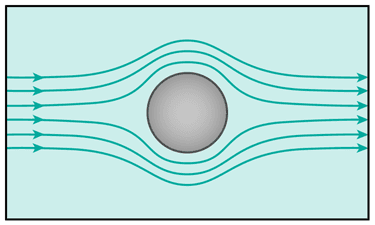
Theoretical Streamlines Around a Cylinder (APS)
Using Bernoulli’s Principle, the pressure distribution on the cylinder’s surface can be calculated. According to potential flow theory, the high-pressure regions on the front half of the cylinder (the surface facing the flow) are exactly balanced by the high-pressure regions on the rear half (the surface where the flow separates). Similarly, the low-pressure regions on the top and bottom are symmetric. Due to this perfect symmetry of pressure forces, the net force in the direction of flow (drag force) and the net force perpendicular to the flow (lift force, for symmetric bodies) are both calculated to be zero.
This is precisely where the paradox arises: According to theory, a cylinder (or any shaped body) moving through an ideal fluid should experience no resistance. Yet this contradicts all our real-world observations, from the drag we feel when we put our hand out of a moving car window to the resistance a boat encounters while moving through water.
This contradiction, which was a mystery to d’Alembert and his contemporaries, has been resolved only through a deeper understanding of the effects of viscosity. The solution lies in a single critical factor ignored by potential flow theory: viscosity. Real fluids are not frictionless; they possess internal friction.
In summary, the total drag force acting on a body in a real fluid is the sum of pressure drag and friction drag, both of which arise fundamentally from viscosity. Since potential flow theory neglects viscosity, it cannot account for either of these two drag mechanisms, leading to the prediction of zero drag.
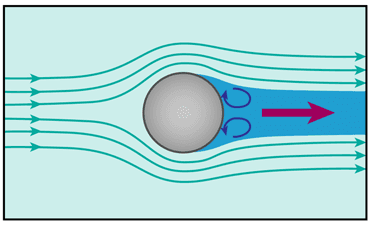
Streamlines Around a Cylinder Due to Viscosity (APS)
d’Alembert’s Paradox is a classic example that underscores the limitations of idealized theoretical models and the importance of correctly incorporating physical effects—in this case, viscosity—to understand real-world phenomena. This paradox:
Today, d’Alembert’s Paradox is considered “resolved.” It is no longer viewed as a contradiction but rather as a natural consequence of the inviscid flow model, and it is now well understood that drag forces in real fluids arise from viscosity and its effects—boundary layer formation, flow separation, and friction. The paradox continues to hold an important place in the teaching and history of fluid mechanics.
Stewartson, K. 1981. "D'Alembert's Paradox." *SIAM Review* 23, no. 3 (July): 308–343. https://doi.org/10.1137/1023063.
Potential Flow and the Source of the Paradox
Solution to the Paradox: The Role of Viscosity
Implications and Contemporary Relevance