


This article was automatically translated from the original Turkish version.
+2 More
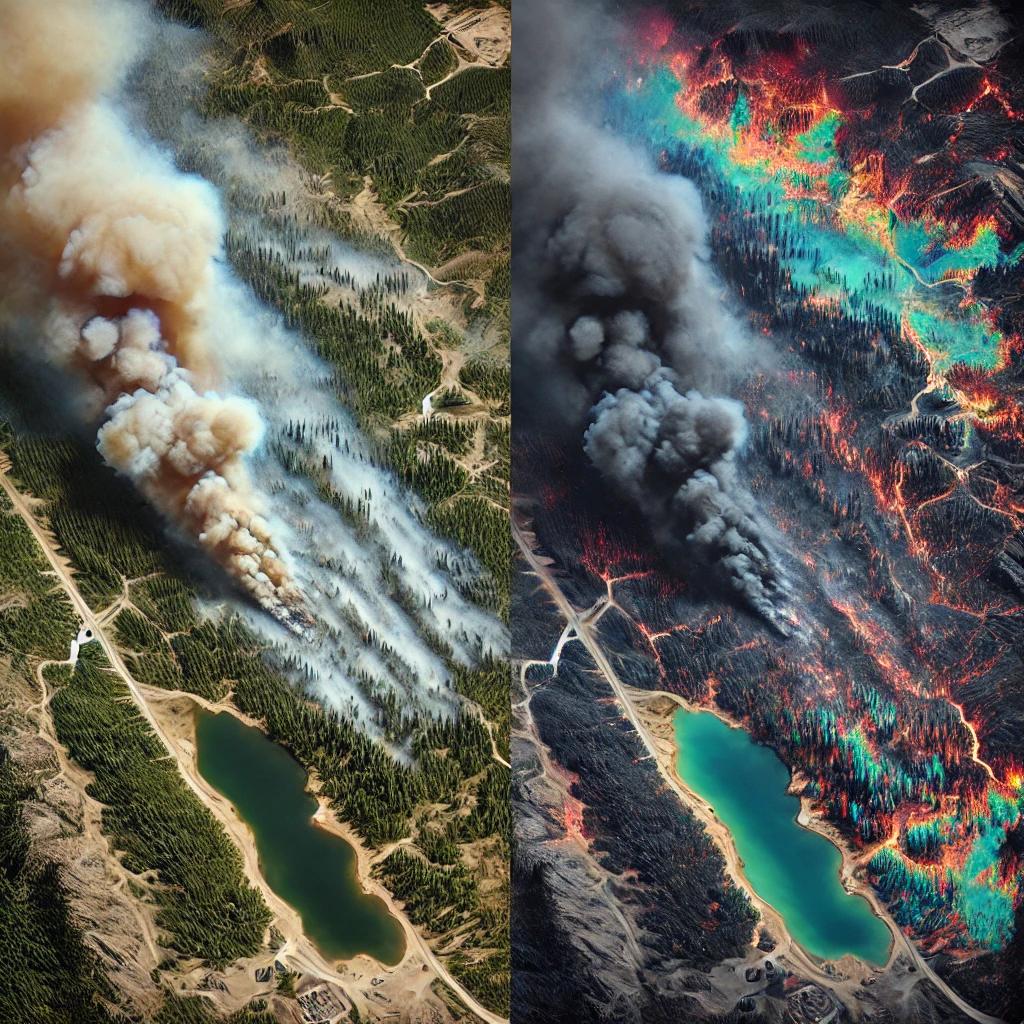
Damage Detection in Forest Fire Areas Using Satellite Imagery
Description | Forest fires cause serious damage to ecosystems, and satellite technologies play a critical role in monitoring fires and assessing damage. | ||||||||
|---|---|---|---|---|---|---|---|---|---|
Used Satellite Systems | MODIS: A medium-resolution fire detection system covering large areas. VIIRS: Detects fires using thermal data from both night and day. Landsat Series: Provides detailed analysis with a resolution of 30 meters. Sentinel-2: Tracks vegetation cover changes with a resolution of 10-20 meters. | ||||||||
Damage Analysis with Spectral Indices | dNBR: Identifies severely damaged areas by measuring fire intensity. BAI: An index developed to identify burned areas. NBR: Used to determine the impact of fire. NDVI: Measures changes in vegetation cover before and after fire. | ||||||||
Classification Methods | Threshold Value Approach: Burned areas are determined based on specific spectral index values. Supervised Classification: Classification is performed using sample areas. Unsupervised Classification: Data are grouped according to their inherent differences. | ||||||||
Orman fires are natural disasters that cause severe damage to ecosystems. Accurate assessment of post-fire damage is critical for monitoring ecological recovery and planning reforestation efforts. Satellite imagery is one of the most effective methods for damage detection, as it can cover large areas in a short time. Remote sensing technologies enable the identification of fire-affected areas, classification of damage severity, and analysis of long-term impacts on ecosystems.

class=\
The main satellite systems used for monitoring forest fires and detecting damage are as follows:

Various spectral indices are used to evaluate post-fire areas. These indices help identify burned areas, measure vegetation loss, and monitor ecological recovery.

class=\
Data derived from satellite imagery after forest fires are classified to analyze fire damage. Classification methods assist in categorizing the level of damage.
Early detection systems are of great importance in minimizing fire damage. Satellite sensors such as MODIS and VIIRS can identify the exact locations of fires in real time by detecting thermal anomalies. Additionally, machine learning techniques can pre-identify regions with high fire risk.
Satellite imagery is used to assess reforestation and ecological recovery efforts after fires. Indices such as NDVI and NBR enable tracking of vegetation regrowth in affected areas, allowing authorities to determine where intervention is most needed.
Forest fires release large amounts of carbon into the atmosphere. Satellite imagery and spectral analyses are used to calculate carbon emissions from fires and assess their impact on global climate change.
Anadolu Ajansı. "Yanan 85 Bin Futbol Sahası Büyüklüğündeki Alan Uzaydan Görüntülendi." 2021.Accessed Adresi
Euronews. "ABD Ülke Tarihinin En Büyük Orman Yangınları Kontrol Altına Alınamıyor." July 26, 2021.Accessed Adresi
European Space Agency (ESA). "Satellite Data for Wildfire Monitoring." 2022.
NASA Earth Observatory. "Remote Sensing for Fire Damage Assessment." 2021.
US Geological Survey (USGS). "Landsat Data for Post-Fire Analysis." 2023.

Damage Detection in Forest Fire Areas Using Satellite Imagery
Description | Forest fires cause serious damage to ecosystems, and satellite technologies play a critical role in monitoring fires and assessing damage. | ||||||||
|---|---|---|---|---|---|---|---|---|---|
Used Satellite Systems | MODIS: A medium-resolution fire detection system covering large areas. VIIRS: Detects fires using thermal data from both night and day. Landsat Series: Provides detailed analysis with a resolution of 30 meters. Sentinel-2: Tracks vegetation cover changes with a resolution of 10-20 meters. | ||||||||
Damage Analysis with Spectral Indices | dNBR: Identifies severely damaged areas by measuring fire intensity. BAI: An index developed to identify burned areas. NBR: Used to determine the impact of fire. NDVI: Measures changes in vegetation cover before and after fire. | ||||||||
Classification Methods | Threshold Value Approach: Burned areas are determined based on specific spectral index values. Supervised Classification: Classification is performed using sample areas. Unsupervised Classification: Data are grouped according to their inherent differences. | ||||||||
No Discussion Added Yet
Start discussion for "Damage Detection in Forest Fire Areas Using Satellite Imagery" article
Satellite Systems Used
Damage Analysis Using Spectral Indices
Classification Methods
Monitoring and Management of Fire Damage Using Remote Sensing
Early Warning and Real-Time Monitoring
Post-Fire Rehabilitation
Carbon Emissions and Climate Change