

This article was automatically translated from the original Turkish version.
+2 More
Subject(s) | Stages of life and the phenomenon of death | ||||||||
|---|---|---|---|---|---|---|---|---|---|
Type(s) | Allegorical painting | ||||||||
Technique | Oil on canvas | ||||||||
Year of Creation | 1910–1911; reorganized in 1916 | ||||||||
Title of Work | Death and Life | ||||||||
Artist | Gustav Klimt | ||||||||
Location | Leopold Museum Vienna | ||||||||
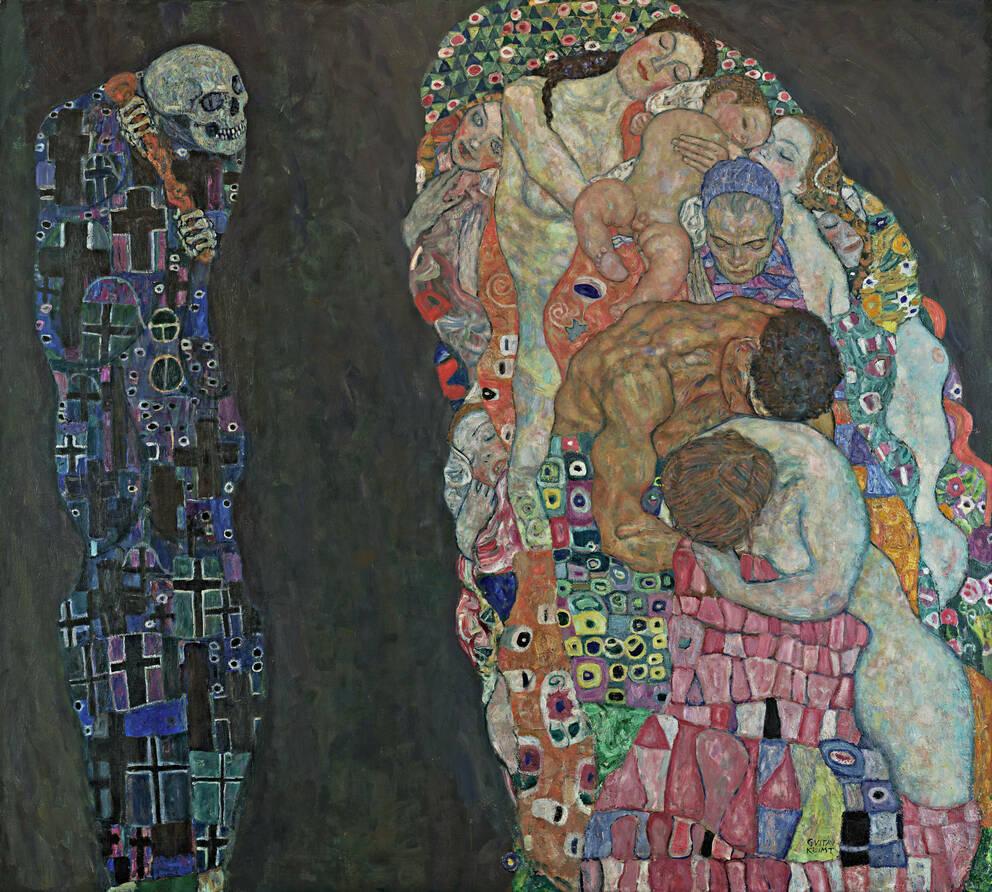
Death and Life, an oil painting created by Austrian artist Gustav Klimt between 1910 and 1911 and later revised by the artist in 1916 to reach its final form, presents an allegorical narrative that unites the different stages of human life with the concept of death within a single composition.
The work is part of the permanent collection of the Leopold Museum and is displayed in the museum’s dedicated sections on Gustav Klimt. The museum classifies the piece as one of the key examples of Klimt’s symbolist expression.【1】
The painting is dated to Klimt’s mature period. Its initial version was exhibited at the International Art Exhibition in Rome in 1911 and received an award. Following this exhibition, the artist reworked the piece, making significant changes to the color palette and the arrangement of figures. The 1916 revision is regarded as the definitive version of the work.
The work is executed in oil on canvas. Klimt’s characteristic decorative approach is evident in the patterned areas surrounding the figures. Colors and forms are employed to distinguish the figures from one another and to balance the composition.
The central theme of the painting is the continuity of human life and the inevitability of death. Klimt brings together life and death on the same surface as complementary yet non-interacting forces. Rather than drawing on mythological or historical narratives, the work addresses a universal human condition.【2】
In the painting, the figure of death occupies the left section while a group of figures representing life is positioned on the right. The life group comprises depictions of a baby, child, youth, adult, and elderly person. The figures are rendered in an interwoven arrangement. The figure of death, set against a dark background and holding a symbolic object, serves as the counterpoint to the composition.
Google Arts & Culture. "Death and Life." Art and Culture. Accessed January 13, 2026. https://artsandculture.google.com/asset/death-and-life-gustav-klimt/rAGqexSs58_H0A?hl=en
Leopold Museum. "Death and Life." Online Collection. Accessed January 16, 2026. https://onlinecollection.leopoldmuseum.org/en/object/629-death-and-life/
[1]
Leopold Museum, “Death and Life,” Online Collection, Erişim tarihi: 16 Ocak 2026, https://onlinecollection.leopoldmuseum.org/en/object/629-death-and-life/
[2]
Google Arts & Culture, “Death and Life,” Google Arts and Culture, Erişim tarihi: 27 Aralık 2025,

Subject(s) | Stages of life and the phenomenon of death | ||||||||
|---|---|---|---|---|---|---|---|---|---|
Type(s) | Allegorical painting | ||||||||
Technique | Oil on canvas | ||||||||
Year of Creation | 1910–1911; reorganized in 1916 | ||||||||
Title of Work | Death and Life | ||||||||
Artist | Gustav Klimt | ||||||||
Location | Leopold Museum Vienna | ||||||||
No Discussion Added Yet
Start discussion for "Death and Life (Painting)" article
Production Process
Technical Characteristics
Subject and Thematic Framework
Composition and Figure Arrangement