


This article was automatically translated from the original Turkish version.
Parse Tree is one of the fundamental concepts in formal language theory and is a graphical representation that shows, in a hierarchical structure, how a string is generated according to the production rules (grammar) of a language. Parse trees are widely used in computer science, especially in compiler design, natural language processing (NLP), analysis of mathematical expressions, and sentence parsing.
Essentially, a parse tree visually represents whether a given input string can be generated by a particular context-free grammar (CFG), and if so, through which sequence of production steps. This structure also includes the order of application of production rules and intermediate stages.
The foundation of parse trees lies in formal language theory. A grammar G = (V, Σ, R, S) consists of four components:
A parse tree:
A parse tree reaches terminal symbols through branches stemming from a root node. Nodes are divided into two types:
Each node carries a label. For example, in the expression (x + y) * z, the root node is E. The tree branches depending on the order in which production rules are applied.
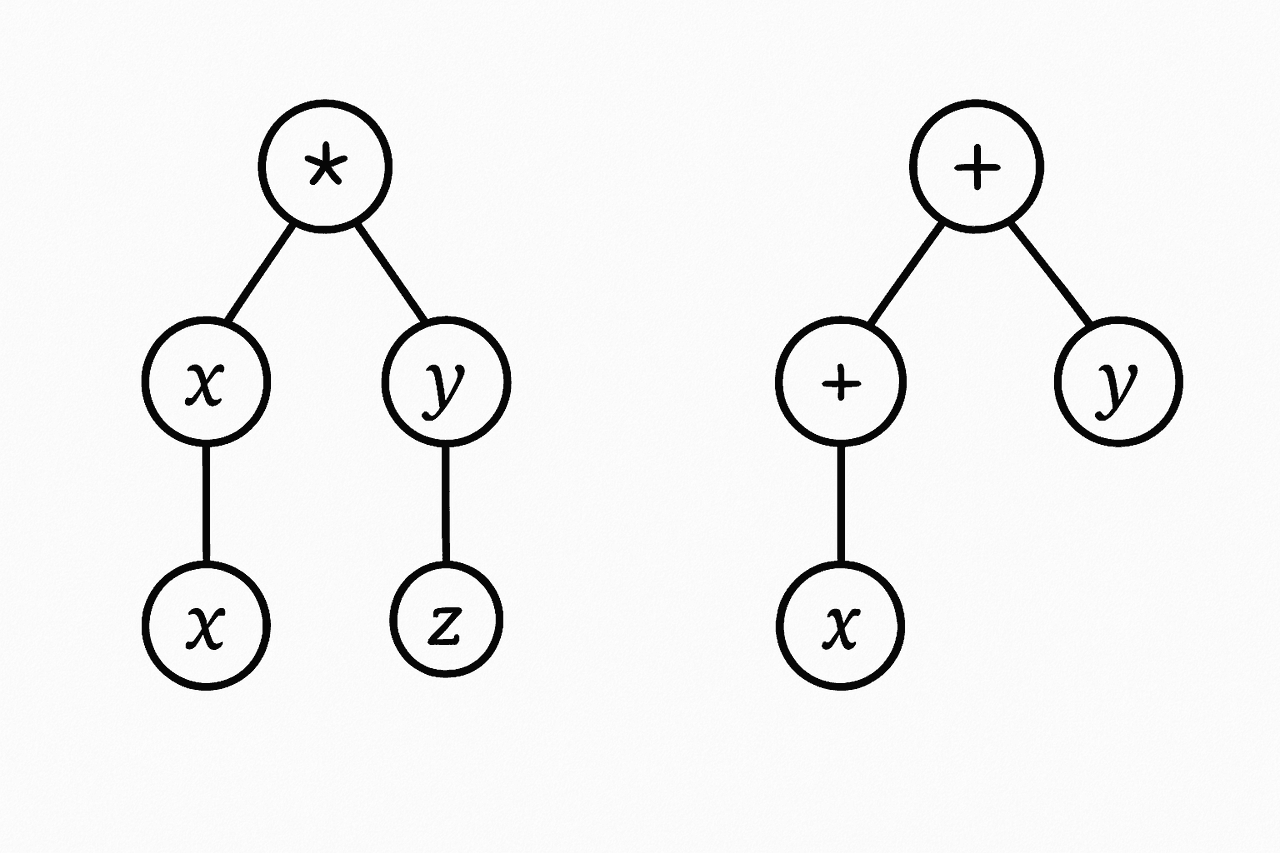
Example of parse tree structure (generated by artificial intelligence.)
A parse tree can arise from multiple different derivations. During derivation:
Example: x + y * z
Here, different derivations can produce the same expression. If different derivations correspond to different parse trees, the grammar is ambiguous.
A grammar is ambiguous if it can generate more than one distinct parse tree for a given string. For example, the expression a + b * c can be parsed differently depending on whether multiplication or addition has higher precedence. This is undesirable in compilers. Therefore, most programming language grammars are unambiguous and explicitly define precedence rules.
Example:
Ambiguous grammar: E→E+E, E→E∗E, E→a∣b∣c
This grammar can parse the expression a + b * c as either (a+b)*c or a+(b*c).
Backus-Naur Form (BNF) is commonly used to define parse trees. In BNF, production rules are typically written as:
Example: Parse tree for the expression 4 + 8 * (2 - 3);
Constructing a parse tree is one of the fundamental operations in formal language theory. In particular, parsing fully parenthesized mathematical expressions provides a concrete application of theoretical concepts. During parsing, each symbol is treated as a token, and the parsing process proceeds step by step over this sequence of tokens.
Four basic rules define the construction of a parse tree:
This process continues recursively until the entire tree is built. A stack is essential to preserve parent-child relationships. Each time the algorithm descends to a child node, the current node is pushed onto the stack; each time it ascends, the node is popped from the stack.
Application Example:
For the expression ( 3 + ( 4 * 5 ) ):
At the end of this process, a complete parse tree is formed. Each branch corresponds to a parenthesized sub-expression.
Constructing a parse tree not only provides a structural analysis of a string but also enables the computation of its numerical value. In this context, evaluating a parse tree is a form of tree-based computation algorithm.
The evaluation algorithm is recursive:
For example, for (3 + (4 * 5)):
This method automatically preserves the correct order of operations even in complex expressions, because the parse tree inherently encodes the precedence relationships between operations.
LL(1) parsing is a top-down parsing method.
In LL(1) grammars, the production rule to apply at each step can be determined solely by examining the next input token. This property enables the design of grammars that are easily understandable by humans. As in grammar G2, operator precedence in arithmetic expressions is explicitly defined, eliminating ambiguity.
LR(1) parsing is a bottom-up parsing method.
LR(1) grammars can define more complex language structures than LL(1) grammars. As in grammar G3, determining which rule to apply in certain language constructs requires considering not only the position of the symbol but also operator precedence. Therefore, LR(1) parsers use a shift/reduce algorithm to process the input and determine which production rule to apply.
For example, in the expression (x + y) * z, the LR(1) algorithm:
Critchlow, Carol and Eck, David J. "Parsing and Parse Trees." Engineering LibreTexts. Accessed July 8, 2025.
Runestone Academy. "Parse Tree." Accessed July 8, 2025.
Stanford InfoLab. "Parse Trees." Accessed July 8, 2025.
The University of North Carolina at Chapel Hill. "Parse Trees." Accessed July 8, 2025. Accessed Adresi.
Şeker, Şadi Evren. "Parçalama Ağacı (Parse Tree)." Accessed July 8, 2025. Accessed Adresi.

Parse Tree in the Context of Formal Language Theory
Structure of a Parse Tree
Derivation Types: Leftmost and Rightmost
Ambiguity
Parse Trees and BNF Notation
Constructing a Parse Tree: Algorithm
Evaluating a Parse Tree
LL(1) and LR(1) Parsers
LL(1) Parser
LR(1) Parser