


This article was automatically translated from the original Turkish version.
+2 More

Food Effect (Generated by Artificial Intelligence.)
Other Name(s) | Asymmetric Dominance Effect Attraction Effect | ||||||||
|---|---|---|---|---|---|---|---|---|---|
Selection Structure | Decoy (asymmetrically dominated alternative) Competitor Target | ||||||||
Basic Mechanism | The change in preference rate in favor of the target option due to the addition of a third option that is similar to the target but of lower quality. | ||||||||
Field | Behavioral Economics, Consumer Behavior, Cognitive Psychology | ||||||||
Concept | Decoy Effect | ||||||||
Decoy effect; a cognitive bias in which individuals shift their preference between two options when a third, asymmetrically inferior option (the decoy) is introduced. This effect is also known in the literature on behavioral economics and consumer decision making as the asymmetric dominance effect or the attraction effect.
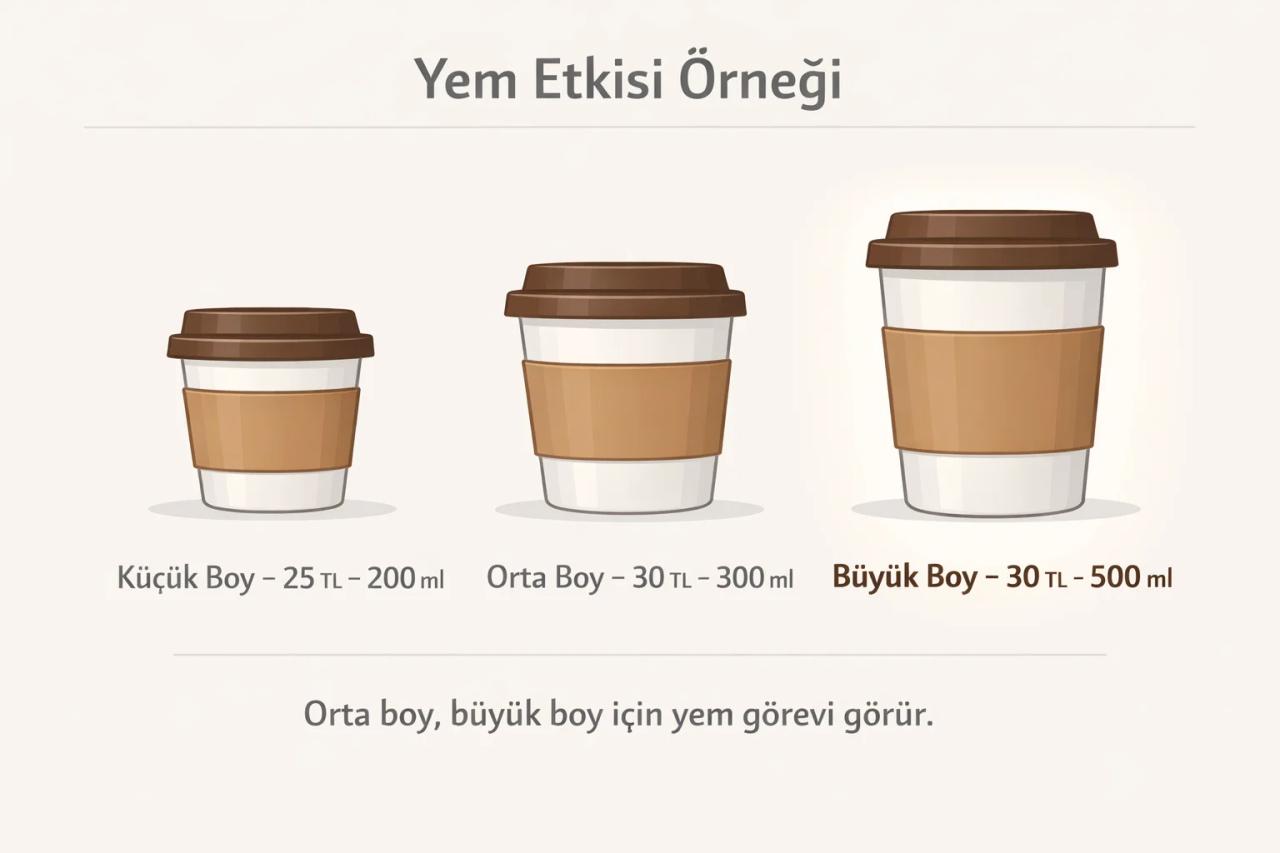
Example of the Decoy Effect (Generated by Artificial Intelligence)
The decoy effect arises when an asymmetrically dominated alternative is added to a choice set. This structure consists of three key elements:
The decoy option is inferior to the target option across all relevant dimensions or at least across critical ones. In contrast, the competitor option may be superior to the target in some dimensions but inferior in others. The presence of the decoy option makes the target option appear relatively more advantageous and preferable.
This phenomenon is linked to individuals making decisions based on comparative frameworks rather than absolute values. Contextual comparisons between options can alter preference distributions.
The decoy effect is one of the context-sensitive decision-making phenomena studied within behavioral economics. Within this framework, it is accepted that individuals:
The decoy effect becomes more pronounced when individuals initially show approximately equal preference between two options. When one option is superior in one dimension and the other in a different dimension, decision-making becomes difficult. At this point, introducing a third option that resembles the target but is clearly inferior can shift preference ratios in favor of the target.
The core mechanism of the decoy effect is based on the principle of asymmetric dominance. According to this principle:
This asymmetry positions the target option in the decision maker’s mind as a more “reasonable” and “rational” choice.
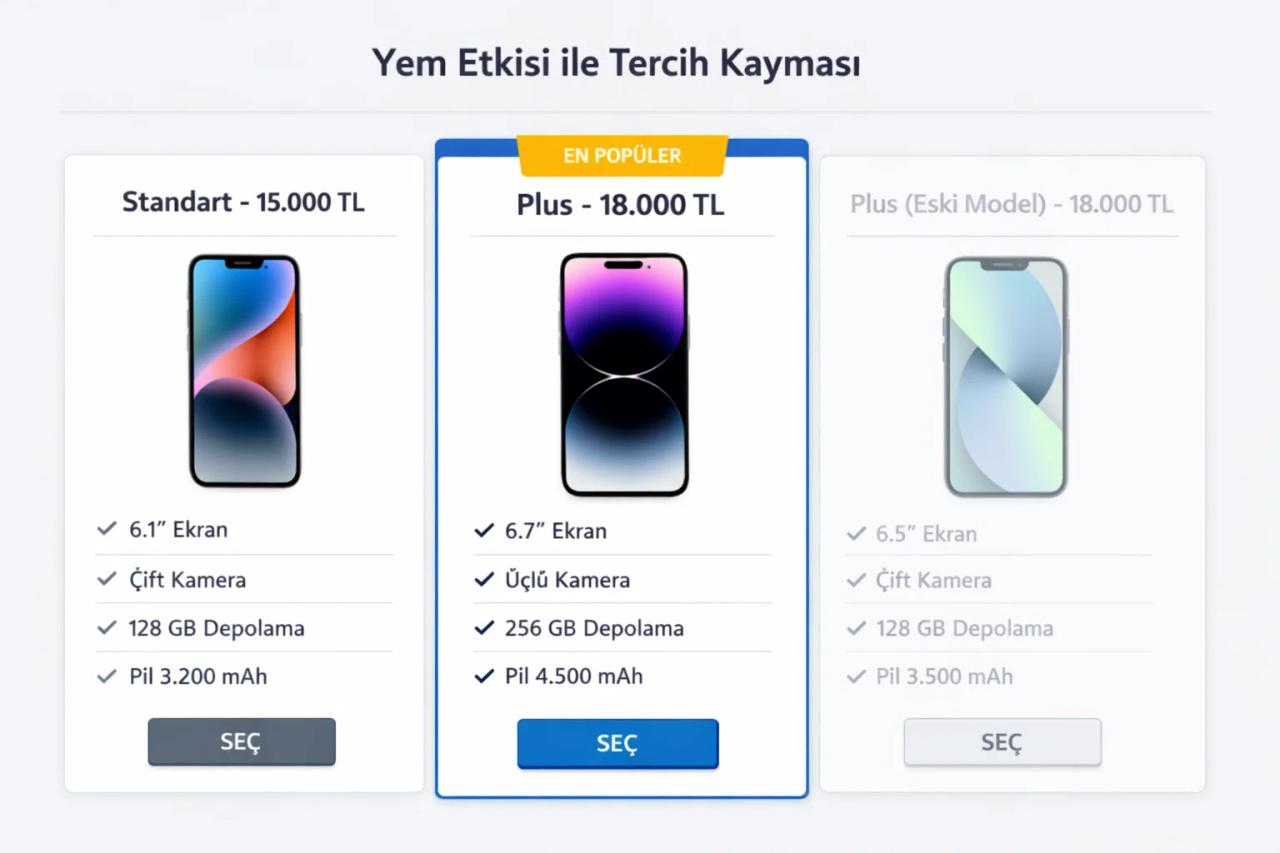
Example of the Decoy Effect (Generated by Artificial Intelligence)
The decoy effect is most commonly explained using two quantitative dimensions. These dimensions may include:
When one of two options is superior in one dimension and the other in a second dimension, preference tends to be evenly distributed. However, adding a decoy option that resembles the target but offers lower value at the same price level clearly elevates the target’s position.
For the decoy option to be effective, it must:
These conditions are necessary.
The decoy effect is context-dependent. When the structure of the choice set changes, preference distributions may also change. This violates the “regularity” principle predicted by classical rational choice theories. According to the regularity principle, adding a new option should not increase the likelihood of preference for existing options; however, the decoy effect explicitly violates this principle.
Example of the Decoy Effect (Generated by Artificial Intelligence)
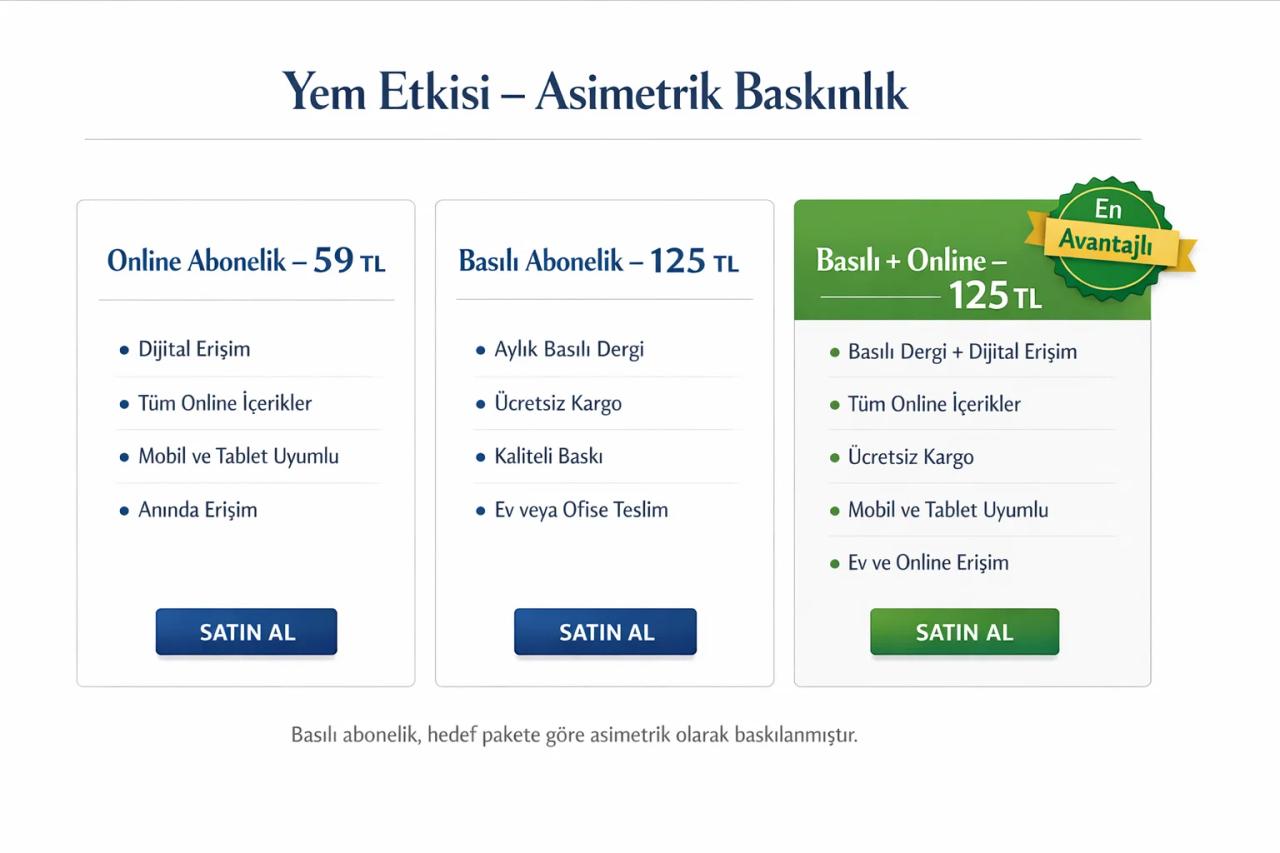
In a practical example of the decoy effect, three subscription options were presented:【1】
The print-only subscription is priced identically to the print + online option but offers less content. Thus, the print-only option functions as a decoy that is asymmetrically dominated by the print + online option.
In the two-option scenario, a significant portion of participants preferred the lower-priced online-only option. However, when the decoy option was added in the three-option scenario, the preference for the more expensive print + online option increased markedly. This shift demonstrates that the decoy option created a perceptual advantage for the target option.
Example of the Decoy Effect (Generated by Artificial Intelligence)
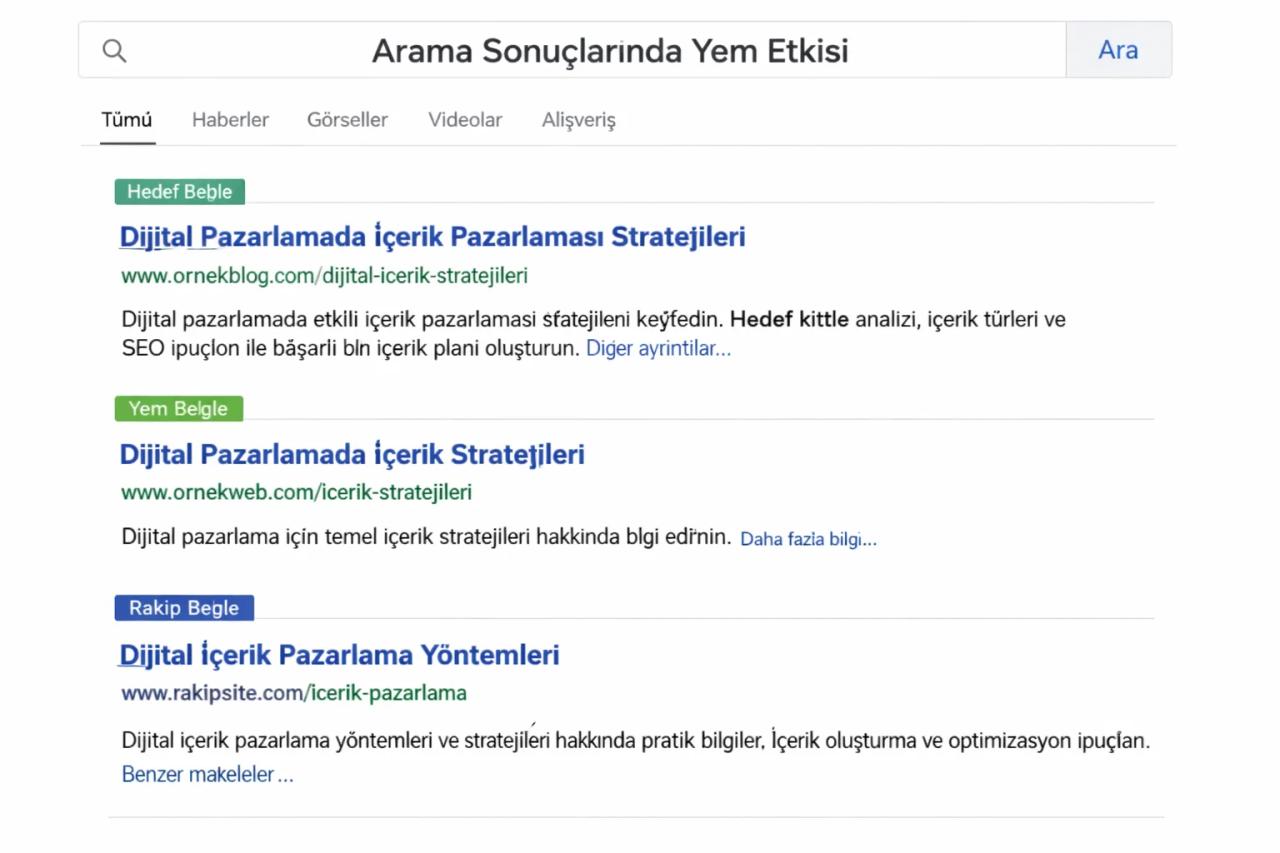
The decoy effect has also been observed not only in consumption decisions but also in information search contexts. When search result pages display:
side by side, users are more likely to click on the target document.
Experimental findings show that documents containing decoys can achieve:
These outcomes suggest that decoys influence user behavior even in information retrieval contexts.
It has also been shown that the decoy effect weakens under certain conditions. Specifically:
Additionally, task difficulty and the user’s prior knowledge about the subject can alter the effect. In more difficult tasks and among users with higher levels of expertise, individuals tend to engage in more analytical evaluations, which can weaken the decoy effect.
Businesses utilize the decoy effect to:
The goal of this strategy is to enhance the perceived value of the target product and alter the consumer’s comparative framework. Triple pricing structures are a common tool for implementing this effect.
In information retrieval systems, the decoy effect has been linked to the presentation format of ranking algorithms. Some studies have shown that search engines, when displaying results in certain orders, can influence user behavior by presenting:
Within this framework, evaluation metrics have been developed to measure the vulnerability of systems to the decoy effect. These metrics assess both the system’s ability to surface highly relevant documents and its potential to generate decoy pairs.
Chen, Nuo, Jiqun Liu, Hanpei Fang, Yuankai Luo, Tetsuya Sakai, and Xiao-Ming Wu. “Decoy Effect in Search Interaction: Understanding User Behavior and Measuring System Vulnerability.” 1, no. 1 (October 2024): 1–54. Accessed March 3, 2026. https://arxiv.org/abs/2403.18462
Chen, Nuo, Jiqun Liu, Tetsuya Sakai, and Xiao-Ming Wu. “Decoy Effect in Search Interaction: A Pilot Study.” *Proceedings of EVIA ’23*, December 12–15, 2023, Tokyo, Japan. Accessed March 3, 2026. https://arxiv.org/abs/2311.02362
Di Crosta, Adolfo, Anna Marin, Rocco Palumbo, Irene Ceccato, Pasquale La Malva, Matteo Gatti, Giulia Prete, Riccardo Palumbo, Nicola Mammarella, and Alberto Di Domenico. “Changing Decisions: The Interaction between Framing and Decoy Effects.” *Behavioral Sciences* 13, no. 9 (2023): 755. Accessed March 3, 2026. https://www.mdpi.com/2076-328X/13/9/755
Jeong, Y., S. Oh, Y. Kang, and S. H. Kim. “Impacts of Visualizations on Decoy Effects.” *International Journal of Environmental Research and Public Health* 18, no. 23 (2021): 12674. Accessed March 3, 2026. https://pmc.ncbi.nlm.nih.gov/articles/PMC8657019/
Sun, Hongyang. “Behavioral Economics: The Decoy Effect.” *Advances in Economics, Management and Political Sciences* 13, no. 1 (September 2023): 46–51. https://doi.org/10.54254/2754-1169/13/20230670. Accessed March 3, 2026. https://www.researchgate.net/publication/373896845_Behavioral_Economics_The_Decoy_Effect
Çınar, Dilaysu. “Promosyonel Ürünlerde Yem Etkisi: Tüketici Karar Alım Tarzları Temelinde Bir Değerlendirme.” *Uluslararası Ekonomi Siyaset İnsan ve Toplum Bilimleri Dergisi* 2, no. 2 (2019): 69–87. Accessed March 3, 2026. https://izlik.org/JA86YG79CB
[1]
Hongyang Sun, “Behavioral Economics: The Decoy Effect,” Advances in Economics, Management and Political Sciences 13, no. 1 (September 2023): 46–51, Accessed 3 March 2026, https://www.researchgate.net/publication/373896845_Behavioral_Economics_The_Decoy_Effect

Food Effect (Generated by Artificial Intelligence.)
Other Name(s) | Asymmetric Dominance Effect Attraction Effect | ||||||||
|---|---|---|---|---|---|---|---|---|---|
Selection Structure | Decoy (asymmetrically dominated alternative) Competitor Target | ||||||||
Basic Mechanism | The change in preference rate in favor of the target option due to the addition of a third option that is similar to the target but of lower quality. | ||||||||
Field | Behavioral Economics, Consumer Behavior, Cognitive Psychology | ||||||||
Concept | Decoy Effect | ||||||||
Conceptual Framework
Theoretical Background
Behavioral Economics and Cognitive Biases
Asymmetric Dominance
Mechanism of Operation
Two-Dimensional Decision Structure
Context Dependence
Experimental Findings and Practical Examples
Subscription Experiment
Online Search Environment
Limitations and Conditions
Application in Marketing and Pricing Strategies
Vulnerability in Information Retrieval Systems