

This article was automatically translated from the original Turkish version.
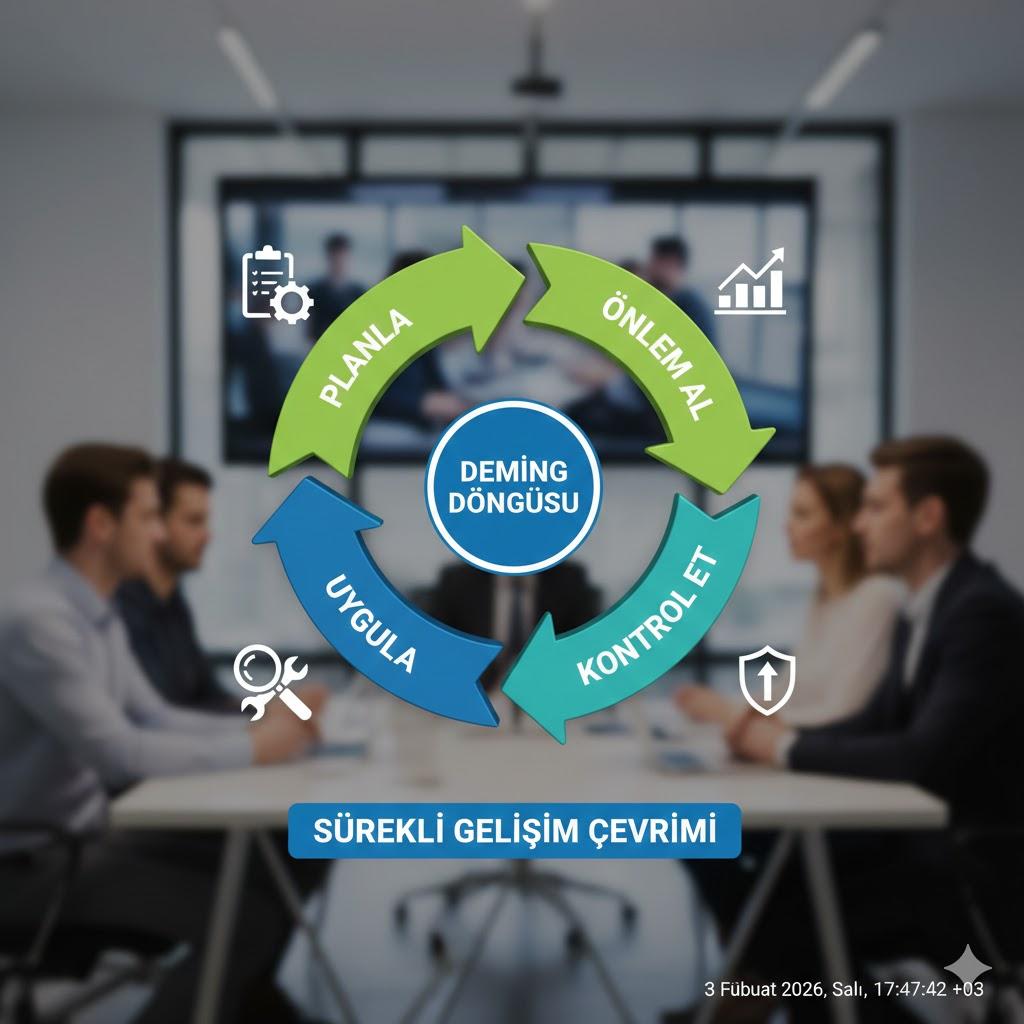
Deming Döngüsü (PUKÖ) (Yapay Zeka ile Oluşturulmuştur)
Deming Cycle (PDCA) is a cyclical management and quality improvement model designed to achieve planned, systematic, and continuous improvement in organizations and processes. The model is known by the acronym PDCA, derived from the initial letters of its four stages—Plan, Do, Check, Act—and is based on the principles of designing, implementing, measuring, and improving processes in alignment with their objectives. The PDCA Cycle is regarded as an advanced application of quality management grounded in statistical process control.
The historical foundations of the PDCA Cycle lie in the statistical quality control studies developed by Walter A. Shewhart in the 1930s. Shewhart’s approach to analyzing process variation was later transformed by William Edwards Deming into a systematic model of learning and improvement. For this reason, the model is also referred to in literature as the Shewhart Cycle, Deming Cycle, or Deming Wheel. Over time, the four core stages became clearly defined, and the Plan-Do-Check-Act (PDCA) framework gained widespread acceptance.

PDCA Cycle (Generated by artificial intelligence)
The Plan stage begins with an analysis of the current situation and identification of areas requiring improvement. In this stage, objectives and goals are defined, performance indicators and criteria are established, and the resources necessary to achieve the goals are planned. Potential risks are also assessed and preventive approaches are developed to address them. Planning is recognized as the foundational stage that determines the effectiveness of subsequent stages.
In the Do stage, the planned activities are implemented and processes are operated according to the defined methods. Responsibilities are assigned, necessary procedures are applied, and data related to the process are systematically collected. Problems encountered during implementation and findings obtained are documented to provide input for the evaluation process.
The Check stage involves analyzing the data obtained from implementation against the planned objectives and established criteria. Evaluations based on performance indicators identify deviations from targets and measure the effectiveness of the process. This stage serves as the essential evaluation phase that ensures decision-making is grounded in objective data.
In the Act stage, necessary corrective and preventive actions are determined based on the results of the Check phase. Successful practices are standardized to ensure continuity, while inadequate or problematic areas are addressed through the development of new measures and the replanning of the process. Thus, the PDCA Cycle acquires a cyclical structure based on continuous learning and improvement.
The PDCA Cycle is recognized as one of the fundamental building blocks of quality assurance systems. In particular, higher education institutions apply the PDCA approach to the planning, implementation, monitoring, and improvement of teaching and learning, research, societal contribution, and administrative service processes. Internal evaluation, external evaluation, and accreditation processes are based on the effective operation of the PDCA Cycle.
The Deming Cycle is not limited to quality management but is also applied in strategic management and performance evaluation approaches. When combined with management tools such as the Balanced Scorecard, it enables institutions to monitor their progress toward strategic objectives and systematically carry out improvement initiatives. In this regard, the PDCA Cycle provides a holistic framework for institutional sustainability and performance management processes.
Arveson, Paul. "The Deming Cycle." Balanced Scorecard Institute. 1998. https://balancedscorecard.org/bsc-basics/articles-videos/the-deming-cycle/
Ayna, Y. Emre. "Kalite Süreçlerinde PUKÖ Döngüsü." Bingöl Üniversitesi. Accessed March 10, 2026. https://kalite.bingol.edu.tr/media/10916/kalite-sureclerinde-puko-dongusu.pdf
KalDer Ankara Branch. "PUKÖ Döngüsü." KalDer Ankara Branch Information Center. Accessed March 10, 2026. https://www.kalderankara.org/bilgi-merkezi/yonetim-ve-kalite-araclari/puko-dongusu-3
The W. Edwards Deming Institute. "PDSA Cycle." The W. Edwards Deming Institute. Accessed March 10, 2026. https://deming.org/explore/pdsa/
Çulhaoğlu, Özer. "Kalite Güvence Sistemi ve PUKÖ Döngüsü." Bartın Üniversitesi Kalite Koordinatörlüğü. Accessed March 10, 2026. https://cdn.bartin.edu.tr/kalite/e43624f4432f9e9d9bbcd8492f1b03ea/kalite-guvence-sistemi-ve-puko-dongusu.pdf

Deming Döngüsü (PUKÖ) (Yapay Zeka ile Oluşturulmuştur)
No Discussion Added Yet
Start discussion for "Deming Cycle (PDCA)" article
Historical Development and Conceptual Framework
Stages of the PDCA Cycle
Plan
Do
Check
Act
PDCA Cycle in Quality Assurance Systems
Role in Institutional Management and Performance Evaluation Approaches