

This article was automatically translated from the original Turkish version.
+1 More
Type of Geographical İndication | Signpost | ||||||||
|---|---|---|---|---|---|---|---|---|---|
Application Date | 04.07.2021 | ||||||||
Registration Number | 1564 | ||||||||
Registration Date | 27.03.2024 | ||||||||
Product / Product Group(s) | Processed and unprocessed fruits vegetables and mushrooms | ||||||||
Province(s) | Manisa | ||||||||
Applicant/Registrant(s) | Demirci Chamber of Agriculture | ||||||||
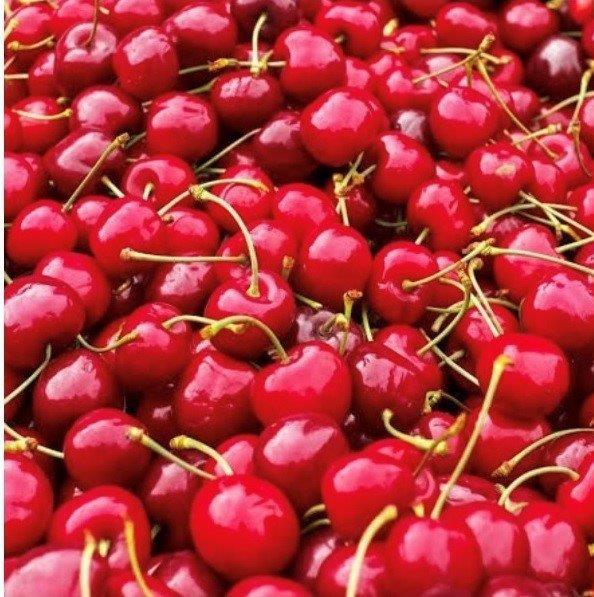
Demirci Cherry is a variety of cherry belonging to the species Prunus avium L., specifically the 0900 Ziraat (Napoléon) cultivar, cultivated in the Demirci district of Manisa Province. Recognized for its long-stemmed, large, dark red to burgundy-colored fruits, this cherry holds a significant place in the district’s agricultural economy and has a strong geographical indication. It was registered as a geographical indication on 27 March 2024 under Law No. 6769 on Industrial Property. The registration was carried out by the Demirci Chamber of Agriculture.
Demirci Cherry exhibits the characteristic traits of the 0900 Ziraat cultivar. The trees grow vigorously, upright or semi-upright, forming a broad canopy. Since the variety is self-sterile, at least three trees of pollinator varieties such as Regina, Lambert, Noble, Summit, Sunburst, Bigarreau Gaucher, Octavia, Metron Late, Cherry, or Starks Gold must be present in the orchard for pollination. Rootstocks used are bird cherry or idris (mahlep). The flower stalk measures 27–32 mm in length, the petal length is 14.7–17.25 mm, the sepal length is 7.2–8.6 mm, the pistil length is 10–14 mm, and the stamen length is 7–11 mm, with 30–40 stamens per flower. Leaf length ranges from 12–13.5 cm, width from 6.2–6.8 cm, and petiole length from 4.2–4.8 cm. Leaf area varies between 58–68 cm².
Demirci Cherry is a heart-shaped or round, large, firm, and juicy fruit. The skin is thin, crisp, smooth, and glossy, with no cracking. Fruit length is 20–22 mm, cheek length is 21.5–23 mm, and belly length is 19–22 mm. Weight ranges from 8.5–11.5 g, with a stone weight of 3.3–3.8 g. The stone is semi-adherent to the flesh. The flesh and juice are pink in color. The skin color ranges from dark red to burgundy. Nutritional content per 100 g includes 75–85 kcal of energy, 14.8–15 g of carbohydrates, 0.8–0.9 g of protein, and 0.2–0.3 g of fat. Soluble dry matter content is 15.5–16.7%, pH value is 4.2–4.3, and titratable acidity is 0.8–1.15.
Demirci Cherry is cultivated in the clay-loam soils of Demirci district in Manisa, on lands with high water retention capacity. The region has a climate in which 40–50% of annual rainfall occurs during winter months, receives 396.75 hours of sunlight in July, and experiences cold conditions from November to April. The chilling requirement of the cherry exceeds 1000 hours below 7.2 °C. These conditions meet the tree’s water needs and typically eliminate the need for irrigation after flowering. For orchard establishment, slopes and hillside areas sheltered from strong winds are preferred; soil depth must be at least 2 m.
Production begins with bird cherry or idris rootstocks. Seedbeds are prepared in loamy-sandy soils during July–September. The soil is tilled to a depth of 50–60 cm, and 4 kg/m² of well-rotted manure is applied. Seeds are sown with row spacing of 30–35 cm and intra-row spacing of 15–20 cm. After germination, weed control and 3–4 irrigations are carried out. In September–October, rootstocks are dug up, classified by diameter (1.5–2 cm) and length, and stored in trenches.
Bud grafting is performed between July and September. Long shoots from the rootstock’s neck and trunk are cut, and a horizontal cut is made at a height of 50–70 cm. A vertical incision 4–5 cm deep is made, into which a 10–15 cm long scion with 3–4 buds is inserted and secured.
The orchard is prepared so that organic matter content exceeds 2.5%. Planting occurs between December and February, with spacing of 6 m between rows and within rows. Saplings must be at least one year old, placed in holes of 50x50 cm, covered with fertilized soil, and watered thoroughly.
Harvest occurs between 15 June and 15 August, when the fruit reaches a flag-red color and the stalk remains dark green. The fruit is detached by bending it at the base of the stalk, avoiding damage to the fruit scar. Harvested cherries are sorted and packed in 6 or 12 kg crates, cooled to 2–4 °C, and stored for up to 10 days at 0 °C with 90–95% relative humidity. Transportation is carried out under the same conditions.
Demirci Cherry has deep roots in the district’s agricultural history and holds significant economic value. All production processes, except for rootstock sourcing, take place within Demirci district. Monitoring is conducted twice annually under the coordination of the Demirci Chamber of Agriculture, with experts from the District Directorate of Agriculture and Forestry and the Chamber of Commerce and Industry. The variety, rootstock suitability, pollinator compatibility, production method, fruit color, and use of the geographical indication are all verified during inspections.
Turkish Patent and Trademark Office. "Demirci Kirazı." Geographical Indications Portal. Accessed August 16, 2025. https://ci.turkpatent.gov.tr/Files/GeographicalSigns/13257569-742a-41b5-8dd9-afc5fddcfb0a.pdf.
Turkish Patent and Trademark Office. "Demirci Kirazı." Geographical Indications Portal. Accessed August 16, 2025. https://ci.turkpatent.gov.tr/cografi-isaretler/detay/4605.

Type of Geographical İndication | Signpost | ||||||||
|---|---|---|---|---|---|---|---|---|---|
Application Date | 04.07.2021 | ||||||||
Registration Number | 1564 | ||||||||
Registration Date | 27.03.2024 | ||||||||
Product / Product Group(s) | Processed and unprocessed fruits vegetables and mushrooms | ||||||||
Province(s) | Manisa | ||||||||
Applicant/Registrant(s) | Demirci Chamber of Agriculture | ||||||||
Botanical Characteristics
Fruit Characteristics
Cultivation Conditions
Production Process
Rootstock Preparation
Grafting
Orchard Establishment and Sapling Planting
Maintenance
Harvest and Storage
Geographical Link and Monitoring