
+2 More

Doğum tarihi | 1940-08-08 | ||||||||
|---|---|---|---|---|---|---|---|---|---|
Place of Birth | Türkiye New York Queens | ||||||||
Subsequent Endeavors | SpaceX Starship circumlunar flight plan Inspiration Mars Foundation | ||||||||
Historical Location | First privately funded spaceflight passenger to reach orbit | ||||||||
Fee Paid | Approximately 20 million dollars | ||||||||
Flight Duration | Approximately 7 days 22 hours | ||||||||
Mission Crewmates | Yuri Baturin Talgat Musabayev | ||||||||
Launch Site | Kazakhstan Baikonur Cosmodrome | ||||||||
Launch Date | 28 April 2001 | ||||||||
Space Mission | Soyuz TM-31 return Soyuz TM-32 | ||||||||
Company Founded | Wilshire Associates | ||||||||
Institution Employed at | NASA Jet Propulsion Laboratory | ||||||||
Specialization Area | Financial modeling Orbital calculations Aerospace and astronautics | ||||||||
Education | Rensselaer Polytechnic Institute New York University College of Engineering | ||||||||
Profession(s) | Entrepreneur Investment advisor Engineer | ||||||||
Destination | International Space Station | ||||||||
Nationality | American | ||||||||
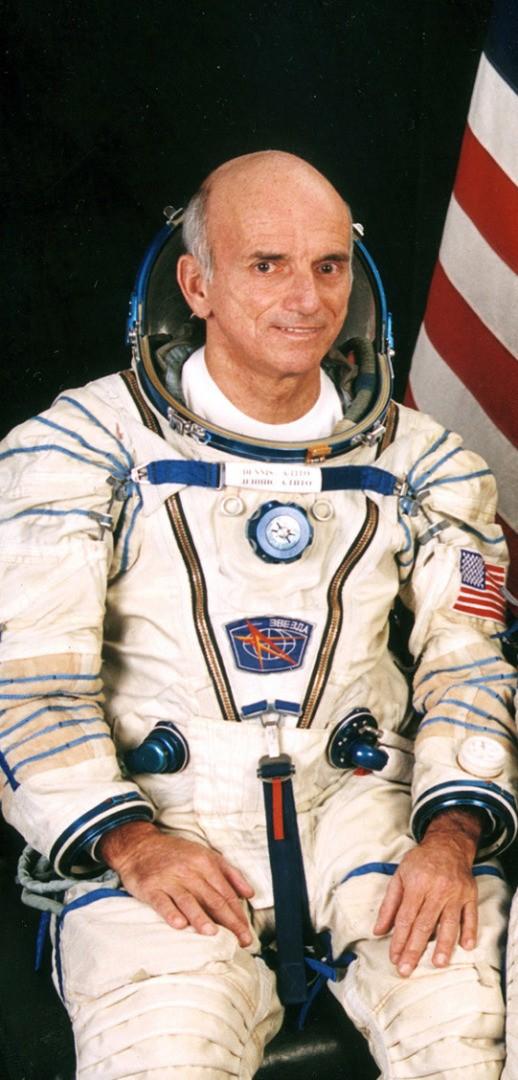
Dennis Anthony Tito, is an American engineer and investment advisor who became the first private space traveler to orbit Earth, funded entirely by his own resources, when he traveled to the International Space Station aboard the Russian Soyuz TM-32 spacecraft in 2001. Tito earned his undergraduate degree in aerospace and astronautics from the New York University College of Engineering and a master’s degree in engineering science from Rensselaer Polytechnic Institute. He began his professional career at age 23 as an aerospace engineer at NASA’s Jet Propulsion Laboratory.
At JPL, he worked on orbital calculations for Mars and Venus missions under the Mariner program. He later transitioned into investment management, founding Wilshire Associates and applying his engineering background in mathematical modeling to financial analysis. The financial resources he gained from his consulting firm enabled him to fund his trip to the ISS, thereby pioneering private space travel.
Dennis Anthony Tito was born on 8 August 1940 in Queens, New York, United States. His childhood and youth coincided with a period after World War II when scientific, engineering, and technological advancement gained increasing prominence in the United States. From the 1950s onward, the space race generated strong public interest. Tito’s fascination with space developed early within this atmosphere. The Soviet Union’s launch of Sputnik 1 in 1957 and the subsequent beginning of human spaceflight transformed space for his generation from a purely scientific domain into a new frontier accessible through engineering.
In his youth, Tito adopted the idea of traveling to space as a personal goal. In an interview shortly before his Soyuz flight, he described this interest as “It’s something I’ve wanted to do since I was a teenager”, emphasizing that abandoning such an early dream was not easy.【1】 This passion shaped his university choices. He pursued his undergraduate studies in aerospace and astronautics at the New York University College of Engineering, followed by a master’s degree in engineering science at Rensselaer Polytechnic Institute. Rensselaer later awarded him an honorary doctorate in engineering.
Moments of Dennis Tito’s Launch to the ISS (Gmednikov)
Tito’s education directed him toward technical fields such as spacecraft motion, orbital calculations, and planetary mission planning. His training in aerospace and astronautics enabled him to view space not as an abstract or imagined realm but as a quantifiable engineering problem. In his own words, designing trajectories required more than mathematical computation—it demanded mental visualization: “When you actually design trajectories, as I did, you have to visualize your spacecraft and visualize the planet that you’re orbiting”.【2】 This way of thinking formed the foundation for the technical roles he would later assume at JPL.
His formative years prepared him for two major life paths. On one hand, his passion for spaceflight was strengthened by his engineering training. On the other, he developed skills in numerical modeling of complex systems, risk assessment, and analysis of large-scale movements. These skills were initially applied to orbital planning for space missions and later transferred to the field of finance, specifically investment advisory and market analysis. Thus, Tito’s early life and education marked the beginning of both his career as a space engineer and his future financial career, which would ultimately fund his own spaceflight.
After completing his university education, Dennis Tito began his professional career at age 23 as an aerospace engineer at NASA’s Jet Propulsion Laboratory in California. JPL was a leading research center known for designing and executing unmanned planetary missions. At JPL, Tito worked on orbital designs for spacecraft destined for Mars and Venus under the Mariner program. This task required precise calculations of velocity, direction, timing, planetary positions, and gravitational influences to ensure spacecraft could reach their targets after leaving Earth.
The Mariner missions held a significant place among the United States’ earliest planetary explorations beyond the Moon. Tito’s work focused on predicting and defining a spacecraft’s trajectory after launch. For targets such as Mars and Venus, orbital planning involved not only the path the spacecraft would follow but also launch windows, flight duration, the planet’s position at the time of encounter, and the angle of approach. This process helped Tito perceive space not as an observational domain but as an environment that could be modeled mathematically and accessed through engineering.

Dennis Tito, Musabayev and Baturin (NASA)
In later interviews, Tito reflected on his JPL role as an extension of his personal passion for space. In a CBS interview, he described his eventual journey to space as the fulfillment of decades of technical work: “So by actually going into space, it’s really just living out what I’d worked on for so many years”.【3】
During his time at JPL, Tito also gained experience in computer programming and mathematical modeling. The computational methods used in interplanetary missions required numerical tracking of complex systems and simultaneous evaluation of multiple variables. This experience directly informed his later quantitative approach to analyzing financial market movements. After approximately five years at JPL, Tito left aerospace engineering to enter investment management, but he did not abandon the technical skills he had acquired.
After transitioning to finance, Tito adapted his engineering approach to modeling and calculation for market analysis. Although calculating rocket trajectories and tracking large-scale financial movements belong to different domains, both required systematic evaluation of numerous variables. Tito’s founding of Wilshire Associates and his adoption of quantitative methods in investment management were a direct continuation of the technical foundation he built at JPL.
After working at the Jet Propulsion Laboratory for approximately five years, Dennis Tito left aerospace engineering to enter the field of investment management. This shift was partly motivated by the limited earning potential of an aerospace engineer’s salary. His transition did not mean abandoning his technical and mathematical mindset. The skills he acquired at JPL—in computer programming, orbital calculation, and modeling complex systems—became the foundation for his analysis of financial markets using numerical methods.
In 1972, Tito founded Wilshire Associates. The company evolved into an institution offering investment management, advisory services, and technology solutions. Wilshire provided mathematical modeling-based investment analysis primarily for institutional investors, pension funds, and high-net-worth individuals. Tito and his team approached asset management not through intuition or traditional market commentary but through numerical formulas, computer-assisted calculations, and risk analysis. By the early 2000s, Wilshire employed about 250 professionals, provided advisory services on approximately one trillion dollars in assets, directly managed about ten billion dollars, and supplied analytical tools to hundreds of institutions.【4】
One of Wilshire Associates’ distinguishing features was its early and intensive use of computers and engineering-based computational methods in investment management. Tito adapted the analytical approach he used to calculate spacecraft trajectories to the analysis of financial market movements. Market risks, asset allocation, and long-term return expectations were evaluated mathematically within this framework. This method proved particularly effective in monitoring large institutional portfolios and calculating future liabilities of pension funds.
Dennis Tito’s Arrival at the ISS (Reuters)
One of Tito’s most notable contributions in finance was the Wilshire Total Market Index, commonly known as the Wilshire 5000, developed in 1974. Designed to comprehensively track the U.S. stock market, it aimed to reflect the entire market—not just selected large companies—and became one of the key indicators for evaluating the overall direction of the U.S. equity market. Tito’s engineering perspective of large-scale systems found its counterpart here in the holistic modeling and monitoring of financial markets.
Wilshire Associates’ work also stood out in developing asset/liability modeling for pension funds. This approach allowed funds to evaluate their future payment obligations alongside current and expected asset returns. The long-term nature of pension funds required accounting not only for short-term market fluctuations but also for multi-year risks, cash flows, and return probabilities. Tito’s engineering-based numerical modeling approach proved valuable in solving such long-term financial problems.
Wilshire Associates formed the foundation of Tito’s wealth. The company’s growth and its position in institutional investment enabled him to finance his 2001 Soyuz TM-32 mission. After entering finance, Tito maintained his interest in space; the economic power he gained through investment management provided the means to realize his lifelong goal of reaching orbit. Thus, his technical career, beginning with engineering education, evolved through financial modeling into investment advisory, and ultimately led to a privately funded human spaceflight.
Dennis Tito’s ambition to travel to space was tied to the role of Russian Soyuz spacecraft in the International Space Station program. In the early years of the ISS, a Soyuz capsule was always docked as an emergency return vehicle. Because its operational lifespan in orbit was limited, it needed periodic replacement. Russia conducted these replacements through short-term “taxi” missions: a new Soyuz would be delivered to the station, and the old one would return to Earth with its crew. The standard Soyuz crew consisted of two mandatory personnel—a commander and a flight engineer—with a third seat available for short-term visitors. Tito’s flight became possible through the commercial use of this third seat.
The Russian side signed a contract with Tito for approximately $20 million. He would occupy the right-hand seat aboard the Soyuz but would not be classified as a professional cosmonaut or researcher. Instead, he would be designated a “spaceflight participant,” meaning he was viewed as a paying private passenger rather than a member of the professional astronaut or cosmonaut corps. Tito’s flight aligned with Russia’s post-Cold War efforts to generate revenue from its space infrastructure. Selling the third Soyuz seat provided direct cash inflow for the Russian space program.
Tito’s flight quickly became a source of institutional tension between NASA and the Russian side. NASA objected to Tito’s journey on grounds of training adequacy, legal liability, and operational safety. The first concern was that Tito had not met the established training and qualification requirements for visitors to the ISS. NASA argued that he needed additional training, particularly regarding systems in the U.S. segment. The second issue involved legal liability. Although agreements among ISS partners governed responsibility and compensation, no clear legal framework existed between RSC Energia, which arranged Tito’s trip, and the United States. The third issue concerned flight timing. At the time Tito wished to fly, the ISS was still undergoing assembly and system installation, and every person aboard was expected to have emergency response capabilities for the ISS, Soyuz, and Space Shuttle systems.

Table of Crew Responsibilities for ISS Missions (NASA)
The tension became visible on 19 March 2001 during training at Johnson Space Center. Talgat Musabayev, Yuri Baturin, Dennis Tito, and the backup crew arrived at JSC for training ahead of the upcoming Soyuz taxi mission. NASA refused to allow Tito to participate until legal and technical issues were resolved. In response, the Russian cosmonauts refused to continue the training without Tito and left the program. The next day, the cosmonauts resumed training at JSC without Tito; however, this incident revealed that Tito’s case was not merely an individual’s desire to fly but a broader issue concerning authority sharing and decision-making within the ISS partnership.
The Russian side refused to back out of its contract. Despite pressure to cancel or delay the flight, the position emerged that the agreement signed with Tito could not be unilaterally voided. During this period, some initiatives from within NASA suggested Tito postpone his spring flight to a later mission. Tito, however, stated he would accept a delay only if his right to fly was guaranteed. The process in Star City became a negotiation: NASA sought to uphold its safety and partnership procedures, while the Russian side defended its authority over its Soyuz flights and its commercial agreement.
Outside of Russia, other ISS partners initially opposed Tito’s flight on 30 April 2001. This opposition was driven by concerns over inadequate training, legal uncertainties, and the operational workload on the station. For NASA, the ISS was not an area where a single partner could make unilateral decisions but an international program governed by multilateral rules and shared safety standards. The Russian side, however, viewed its right to use the third Soyuz seat as part of its program autonomy and financial needs. Thus, Tito’s seat became more than a private passenger ticket—it became a concrete issue for debate over sovereignty, responsibility, safety, and commercialization limits in the early ISS era.
Tito’s flight was eventually permitted under specific conditions. Commitments regarding liability and damage were established, and restrictions were imposed on his movement and safety protocols aboard the ISS. He was required not to enter the U.S. segment unaccompanied, not to interfere with professional crew operations, and to assume financial responsibility for any damage he might cause. These conditions allowed a private individual to visit the ISS while preserving the station’s international partnership framework, safety standards, and the priority of professional crew duties. This 2001 process established the foundational debates for future private spaceflights: the training of paying passengers, their legal liability, their position within the crew, and the commercial use of government-supported space infrastructure.
Dennis Tito launched on 28 April 2001 aboard the Soyuz TM-32 spacecraft, carried into orbit by a Soyuz-U rocket from the Baikonur Cosmodrome in Kazakhstan. The crew consisted of Russian cosmonaut Talgat Musabayev as commander, Yuri Baturin as flight engineer, and Tito as a short-term spaceflight participant. The mission was the first Soyuz taxi flight under the ISS program. Its technical purpose was to deliver a new Soyuz spacecraft to the station and return the aging Soyuz vehicle to Earth. Tito’s presence was made possible by the commercial use of the Soyuz’s third seat.

Dennis Tito and His Crew (Science Museum-NASA)
After a two-day journey, Soyuz TM-32 docked with the International Space Station on 30 April 2001. This arrival occurred approximately one day after the Space Shuttle Endeavour’s STS-100 mission departed the station. The Endeavour crew had delivered the Canadarm2 robotic arm, so Tito’s arrival coincided with Expedition 2’s intensive period of assembly, system installation, and research. Onboard were Russian cosmonaut Yuri Usachev and NASA astronauts James Voss and Susan Helms. After docking, the Soyuz TM-32 crew was welcomed by the Expedition 2 crew in the Zvezda service module.
Tito’s arrival at the station, following months of debate, was closely watched. When the hatch opened, Usachev greeted the new crew; Tito responded with joy, saying “I love space!”.【5】 He said the journey had gone well and that, contrary to expectations, he already felt adapted to the environment. Talgat Musabayev noted that after his arrival, Tito appeared “about ten years younger.”.【6】 Nevertheless, during the initial phase of the journey, Tito experienced brief space adaptation syndrome; he reported that fruit juice and dried fruit had upset him, and he learned to be more cautious afterward.【7】

Soyuz TM-32’s Arrival at the ISS (NASA)
Tito’s movement aboard the ISS was restricted by rules established during pre-flight negotiations. He was not permitted to enter the U.S. segment unaccompanied, was required not to interfere with professional crew operations, and was expected to assume financial responsibility for any damage to station systems. Despite these limitations, he reported that during his first hours aboard, he was given a tour of the U.S. segment and experienced no tension with the crew. In later assessments, he noted that Jim Voss and Susan Helms showed him the station’s modules and assisted him with safety procedures.【8】 Contrary to the debates, Tito maintained that he did not see himself as a burden to the crew. On Larry King Live, he stated: “I had 900 hours of training, I was trained as well as any other cosmonaut. And I was not going to be a burden.”.【9】

Dennis Tito’s Entry into the ISS (NASA)
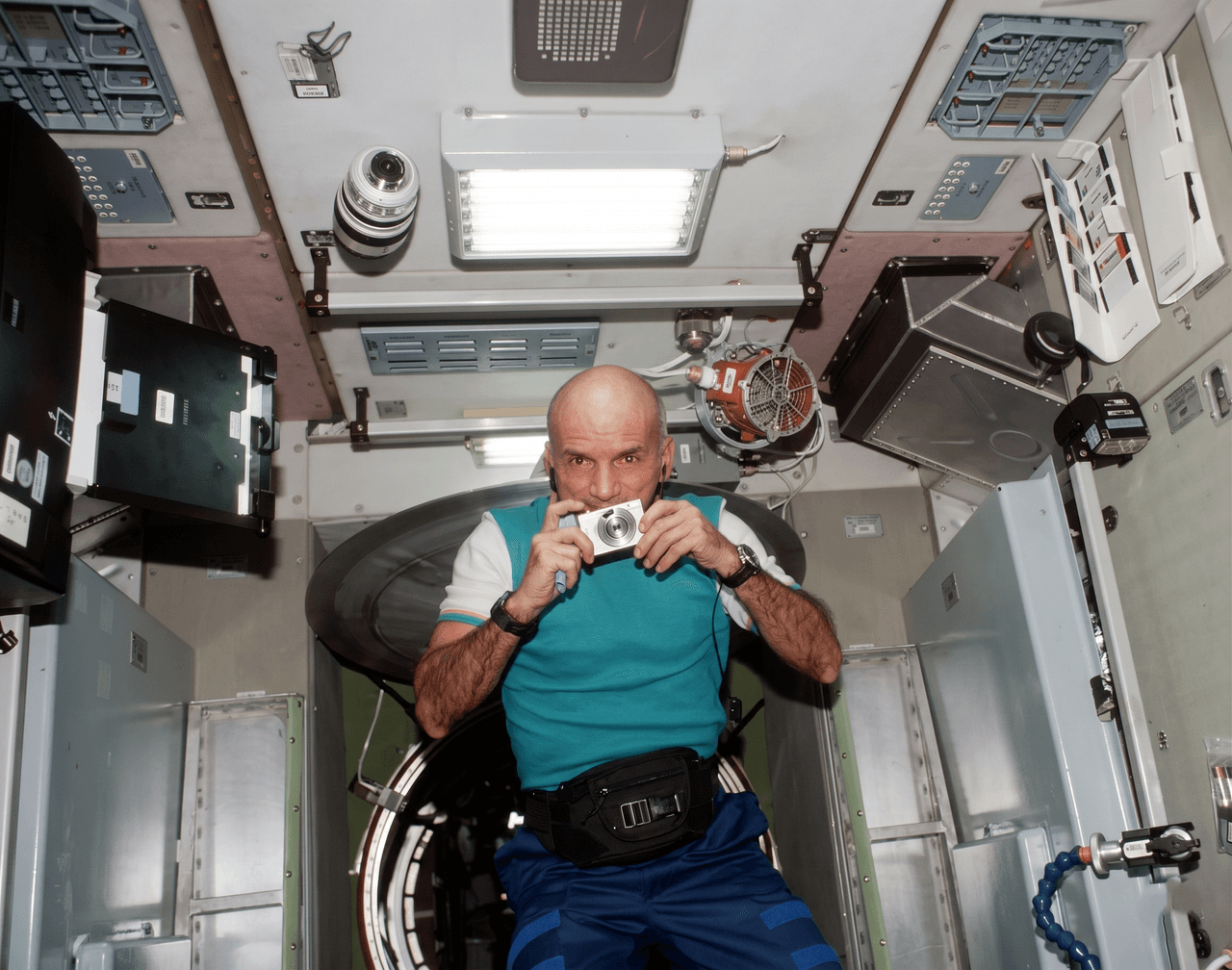
During his stay on the ISS, Tito was not part of the long-duration science crew but rather a short-term visitor. Nevertheless, life science and biotechnology experiments were conducted during his mission, and photographs of selected Earth targets were taken. His presence created one of the first examples of how a private passenger could be integrated into the station’s technical program. While the professional crew continued their work, the Soyuz taxi team remained focused on delivering the new Soyuz spacecraft and completing the short-term visit program.
After his return to Earth, Tito described his space experience primarily through the lens of weightlessness, views of Earth, and daily life aboard the station. Regarding weightlessness, he said learning to move initially required attention but that he did not suffer from severe disorientation or persistent motion sickness. On food, he noted his appetite was low during the first two days but that he later enjoyed Italian meals among the station’s offerings. When asked if he felt fear, he said his heartbeat remained normal during launch and that he did not experience serious fear due to the Soyuz’s escape system.【10】 These statements indicate that while aware of the technical risks, he remembered the experience primarily as a profound personal fulfillment.

Departure of Soyuz TM-31 from the ISS (NASA)
After spending approximately one week aboard the ISS, the Soyuz TM-32 crew transferred to the Soyuz TM-31 spacecraft for return. This vehicle had delivered the Expedition 1 crew to the station in November 2000 and had remained attached as the emergency return capsule for nearly six months. Tito, Musabayev, and Baturin departed the station aboard Soyuz TM-31 on 6 May 2001 and landed in Kazakhstan a few hours later. After landing, Tito and the two cosmonauts underwent medical checks; as part of the traditional Russian reception, apples were offered to them. Tito humorously remarked that he struggled to hold the apple, indicating he was still adjusting to Earth’s gravity.【11】
Immediately after returning to Earth, Tito’s statements revealed that he perceived his flight as an extraordinary personal experience. Speaking to journalists in Kazakhstan, he said: “It was paradise. I just came back from paradise.”.【12】 On Larry King Live, he described his days in space as the most powerful experience of his life, characterizing weightlessness, the view of Earth, and the sense of existence aboard the station as conditions beyond ordinary human experience.【13】 Thus, the Soyuz TM-32 mission was not merely a taxi flight to deliver a new Soyuz spacecraft; it opened a new societal and commercial debate on human spaceflight through the experience of a private individual.
Dennis Tito’s 2001 flight brought the role of private funding in human space activities into public view. Previously, those who traveled to space were largely selected by government space agencies as astronauts, cosmonauts, military pilots, scientists, or experts assigned through international agreements. Tito, however, purchased his Soyuz seat using his personal wealth and traveled to the International Space Station without being a government official. This situation initiated the first open discussion of orbital flight as a transaction based on individual payment, contractual arrangements, private company intermediation, and the commercial use of government space infrastructure. Tito’s approximately $20 million flight was prohibitively expensive for all but a tiny elite, yet it made concrete the question of whether private individuals’ desire to reach space could constitute a real market.
After his flight, Tito gave numerous talks across the United States and other countries. He noted that young audiences, in particular, showed strong interest in the idea of traveling to space, and that people were inspired by the notion that they or their children might one day fly. At a 2003 joint congressional hearing on commercial human spaceflight, he recalled that 40 years earlier, approximately 600,000 people had applied to become astronauts; he argued that the desire to reach space was not limited to a small group of specialists.【14】 Tito’s approach during this period acknowledged that orbital flight remained extremely costly but suggested that shorter, lower-cost suborbital flights could serve as an accessible starting point for a broader public.

The Bread and Salt Tradition Presented Before Tito (NASA)
Tito believed that the cost of orbital flight could not be dramatically reduced in the short term. Instead, he viewed suborbital flights as the initial area for widespread commercial human spaceflight. He drew parallels to the Mercury program, where Alan Shepard and Gus Grissom’s suborbital flights preceded John Glenn’s orbital mission, arguing that commercial suborbital vehicles could offer passengers a few minutes of weightlessness and a view of Earth from approximately 100 kilometers altitude. Such flights would be less complex and expensive than full orbital missions but would partially remove the space experience from the exclusive domain of professional astronauts. Tito regarded private companies beginning to develop reusable suborbital vehicles as a significant step forward.【15】
At the heart of commercial human flight debates was not only technical capacity but also regulatory uncertainty. Tito argued that the private sector could assume responsibility for technical risk, investment risk, and customer demand, but that investment would become difficult if it remained unclear which institution would regulate this new sector with what rules. He expressed this view with the statement: “I am willing to risk my money on a technical concept and a team of engineers. I am willing to risk my money on the customers actually showing up. And I am willing to risk my money competing against other companies in the marketplace. But I am not willing to risk my money on a regulatory question mark.”.【16】 This statement illustrates that Tito viewed commercial spaceflight not merely as a passenger but as an investor.
In 2003 discussions, the division of authority within the Federal Aviation Administration became a critical issue for the future of commercial human spaceflight. Some reusable suborbital vehicles would be winged, capable of taking off and landing on runways, yet also possess characteristics of rocket-powered spacecraft. It remained unclear whether they should be regulated like commercial aircraft or like commercial launch vehicles. Tito argued that applying the stringent certification rules of the commercial aviation industry to the emerging suborbital sector would stifle its development.【17】 The example of Burt Rutan’s SpaceShipOne program was used in these debates to illustrate the tension between private development costs and heavy aviation certification requirements.
Tito’s flight also sparked debate over the boundaries of the concept of “space tourism.” On one hand, the flight was viewed as a luxury and exclusive personal experience, as its cost was accessible only to the very wealthy. On the other hand, it was seen as a sign of a new market, demonstrating that private access to space was technically feasible. After 2001, private citizens such as Mark Shuttleworth, Gregory Olsen, Anousheh Ansari, and Charles Simonyi traveled to the ISS, showing that Tito’s flight was not an isolated exception. Between 2001 and 2009, seven private citizens made eight ISS flights through Space Adventures, demonstrating that Soyuz seats could be used for short-term private missions over a defined period.

Symbol of the First Soyuz Mission (NASA)
Years later, Tito avoided defining himself primarily by the label “first.” In a 20-year retrospective, he said his main reason for being first was likely that he felt he was running out of time at age 60: “The only reason I was the first is probably because I felt I was running out of time at age 60. And I better make it happen, not because, well, I want to be the first.” In the same reflection, he emphasized that his primary goal was simply to experience being in space.【18】 This statement shows that although publicly regarded as a pioneer of space tourism, Tito personally viewed his flight as the fulfillment of a lifelong personal goal.
In the decade following Tito’s flight, NASA’s approach to private human spaceflight also changed. The 2001 tensions were tied to the early assembly phase of the station, safety concerns, and partnership law. Subsequent private visits were conducted under clearer rules; the idea of commercial human flight expanded beyond merely sending short-term private visitors to the station to encompass broader areas such as private vehicle development, launch services, suborbital tourism, commercial crew transport, and orbital economics. In a 2011 interview, Tito expressed positive views on developments in commercial human spaceflight and said NASA’s support for private spaceflight had surpassed his own expectations.【19】
In this process, Tito’s influence emerged not from founding a company or developing a vehicle but from demonstrating that a paying private individual could reach orbit. His flight brought together diverse elements—private capital, personal desire, Russian Soyuz infrastructure, brokerage firms, international station law, and safety rules—within a single event. Thus, the 2001 mission was not merely a journey; it was one of the earliest and most contentious examples of the transition from state-centered spaceflight to commercially inclusive space activities.
After his 2001 ISS flight, Dennis Tito did not prioritize a second space journey as a personal goal for many years. In a 2011 interview, he found the idea of a private mission around the Moon appealing but noted it was not financially accessible. At the time, Space Adventures was offering lunar orbit seats for approximately $120 million. Tito said his 2001 flight had fulfilled his forty-year personal goal and that he preferred to view a new lunar mission as a milestone for others to achieve. He also mentioned that after his flight, he turned to other pursuits such as glider piloting and high-altitude/speed goals.【20】
Nevertheless, Tito returned to the human spaceflight agenda in 2013. In February 2013, he announced his intention to conduct a privately funded human mission to Mars in 2018 and founded the nonprofit Inspiration Mars Foundation. The planned mission was a 501-day journey designed not to land on Mars but to fly by the planet and return to Earth. The mission was scheduled to launch in January 2018, taking advantage of a favorable orbital alignment between Earth and Mars. While Tito had fulfilled a personal goal in 2001, the Inspiration Mars initiative proposed a larger-scale human exploration project combining private funding, technical expertise, and public interest.
Dennis Tito’s Plans for a Mars Journey (The Mars Society)
Inspiration Mars aimed not to land humans on Mars but to send a crew on a long-duration journey away from Earth, passing near Mars and returning. Therefore, the mission did not involve a Mars lander, surface operations, or a long-term Mars base. Instead, it presented major technical challenges: a 501-day closed-loop journey requiring life support systems, radiation protection, food, psychological resilience, crew health, waste management, and emergency planning. The involvement of Taber MacCallum and Jane Poynter from Paragon Space Development Corporation, who specialized in life support systems, highlighted that the mission’s core challenges were closed-loop life support and long-term crew health. The effects of deep space radiation on human health were among the project’s most critical risks.
Inspiration Mars represented a different position from Tito’s 2001 role as a private passenger. In 2001, he participated in an existing ISS taxi mission using Russian Soyuz infrastructure. In 2013, through a private foundation, he proposed a human deep space mission independent of or parallel to government long-term Mars goals. In this sense, the initiative symbolized the idea that commercial spaceflight need not be limited to short-term orbital visits. The project attracted broad public interest but did not materialize in its 2018 form due to technical, financial, and institutional challenges. Thus, Inspiration Mars occupies a place not as a completed mission but as an early and ambitious proposal for extending private human spaceflight to the scale of Mars.
Tito’s connection to private spaceflight reemerged in 2022. On 12 October 2022, SpaceX announced that Dennis Tito and his wife Akiko Tito had purchased seats on the second commercial lunar flyby mission of Starship.【21】 The planned flight aimed to orbit the Moon without landing and return to Earth. According to the announced profile, the journey would last approximately one week, with the spacecraft approaching within about 200 kilometers of the lunar surface and completing a full lunar orbit. This announcement revealed that Tito, after his 2001 flight as the first paying private space traveler, was again part of a private human spaceflight plan in his later years.
Dennis Tito’s Return to Space with SpaceX (CBS Mornings)
Akiko Tito’s inclusion in this announcement also attracted media attention. According to the announcement, this planned journey would make Akiko Tito the first woman to fly around the Moon aboard Starship. However, since the Starship program remains subject to development, testing, and regulatory processes, this flight is not yet a confirmed mission with a fixed date but is evaluated as a proposed private human lunar flyby mission. The 2022 announcement revealed that Tito’s place in private spaceflight history is not limited to his 2001 ISS visit; he is also associated with later initiatives involving deep space, lunar flybys, and commercial human transportation projects.
Dennis Tito’s historical position arises from the convergence of his engineering education, wealth accumulated through investment management, and his pioneering role in private spaceflight. His childhood fascination with space evolved into a technical career at JPL, where he calculated trajectories for Mars and Venus missions. His success in finance enabled his 2001 flight aboard Soyuz TM-32 to the ISS. In subsequent years, Inspiration Mars and the Starship lunar flyby plans extended his relationship with space beyond a single personal journey. The 2001 flight stands as a completed historical event; Inspiration Mars as an unrealized but critical proposal for a Mars mission; and the Starship plan as a future-oriented project tied to private human lunar flybys—each occupying a distinct and critical place in his life.
Associated Press. "Tito Ralphs in Technicolor." *Wired*, May 1, 2001. Accessed April 24, 2026. https://www.wired.com/2001/05/tito-ralphs-in-technicolor/
Biek, Katherine. "2 Decades Later, Dennis Tito Reflects On Historic Spaceflight." *Scripps News*, July 20, 2021. Accessed April 24, 2026. https://www.scrippsnews.com/science-and-tech/space/dennis-tito-reflects-on-historic-spaceflight.
CBS Mornings. "Dennis Tito, First 'Space Tourist,' Teams Up With SpaceX to Return to Space." YouTube. Accessed April 24, 2026. https://www.youtube.com/watch?v=TNT7P_sYmg4
CBS News. "Interview With Dennis Tito." April 27, 2001. Accessed April 24, 2026. https://www.cbsnews.com/news/interview-with-dennis-tito/
Chivukula, Som. "I Just Came Back From Paradise." Rediff.com, May 8, 2001. Accessed April 24, 2026. https://m.rediff.com/news/2001/may/08us1.htm
Cowing, Keith. "NASA Holds Press Conference on the Dennis Tito Issue." *SpaceRef*, March 25, 2001. Accessed April 24, 2026. https://spaceref.com/uncategorized/nasa-holds-press-conference-on-the-dennis-tito-issue/.
Crider, Johnna. "SpaceX Announced Starship 2nd Commercial Spaceflight First Two Crewmembers." *Teslarati*, October 12, 2022. Accessed April 24, 2026. https://www.teslarati.com/spacex-starship-2nd-commercial-spaceflight/
Gmednikov. "Dennis Tito Launches to Space." YouTube. Accessed April 24, 2026. https://www.youtube.com/watch?v=fFBi-VpiO1M.
Ivey, William Noel, and Marieke Lewis. *Astronautics and Aeronautics: A Chronology, 2001–2005*. NASA SP-2010-4031. Washington, DC: NASA History Division, 2010. Accessed April 24, 2026. https://www.nasa.gov/wp-content/uploads/2023/04/sp4031.pdf
Mann, Adam. "Space Tourist to Announce Daring Manned Mars Voyage for 2018." *Wired*, February 20, 2013. Accessed April 24, 2026. https://www.wired.com/2013/02/dennis-tito-mars/.
McArthur, William S., Jr. *NASA Johnson Space Center Oral History Project Edited Oral History Transcript*. Interview conducted by Jennifer Ross-Nazzal. May 23, 2018. Accessed April 24, 2026. https://www.nasa.gov/wp-content/uploads/2025/08/mcarthurws-5-23-18.pdf?emrc=efe741
Perlan Project. "Dennis Tito." Accessed April 24, 2026. https://perlanproject.org/dennis-tito/.
Reuters. "Ground Control to Major Dennis." *Wired*, April 30, 2001. Accessed April 24, 2026. https://www.wired.com/2001/04/ground-control-to-major-dennis/
Reuters. "The World's First Space Tourist." YouTube. Accessed April 24, 2026. https://www.youtube.com/watch?v=JzeYsRt7axc
Space Adventures. "Dennis Tito." Accessed April 24, 2026. https://spaceadventures.com/dennis-tito/
Tcharfas, Julia. "Through the Lens of a Space Tourist." *Science Museum Group Journal*, no. 4 (Fall 2015). Accessed April 24, 2026. https://journal.sciencemuseum.ac.uk/article/space-tourist
The Mars Society. "Dennis Tito - Inspiration Mars - 17th Annual International Mars Society Convention." YouTube. Accessed April 24, 2026. https://www.youtube.com/watch?v=TNT7P_sYmg4.
Tito, Dennis. "Dennis Tito Discusses His Space Odyssey." Interview with Larry King. *Larry King Live*. CNN, May 15, 2001. Accessed April 24, 2026. https://transcripts.cnn.com/show/lkl/date/2001-05-15/segment/00
Tito, Dennis. "Testimony Submitted to the Senate Committee on Commerce, Science & Transportation Subcommittee on Science, Technology, and Space and the House Committee on Science, Subcommittee on Space & Aeronautics Joint Hearing on ‘Commercial Human Spaceflight’." July 24, 2003. Accessed April 24, 2026. https://www.globalsecurity.org/space/library/congress/2003_h/030724-tito.pdf
U.S. Congress. House Committee on Science and Senate Committee on Commerce, Science, and Transportation. *Commercial Human Space Flight: Joint Hearing before the Subcommittee on Space and Aeronautics, Committee on Science, House of Representatives, and the Subcommittee on Science, Technology, and Space, Committee on Commerce, Science, and Transportation, U.S. Senate*. 108th Congress, 1st Session, July 24, 2003. (Serial No. 108–26). Accessed April 24, 2026. https://www.govinfo.gov/content/pkg/CHRG-108jhrg88501/pdf/CHRG-108jhrg88501.pdf
U.S. House of Representatives. "Dennis A. Tito: Biography." Committee on Science, Space, and Technology, November 20, 2013. Accessed April 24, 2026. https://docs.house.gov/meetings/SY/SY16/20131120/101534/HHRG-113-SY16-Bio-TitoD-20131120.pdf
Uri, John. "Space Station 20th – Space Flight Participants." NASA Johnson Space Center, April 30, 2020. Accessed April 24, 2026. https://www.nasa.gov/history/space-station-20th-space-flight-participants/
Uri, John. "Space Station 20th: STS-104 Brings Quest Joint Airlock to the Space Station." *NASA Johnson Space Center*, July 14, 2021. Accessed April 24, 2026. https://www.nasa.gov/history/space-station-20th-sts-104-brings-quest-joint-airlock-to-the-space-station/
Wall, Mike. "First Space Tourist: How a U.S. Millionaire Bought a Ticket to Orbit." Space.com, April 27, 2011. Accessed April 24, 2026. https://www.space.com/11492-space-tourism-pioneer-dennis-tito.html
Wall, Mike. "Space Tourism Pioneer: Q & A With Private Spaceflyer Dennis Tito." Space.com, April 27, 2011. Accessed April 24, 2026. https://www.space.com/11493-space-tourist-flight-dennis-tito-qanda.html
[1]
"Interview With Dennis Tito," CBS News, 27 April 2001, access date: 24 April 2026, https://www.cbsnews.com/news/interview-with-dennis-tito/.
[2]
"Interview With Dennis Tito," CBS News, 27 April 2001, access date: 24 April 2026, https://www.cbsnews.com/news/interview-with-dennis-tito/.
[3]
"Interview With Dennis Tito," CBS News, 27 April 2001, access date: 24 April 2026, https://www.cbsnews.com/news/interview-with-dennis-tito/.
[4]
Dennis Tito, "Testimony Submitted to the Senate Committee on Commerce, Science & Transportation Subcommittee on Science, Technology, and Space and the House Committee on Science, Subcommittee on Space & Aeronautics Joint Hearing on ‘Commercial Human Spaceflight’" (24 July 2003), p. 4. Access date: 24 April 2026, https://www.globalsecurity.org/space/library/congress/2003_h/030724-tito.pdf.
[5]
"Ground Control to Major Dennis," Wired, 30 April 2001, access date: 24 April 2026, https://www.wired.com/2001/04/ground-control-to-major-dennis/.
[6]
"Ground Control to Major Dennis," Wired, 30 April 2001, access date: 24 April 2026, https://www.wired.com/2001/04/ground-control-to-major-dennis/.
[7]
"Tito Ralphs in Technicolor," Wired, 1 May 2001, access date: 24 April 2026, https://www.wired.com/2001/05/tito-ralphs-in-technicolor/.
[8]
"Tito Ralphs in Technicolor," Wired, 1 May 2001, access date: 24 April 2026, https://www.wired.com/2001/05/tito-ralphs-in-technicolor/.
[9]
Dennis Tito, "Dennis Tito Discusses His Space Odyssey," interview with Larry King,Larry King Live, CNN, 15 May 2001, access date: 24 April 2026, https://transcripts.cnn.com/show/lkl/date/2001-05-15/segment/00.
[10]
Dennis Tito, "Dennis Tito Discusses His Space Odyssey," interview with Larry King,Larry King Live, CNN, 15 May 2001, access date: 24 April 2026, https://transcripts.cnn.com/show/lkl/date/2001-05-15/segment/00.
[11]
Som Chivukula, "I Just Came Back From Paradise," Rediff.com, 8 May 2001, access date: 24 April 2026, https://m.rediff.com/news/2001/may/08us1.htm.
[12]
Som Chivukula, "I Just Came Back From Paradise," Rediff.com, 8 May 2001, access date: 24 April 2026, https://m.rediff.com/news/2001/may/08us1.htm.
[13]
Dennis Tito, "Dennis Tito Discusses His Space Odyssey," interview with Larry King,Larry King Live, CNN, 15 May 2001, access date: 24 April 2026, https://transcripts.cnn.com/show/lkl/date/2001-05-15/segment/00.
[14]
U.S. Congress, House Committee on Science and Senate Committee on Commerce, Science, and Transportation, Commercial Human Space Flight: Joint Hearing before the Subcommittee on Space and Aeronautics, Committee on Science, House of Representatives, and the Subcommittee on Science, Technology, and Space, Committee on Commerce, Science, and Transportation, U.S. Senate, 108th Congress, 1st Session, 24 July 2003, (Serial No. 108–26), access date: 24 April 2026, pp. 18–19. https://www.govinfo.gov/content/pkg/CHRG-108jhrg88501/pdf/CHRG-108jhrg88501.pdf.
[15]
Dennis Tito, "Testimony Submitted to the Senate Committee on Commerce, Science & Transportation Subcommittee on Science, Technology, and Space and the House Committee on Science, Subcommittee on Space & Aeronautics Joint Hearing on ‘Commercial Human Spaceflight’" (24 July 2003), access date: 24 April 2026, p. 2. https://www.globalsecurity.org/space/library/congress/2003_h/030724-tito.pdf.
[16]
U.S. Congress, House Committee on Science and Senate Committee on Commerce, Science, and Transportation, Commercial Human Space Flight: Joint Hearing before the Subcommittee on Space and Aeronautics, Committee on Science, House of Representatives, and the Subcommittee on Science, Technology, and Space, Committee on Commerce, Science, and Transportation, U.S. Senate, 108th Congress, 1st Session, 24 July 2003, (Serial No. 108–26), access date: 24 April 2026, p. 20. https://www.govinfo.gov/content/pkg/CHRG-108jhrg88501/pdf/CHRG-108jhrg88501.pdf.
[17]
Dennis Tito, "Testimony Submitted to the Senate Committee on Commerce, Science & Transportation Subcommittee on Science, Technology, and Space and the House Committee on Science, Subcommittee on Space & Aeronautics Joint Hearing on ‘Commercial Human Spaceflight’" (24 July 2003), access date: 24 April 2026, p. 3. https://www.globalsecurity.org/space/library/congress/2003_h/030724-tito.pdf.
[18]
Katherine Biek, "2 Decades Later, Dennis Tito Reflects On Historic Spaceflight," Scripps News, 20 July 2021, access date: 24 April 2026, https://www.scrippsnews.com/science-and-tech/space/dennis-tito-reflects-on-historic-spaceflight.
[19]
Mike Wall, "Space Tourism Pioneer: Q & A With Private Spaceflyer Dennis Tito," Space.com, 27 April 2011, access date: 24 April 2026, https://www.space.com/11493-space-tourist-flight-dennis-tito-qanda.html.
[20]
Mike Wall, "Space Tourism Pioneer: Q & A With Private Spaceflyer Dennis Tito," Space.com, 27 April 2011, access date: 24 April 2026, https://www.space.com/11493-space-tourist-flight-dennis-tito-qanda.html.
[21]
Johnna Crider, "SpaceX Announced Starship 2nd Commercial Spaceflight First Two Crewmembers," Teslarati, 12 October 2022, access date: 24 April 2026, https://www.teslarati.com/spacex-starship-2nd-commercial-spaceflight/.

Doğum tarihi | 1940-08-08 | ||||||||
|---|---|---|---|---|---|---|---|---|---|
Place of Birth | Türkiye New York Queens | ||||||||
Subsequent Endeavors | SpaceX Starship circumlunar flight plan Inspiration Mars Foundation | ||||||||
Historical Location | First privately funded spaceflight passenger to reach orbit | ||||||||
Fee Paid | Approximately 20 million dollars | ||||||||
Flight Duration | Approximately 7 days 22 hours | ||||||||
Mission Crewmates | Yuri Baturin Talgat Musabayev | ||||||||
Launch Site | Kazakhstan Baikonur Cosmodrome | ||||||||
Launch Date | 28 April 2001 | ||||||||
Space Mission | Soyuz TM-31 return Soyuz TM-32 | ||||||||
Company Founded | Wilshire Associates | ||||||||
Institution Employed at | NASA Jet Propulsion Laboratory | ||||||||
Specialization Area | Financial modeling Orbital calculations Aerospace and astronautics | ||||||||
Education | Rensselaer Polytechnic Institute New York University College of Engineering | ||||||||
Profession(s) | Entrepreneur Investment advisor Engineer | ||||||||
Destination | International Space Station | ||||||||
Nationality | American | ||||||||
No Discussion Added Yet
Start discussion for "Dennis Anthony Tito" article
Early Life and Education
Jet Propulsion Laboratory Years and Engineering Expertise
Wilshire Associates, Financial Engineering, and Wealth Accumulation
The Fight for a Soyuz Seat: NASA, Russia, and ISS Partnership
Soyuz TM-32 Mission and Days on the International Space Station
Space Tourism Debates and Impact on Commercial Human Spaceflight
Inspiration Mars, Starship Plans, and Historical Position