


This article was automatically translated from the original Turkish version.
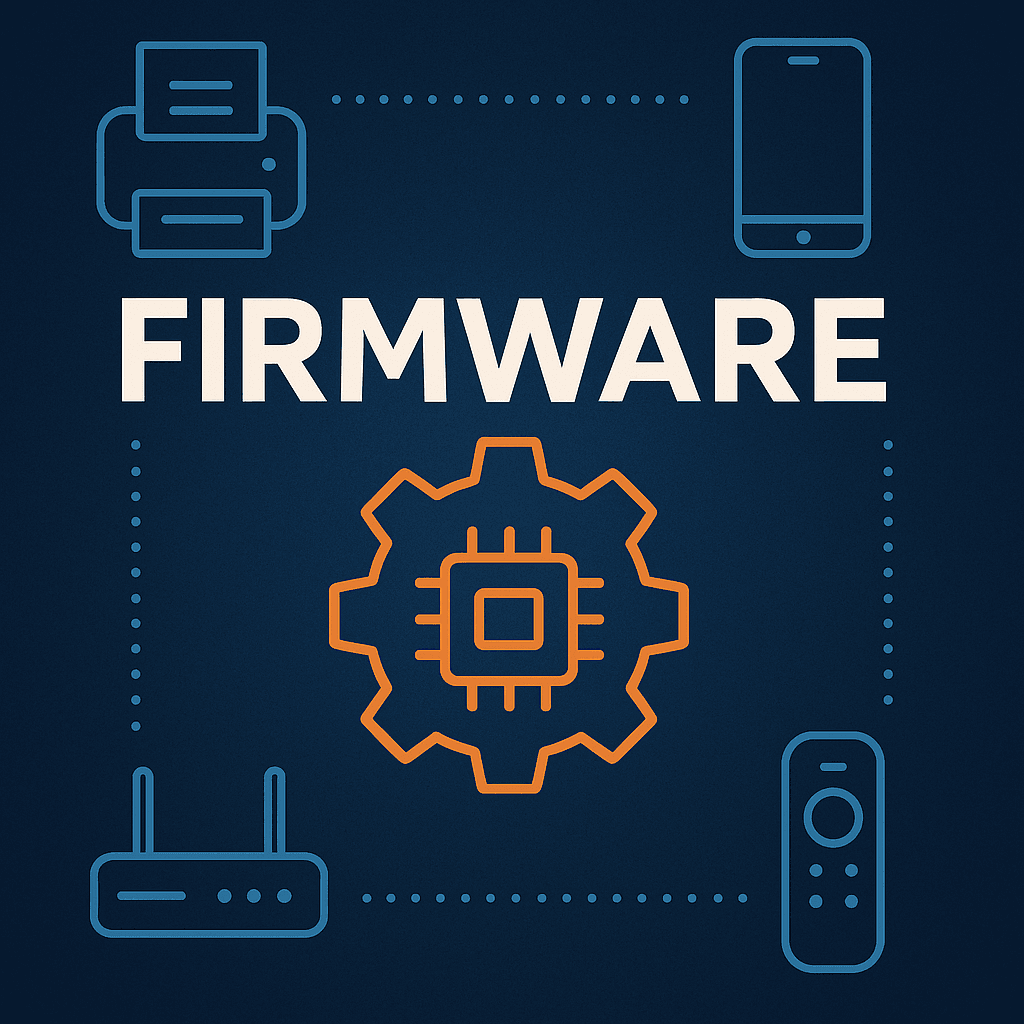
Device Software - Firmware (Generated with Artificial Intelligence.)
First User | Proposed by Ascher Opler in 1967 | ||||||||
|---|---|---|---|---|---|---|---|---|---|
Varieties | Custom Firmware Subsystem Firmware High Level Firmware Medium Level Firmware Low Level Firmware | ||||||||
Application Area(s) | Computer Defense Automotive IoT | ||||||||
Device firmware is an embedded software layer that manages the fundamental functions of hardware devices and operates directly on the hardware. It is typically stored in persistent memory such as ROM, EEPROM, or flash memory and serves as the lowest-level software required for device operation. During the hardware boot process, firmware activates to manage input/output operations and enables higher-level software to function.
Device firmware (Mikhail Nilov - Pexels)
The term "firmware" was first introduced by Ascher Opler in 1967. Opler used this term to describe an intermediate layer between hardware and software. The earliest applications involved loading microcode into computer processors via writable control memory. This approach enabled hardware to perform different functions and become more flexible.
Firmware operates independently of the device’s operating system or other software. It primarily manages boot processes, input/output systems, and the core functions of the hardware. In modern devices, firmware is updatable, allowing updates to provide bug fixes, security enhancements, and the addition of new features.
Firmware is examined at various levels. Low-level firmware is stored in permanent memory and cannot be modified. Mid-level firmware offers an updatable structure and establishes the connection between hardware and software. High-level firmware includes software features that enhance device functionality. Additionally, subsystem firmware manages components within the device such as the processor, graphics card, hard drive, and network card. There are also proprietary or open-source firmware types, developed by communities or independent developers, which provide greater control and customization as alternatives to standard manufacturer software.
Firmware updates are critical for improving device performance, adding new features, and closing security vulnerabilities. In particular, updates for IoT devices should be performed remotely via the OTA (Over-the-Air) method, as these devices often operate on open networks and are vulnerable to attacks.
An incorrect or incomplete firmware update can render a device inoperable (a condition known as "bricking"). Therefore, firmware updates must be carried out with care.
Firmware types can also be classified based on usage and access rights. Proprietary firmware is provided by manufacturers and is generally not modifiable by users. Such software may carry security risks, as faulty or malicious code can negatively affect the entire device’s operation. In contrast, open-source firmware is developed by developer communities or independent firms. It features a more transparent structure and offers users greater control. Examples include OpenWrt used in routers and LineageOS found on mobile devices.
Firmware is used in computers, smartphones, routers, printers, televisions, storage units, network hardware, and industrial machines. Modern examples include the operating software of smart televisions, UEFI-based systems, and software that manages read-write algorithms in SSDs.
IBM. "Firmware." ibm.com. Accessed August 5, 2025. https://www.ibm.com/think/topics/firmware
IEEE. "IEEE Standard Glossary of Software Engineering Terminology." IEEE Std 610.12-1990. PDF version. Accessed September 27, 2025. https://www.informatik.htw-dresden.de/~hauptman/SEI/IEEE_Standard_Glossary_of_Software_Engineering_Terminology%20.pdf
IEEE. IEEE Standard Glossary of Software Engineering Terminology, IEEE Std 610.12-1990.
Opler, Ascher. Fourth Generation Software. Datamation, 1967.
Pexels. "Kodlama Ekranı (Coding Script) JPG." Pexels. Accessed August 23, 2025. https://www.pexels.com/photo/coding-script-965345/
Pexels. "Mavi Bisiklet Yaka Tişört Giyen ve Siyah Çerçeveli Gözlük Takmış Adam JPG." Pexels. Accessed August 23, 2025. https://www.pexels.com/photo/man-in-blue-crew-neck-shirt-wearing-black-framed-eyeglasses-6963098/
Stallings, William. Computer Organization and Architecture: Designing for Performance. 10th ed. Boston: Pearson, 2016.

Device Software - Firmware (Generated with Artificial Intelligence.)
First User | Proposed by Ascher Opler in 1967 | ||||||||
|---|---|---|---|---|---|---|---|---|---|
Varieties | Custom Firmware Subsystem Firmware High Level Firmware Medium Level Firmware Low Level Firmware | ||||||||
Application Area(s) | Computer Defense Automotive IoT | ||||||||
History
Structure and Characteristics
Types and Examples
Updates and Security
Special Cases: Closed and Open Firmware
Applications