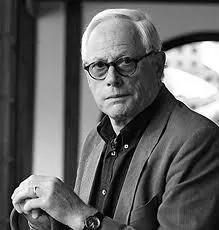



Doğum tarihi | 1932-05-20 | ||||||||
|---|---|---|---|---|---|---|---|---|---|
Eş | Ingeborg Rams | ||||||||
Nation | Germany | ||||||||
Profession(s) | Industrial Designer Academic | ||||||||
Education | Wiesbaden School of Art (Architecture Interior Architecture) | ||||||||
Recognized Institutions | Braun, Vitsœ | ||||||||
Important Philosophy | Weniger aber besser, (Less but better) | ||||||||
Dieter Rams (20 May 1932, Wiesbaden, Germany) is a German industrial designer and academic. He is best known for his work with the consumer products company Braun and the furniture company Vitsœ. Recognized as one of the most important representatives of functionalist design, Rams left a profound mark on the design world through his philosophy of “Weniger, aber besser” (Less but better) and his “Ten Principles for Good Design.” His designs stand out for their simplicity, usability and aesthetic unity, and continue to serve as a source of inspiration for many designers today.
Dieter Rams was born on 20 May 1932 in Wiesbaden, Germany. His grandfather’s profession as a carpenter introduced him at an early age to the relationship between materials and form. Growing up in post-World War II Germany, where resources were scarce, he experienced firsthand the need for practical and durable solutions. These experiences laid the foundation for his later design philosophy.
From 1947 to 1953, Rams studied architecture and interior architecture at the Wiesbaden School of Art (Werkkunstschule Wiesbaden). He also received practical training in carpentry, which enhanced his understanding of materials and craftsmanship. This multidisciplinary education enabled him to approach design with a holistic perspective. After graduation, he worked from 1953 to 1955 in the office of architect Otto Apel in Frankfurt.
In 1955, Dieter Rams joined the German consumer products company Braun as an architect and interior designer. He soon developed an interest in product design and rapidly rose through the ranks. In 1961, he became Head of Braun’s Design Department, a position he held until 1995. During this time, he designed hundreds of iconic products for Braun, including radios, calculators and kitchen appliances.
Parallel to his work at Braun, Rams began designing for the furniture company Vitsœ, founded in 1959 by Niels Vitsœ and Otto Zapf (later known simply as Vitsœ). Furniture pieces he designed for Vitsœ, such as the 606 Universal Shelving System and the 620 Chair Programme, became classics due to their modularity and timeless design.
In 1981, Rams also served as a professor of industrial design at the Hamburg University of Fine Arts (Hochschule für bildende Künste Hamburg), where he passed on his knowledge to younger generations.
Throughout his career, Dieter Rams received numerous national and international design awards. His designs are part of the permanent collections of leading museums worldwide, including the Museum of Modern Art (MoMA) in New York and the Vitra Design Museum in Germany. Perhaps his greatest achievement, however, is the universal acceptance of his “Ten Principles for Good Design,” formulated in the late 1970s, which now serve as a guiding framework for designers today. These principles encapsulate the essence of his design philosophy.
Dieter Rams’s most significant contribution to the world of design was popularizing a minimalist and functionalist approach summarized by the slogan “Weniger, aber besser” (Less but better). According to him, good design:
These principles offer a timeless framework for how sustainable, user-centered and aesthetically satisfying products should be. Rams avoided unnecessary ornamentation in his designs, focusing instead on the core function of the product and emphasizing simplicity and clarity.
Although Dieter Rams retired from active duty at Braun in 1997, his influence on the design world continues. Through the Rams Foundation, which he established, he continues to transmit his design philosophy and legacy to future generations. He occasionally participates in conferences and inspires young designers. He continues to emphasize that design is not merely an aesthetic concern but also an ethical responsibility.
Dieter Rams’s design philosophy and iconic products will continue to influence designers, manufacturers and consumers for many years after his passing. The “Ten Principles for Good Design” will remain one of the foundational texts in design education, and as new technologies emerge, these principles will continue to be interpreted and applied. The timelessness of his designs demonstrates that they will remain on display in museums and sought after by collectors well into the future.
Dieter Rams has been a major source of inspiration for countless contemporary designers, most notably Jony Ive, former Chief Design Officer at Apple. The minimalist aesthetics and user-friendly interfaces of Apple products clearly reflect Rams’s influence. Leading industrial designers such as Jasper Morrison and Naoto Fukasawa have also acknowledged their debt to Rams’s work. His “Less but better” approach has gained renewed relevance today as a counterpoint to consumerism and unnecessary complexity. In an era where sustainability and mindful consumption are increasingly valued, Rams’s principles are more relevant than ever.
Akgün, Banu. *Dieter Rams’ın Tasarım Anlayışı.* Art-Sanat Dergisi 8 (2017): 655-662. https://dergipark.org.tr/en/download/article-file/783356
Kim, Myung-Ae, and Kun-Pyo Lee. *A Study on the Design Characteristics of Dieter Rams and their Influence on Apple’s Product Design.* Archives of Design Research 30, no. 4 (2017): 23-39. https://koreascience.kr/article/JAKO201758054547209.pdf
Rams Foundation. Homepage. Rams Foundation. Accessed May 25, 2025. https://rams-foundation.org/homepage/
Rams, Dieter. *10 Principles for Good Design*. If Design. Accessed May 25, 2025. https://ifdesign.com/en/if-magazine/dieter-rams-10-principles-for-good-design
The Museum of Modern Art. *Dieter Rams.* Moma Artist Blog. Accessed May 25, 2025. https://www.moma.org/artists/8451-dieter-rams
Vitsoe. *Dieter Rams.* Vitsoe Blog. Accessed May 25, 2025. Erişim Linki: https://www.vitsoe.com/rw/about/dieter-rams#ramss-philosophy

Doğum tarihi | 1932-05-20 | ||||||||
|---|---|---|---|---|---|---|---|---|---|
Eş | Ingeborg Rams | ||||||||
Nation | Germany | ||||||||
Profession(s) | Industrial Designer Academic | ||||||||
Education | Wiesbaden School of Art (Architecture Interior Architecture) | ||||||||
Recognized Institutions | Braun, Vitsœ | ||||||||
Important Philosophy | Weniger aber besser, (Less but better) | ||||||||
Early Life and Education
Childhood and Youth
Educational Background
Career and Achievements
Professional Journey
Key Achievements
Key Works and Contributions
Contributions
Works and Projects
Post-Retirement
Legacy
Source of Inspiration