

This article was automatically translated from the original Turkish version.
Digital folklore encompasses all types of verbal, written, visual, and auditory anonymous or hybrid cultural products and practices produced, shared, transformed, and redistributed by individuals and virtual communities through digital communication technologies, social media platforms, internet forums, and network-based venues.

Kahve Ritüellerinin Dijital Alana Taşınmasına Örnek (Yapay Zekâ ile Oluşturulmuştur)
Traditionally, folklore is defined as a dynamic cultural heritage transmitted from generation to generation through oral, written, and visual narratives via face-to-face interactions, sustaining collective memory; however, digitalization processes have fundamentally altered these transmission practices and the structure of folkloric production.
Digital folklore possesses a fluid and dynamic structure, continuously regenerated through the speed, interactivity, flexibility, and multimedia capabilities (text, sound, image, video) offered by the digital environment, acquiring new layers of meaning across diverse cultural and geographical contexts.
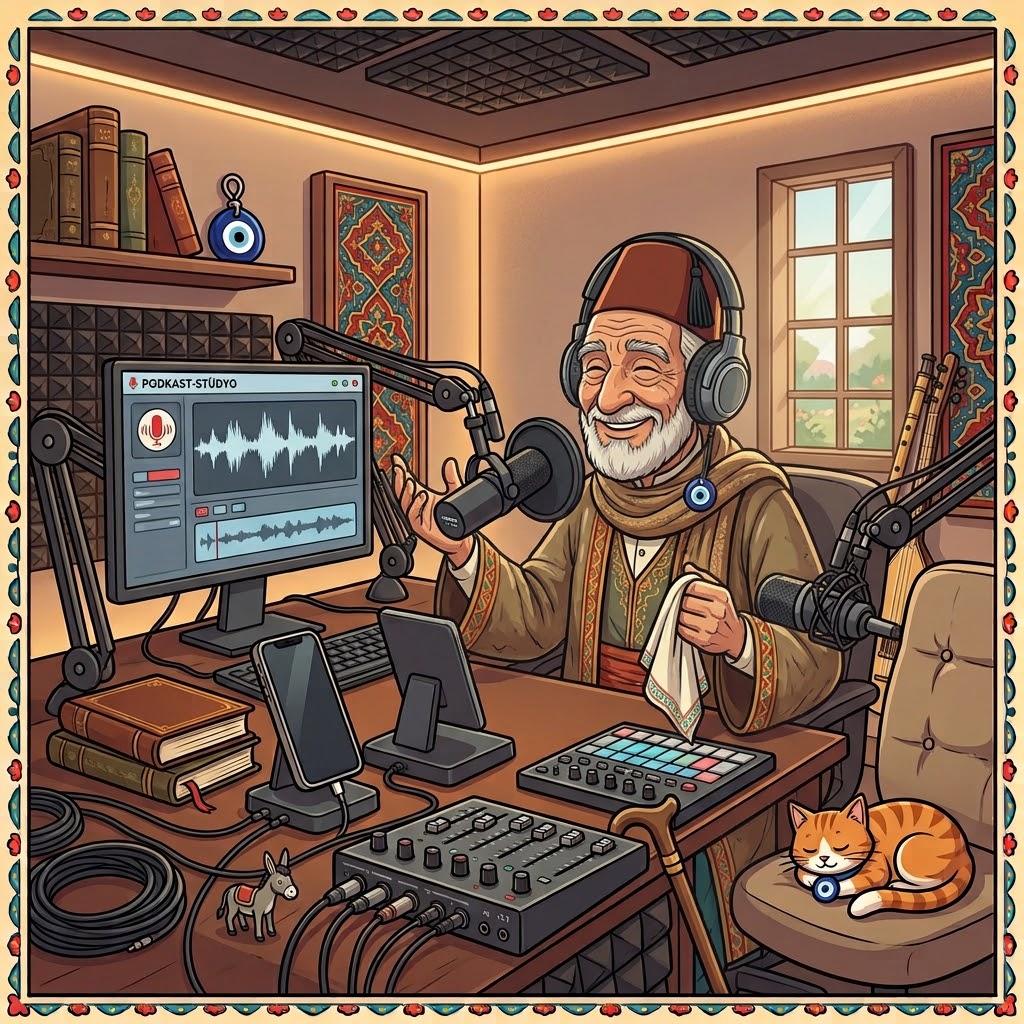
Podcast Yayını Yapan Bir Meddah ( Yapay Zekâ ile Oluşturulmuştur)
Within the framework of Walter J. Ong’s historical classification of communication technologies, digital folklore is an original form of the secondary oral culture era.【2】 In this period, which follows the “primary oral culture” where communication occurred solely through linguistic practices and the “written culture” that emerged with the printing press, text, sound, image, and moving visuals are interwoven. In oral culture societies, products were predominantly produced and disseminated through face-to-face interactions within limited physical spaces; in the secondary oral culture era, communities within digital networks rapidly produce, mutate, and disseminate content globally within seconds through virtual networks.
Although literature has proposed various conceptualizations for this new field and its produced materials—such as computer-mediated folklore, computer folklore, e-folklore, e-lore, electronic folklore, virtual folklore, online folklore, and online folk art—the most comprehensive and holistic concept encompassing all written, verbal, and visual cultural products generated, circulated, parodied, and altered within digital networks is netlore.
One of the most distinctive features of digital folklore environments is their ability to transform individuals from passive content consumers into active content producers and distributors (prosumer). This phenomenon, explained by Henry Jenkins’ model of “participatory culture,” creates a horizontal and interactive ecosystem in which barriers to artistic expression and social participation are reduced, enabling individuals to actively contribute to collective narratives and shared memory by producing their own digital content (memes, micro-narratives, videos).
The historical evolution of cultural transmission and folkloric production is directly linked to profound transformations in space, communication technologies, and human relationships. In pre-modern times, communities constructed their cultural memories through face-to-face communication practices within traditional ritual spaces and passed this heritage to subsequent generations. However, modernization and industrialization processes facilitated people’s departure from traditional ritual spaces toward urban and modern lifestyles, significantly weakening their physical and cultural ties to the past. This situation inevitably compelled communities to acquire new spaces and communication practices capable of preserving and transmitting their cultural memories.【4】
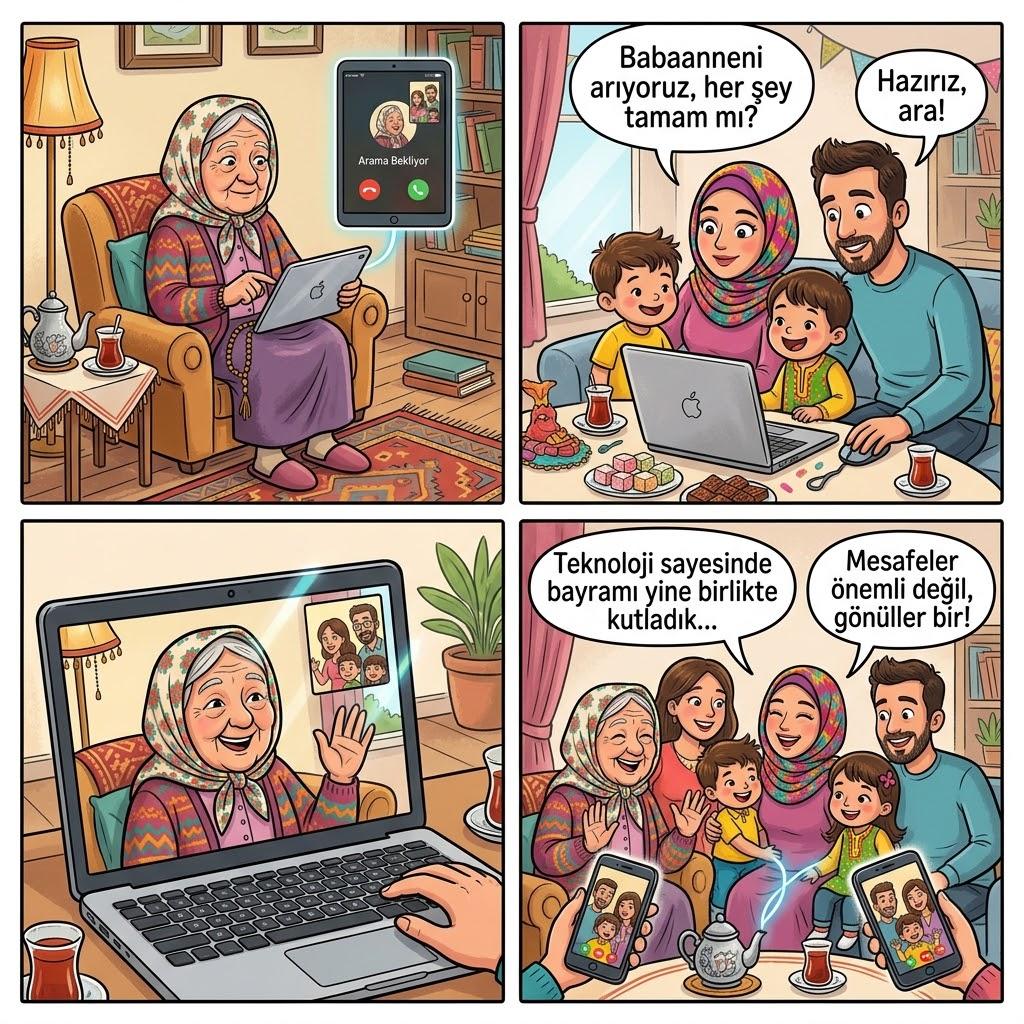
Dijital Ortamlarda Bayramlaşma (Yapay Zekâ ile Oluşturulmuştur)
The concept of cultural space has acquired a new dimension with digitalization, extending beyond physical boundaries. Parallel to Henri Lefebvre’s thesis that spatial transformations generate new forms of social relations and communication, new media environments offer humanity new social and cultural interaction fields that eliminate the concepts of time and space. Individuals geographically distant in the real world form virtual communities through internet networks, forums, social media groups, and virtual platforms. The human relationships established and discursive practices developed in these digital spaces are not independent from everyday reality; rather, they are shaped by the dynamics of daily life.
The transfer of folklore to digital networks and the transformation of new media into a folkloric environment have generated epistemological and ontological debates within academia between traditionalist and innovative approaches:
Traditionalist Approach: Argues that folkloric knowledge must be transmitted from generation to generation through traditional methods and the wisdom of the past via face-to-face interaction. This perspective refuses to recognize digital actors without physical presence as “the people”; it expresses concern that content produced rapidly through technology loses its essence and originality.
Innovative Approach: Accepts that digital actors can indeed constitute “the people.” This approach emphasizes that the only difference between interaction mediated by technology and face-to-face communication is the absence of physical presence; it supports the transmission of local and mythic knowledge by young and dynamic communities within digital networks. Furthermore, it argues that digital platforms do not eliminate folkloric production but liberate it, enabling the evolution of tradition within a new communicative context, since the fundamental nature of folklore lies in variability and fluidity, and every folkloric product inevitably undergoes transformation during transmission throughout history.
For content produced and circulated in virtual environments to be considered digital folklore and for these environments to be recognized as folkloric venues, they must meet specific criteria: spatiality, sociability, communicativeness, traditionality, and performativity. Individuals who gather around shared interests in forums, social networks, or messaging groups, even without physically knowing each other, create their own common languages, jargon, humor, and traditions, thereby forming “digital folklore groups.”
This process, which began with the spread of e-humor via email, has become an integral part of daily life through Web 2.0 technologies enabling user-generated content. Instead of telling jokes to each other in daily routines, individuals now share memes, videos, parodied images, or anonymized user comments on digital platforms, demonstrating that digital folklore is a living extension of tradition in the present day.
To understand digital folklore not merely as an aesthetic or cultural phenomenon but also within the contexts of social memory, power dynamics, relations of authority, and pedagogical processes, interdisciplinary philosophical and critical theories are employed. Cultural narratives produced and circulated in digital venues provide individuals with freedom of expression and participatory environments while simultaneously exhibiting a multilayered structure shaped by various mechanisms of control and power.
In the philosophical analysis of digital folklore environments, Michel Foucault’s theory of knowledge-power provides a fundamental framework. According to Foucault, knowledge is not an impartial entity independent of power; it is power itself, and knowledge production processes are shaped within specific power relations. Although digital platforms appear on the surface as democratic spaces where individuals can freely express their thoughts, software systems, platform policies, and algorithms determine which knowledge is highlighted and which is rendered invisible. Thus, control over knowledge shifts from centralized authorities to social media corporations and automated decision mechanisms.【5】
On one hand, digital folklore carries the potential to create alternative knowledge domains challenging hegemonic discourses; on the other hand, it functions as a medium for the reproduction of power relations and hidden control mechanisms. This hidden control mechanism is deepened through Shoshana Zuboff’s concept of surveillance capitalism. Surveillance capitalism involves the continuous monitoring, analysis, and directional manipulation of individuals’ digital interactions for commercial or political interests. Even when users display their creativity on digital platforms, they are compelled to conform to the invisible rules of algorithms. For example, to go viral, they adapt to specific time limits, trending music, or hashtags. This reveals that digital folklore, while appearing free on the surface, operates within a structure directed by surveillance and data processing systems.
Jean Baudrillard’s theory of simulacra and simulation is a critical tool for analyzing the relationship between digital folklore and reality. Baudrillard describes a state of hyperreality in modern society where reality is replaced by representations and simulations. Rapidly spreading memes, viral content, or conspiracy theories on social media reinforce perceptions about an event rather than its objective reality. In the post-truth era, where objective reality loses significance, these contents, even when detached from their original context, gain social acceptance and generate their own realities. As Neil Postman also emphasized, the overproduction of information complicates meaning-making, distancing individuals from deep thinking and trapping them in superficial content consumption.【6】
The transformation in the nature of narrative is explained by Roland Barthes’ theory of the “death of the author.” In digital venues, the meaning of a text or narrative is no longer limited to the original creator’s intent; every user who reads, interprets, and shares the text adds new meanings, thereby re-creating it. This process directly aligns with postmodern narrative practice, which undermines textual authority and signifies a transition from fixed structures to fluid and collective production.
The educational dimension of digital folklore is constructed through Paulo Freire’s concept of critical pedagogy and Henry Jenkins’ model of participatory culture. Freire argues that education must be a liberating practice enabling individuals to develop critical consciousness and participate in social transformation processes, rather than a one-way transmission of knowledge. Digital folklore transforms students from passive recipients of information into active cultural producers, bringing Freirean dialogue and participation to the digital stage.
Jenkins’ model of participatory culture defines an environment where barriers to artistic expression and civic participation are reduced and individual creations are supported. When students produce content through meme culture, digital storytelling, or social media campaigns, they enhance skills in problem-solving, creative expression, and digital literacy. However, for this process to be beneficial, it depends on cultivating critical media literacy to counter the risks identified by Eli Pariser: filter bubbles and echo chambers, which trap users in one-way flows of information.
Arjun Appadurai’s theory of cultural flows (scapes) (flows of people, media, technology, capital, and ideology) explains the global mobility of digital folklore. Digital platforms enable local folk narratives, dances, and cultural motifs to enter global circulation and gain visibility. However, they also carry the risk of dominant cultural forms suppressing or homogenizing local traditions. In this context, digital folklore serves a dual function: as both a tool of resistance and expression for local identities on the global stage and as a mechanism of accommodation for global popular culture.
The methodological foundation of digital folklore research is strengthened by Bob Scholte’s anthropological approach of reflexive and critical inquiry. Scholte, who critiqued the positivist science claim of objectivity in the 1960s and 70s, argued that the researcher’s subjectivity, ideological position, and chosen methods are essential components of the scientific process.
In Scholte’s theory, a fundamental distinction is made between “reflection” (individual awareness) and “reflexivity” (reflexivity as a methodological and epistemological principle). While reflection remains at the level of individual consciousness, reflexivity becomes a methodological stance that questions the researcher’s position in the field, power relations during data collection, and the processes through which data is constructed.
Scholte’s approach contributes three key insights to folklore and digital folklore studies:
The development of digital technologies has enabled traditional oral culture products and folk narratives to evolve into new forms by integrating multimodal components rather than existing solely as text or sound. These hybrid products emerging in the secondary oral culture era combine verbal, written, visual, and auditory elements into a single form and circulate within digital networks. In Türkiye’s digital folklore venues, one of the most prominent examples of this hybridization and new-generation performance forms is the karikafilmler created and conceptualized by cartoonist Emrah Ablak.
Karikafilm Example (Emrah Ablak)
Defined by its creator in its purest form as “cartoons with added sound,” karikafilmer is an original form of humor and performance in which traditional cartoon art is transformed into humorous short films through camera recording, voiceover, and digital editing. Unlike conventional two-dimensional animation techniques, in karikafilmler, static drawings on paper are filmed with a camera moving across the frames. These camera movements, synchronized with narrative flow and speech rhythm, impart a dynamic cinematic dimension and visual vitality to static cartoon panels.
The structural and performative processes of karikafilmler rely on the collaborative performance of two distinct individuals:
In this sense, the producer of karikafilmer is not merely a visual artist but also occupies the role of collector, performer, and transformer in the digital age.
The primary material of karikafilmler consists of real, humorous, and exaggerated events drawn from ordinary people or well-known figures across different segments of society, reflecting the language of the streets. These narratives are digital adaptations of traditional jokes or folk tales.
Two key examples of digital folklore products emerging in the karikafilm format are as follows:
Karikafilmler serve a critical function by transporting the language of the streets and mainstream humor to internet and social media platforms (YouTube, Instagram, X) at a time when paper-based traditional humor publishing has declined. These contents, viewed millions of times on platforms like YouTube, reveal how traditional narratives mutate within digital networks to achieve popularity and widespread consumption.
Karikafilmler, which integrate oral narration with text, drawing, sound, and visual technology, rank among the foremost contemporary digital folklore genres possessing potential for anonymization and traditionalization. They demonstrate that traditional cultural products are not frozen in fixed forms but continue to exist by acquiring new forms within digital venues.
Digitalization processes have fundamentally transformed traditional literary understanding and narrative forms, redefining the boundaries of literary and cultural production. Literary products once transmitted through printed publications, book pages, and fixed texts in classical eras have now migrated to social media posts, digital storytelling platforms, blogs, and online communities, becoming living, continuously evolving dynamic structures. Digital folklore plays a central role in altering both the production and distribution practices of literary and cultural narratives during this transformation.
Classical literary forms are evolving into new formats on social media platforms such as memes, micro-narratives, digital stories, tweets, blog posts, and TikTok videos. With the rise of digital folklore, literary expression is increasingly realized through multimodalities. In new-generation digital narratives, text is no longer composed solely of words; it is enriched with images, videos, sound effects, music, and hyperlinks (hyperlink).
This shift has altered the structure and consumption patterns of literary texts:
In line with Marshall McLuhan’s assertion that “the medium is the message,” the experience of reading a story in a printed book differs not merely in format from its presentation on social media with a sequence of images, sound, and video; it fundamentally alters the reader’s world of meaning and their relationship to the narrative.【7】
In the digital environment, literary texts are no longer fixed and authoritative structures but transform into interactive ecosystems shaped by active reader participation. A poem or narrative shared on social media becomes a collective text through user comments, adaptations, new fictionalizations, and visual contributions. For instance, stories published on platforms like Wattpad are shaped not only by the author’s unilateral intent but also by real-time reader comments and guidance.
This interactive process challenges the traditional author-reader hierarchy and exemplifies key features of postmodern narrative practice:
Cultural content produced and circulated on digital platforms are not merely individual forms of expression but strategic arenas for the re-production of collective memory and cultural identity. Memes, digital stories, or parodies generated around a social event—whether global or local—shape how that event is remembered in social memory and transmitted to the future.
In contrast to the fixed identity norms reinforced by traditional folklore within localized and closed social structures, digital folklore offers individuals the opportunity to construct flexible, performative, and variable identities. Individuals redefine their cultural and personal existence by performing different identities across various social media platforms. Thus, digital folklore expands the boundaries of literature and narrative, functioning as a dynamic and continuously updated element of cultural memory.
Akgül, Mahmut, and Özal Karadeniz. "Yeni Medya ve Dijital Folklor: Karikafilmlerle Kültürel Anlatıların Yeniden İnşası." *Kültür Dergisi*, no. 27 (2025): 271-294. Accessed September 3, 2026.
Bazancir, Recai. "Halk Edebiyatı Araştırmalarında Düşünümsel ve Eleştirel Yaklaşımlar: Bob Scholte Perspektifi." *International Journal of Economics, Politics, Humanities & Social Sciences* 8, no. 5 (Fall 2025): 573-586. Accessed September 3, 2026.https://dergipark.org.tr/tr/pub/ijephss/article/1770620
Emrah Ablak. "Bir zamanlar terminal." YouTube, 1:58. Accessed September 3, 2026.
Taşçıer, Feysel. "21. Yüzyılda Dijital Folklor ve Eğitim: Edebiyatın Sosyal Medya Anlatılarıyla Dönüşümü." *folklor/edebiyat* 32, no. 126 (Spring 2026): 439-458. Accessed September 3, 2026.https://dergipark.org.tr/tr/pub/fe/article/1940790
[2]
Mahmut Akgül ve Özal Karadeniz, "Yeni Medya ve Dijital Folklor: Karikafilmlerle Kültürel Anlatıların Yeniden İnşası," Kültür Araştırmaları Dergisi, sayı 27 (2025): 272-273. Erişim: 3 Eylül 2026. https://dergipark.org.tr/tr/pub/kulturder/article/1789617
[4]
Mahmut Akgül ve Özal Karadeniz, "Yeni Medya ve Dijital Folklor: Karikafilmlerle Kültürel Anlatıların Yeniden İnşası," 276.
[5]
Taşçıer, "21. Yüzyılda Dijital Folklor ve Eğitim: Edebiyatın Sosyal Medya Anlatılarıyla Dönüşümü," 445, 447.
[6]
Taşçıer, "21. Yüzyılda Dijital Folklor ve Eğitim: Edebiyatın Sosyal Medya Anlatılarıyla Dönüşümü," 454.
[7]
Taşçıer, "21. Yüzyılda Dijital Folklor ve Eğitim: Edebiyatın Sosyal Medya Anlatılarıyla Dönüşümü," 445.


Conceptual and Historical Foundations
Theoretical Frameworks and Critical Approaches
Knowledge-Power Relations and Surveillance Capitalism
Hyperreality, Simulation, and Narrative Theories
Critical Pedagogy and Participatory Culture
Globalization and Cultural Flows
Epistemological and Methodological Reflexivity: The Bob Scholte Perspective
A Digital Folklore Example: Karikafilmler
Concept and Structural Features of Karikafilmler
Digital Performance of Lived Comic Folk Narratives
Metamorphosis of Literature and Cultural Narratives
Transition from Classical Forms to Digital Formats and Multimodality
Collapse of Author-Reader Hierarchy and Intertextuality
Collective Memory and the Construction of Cultural Identity