


This article was automatically translated from the original Turkish version.
+1 More
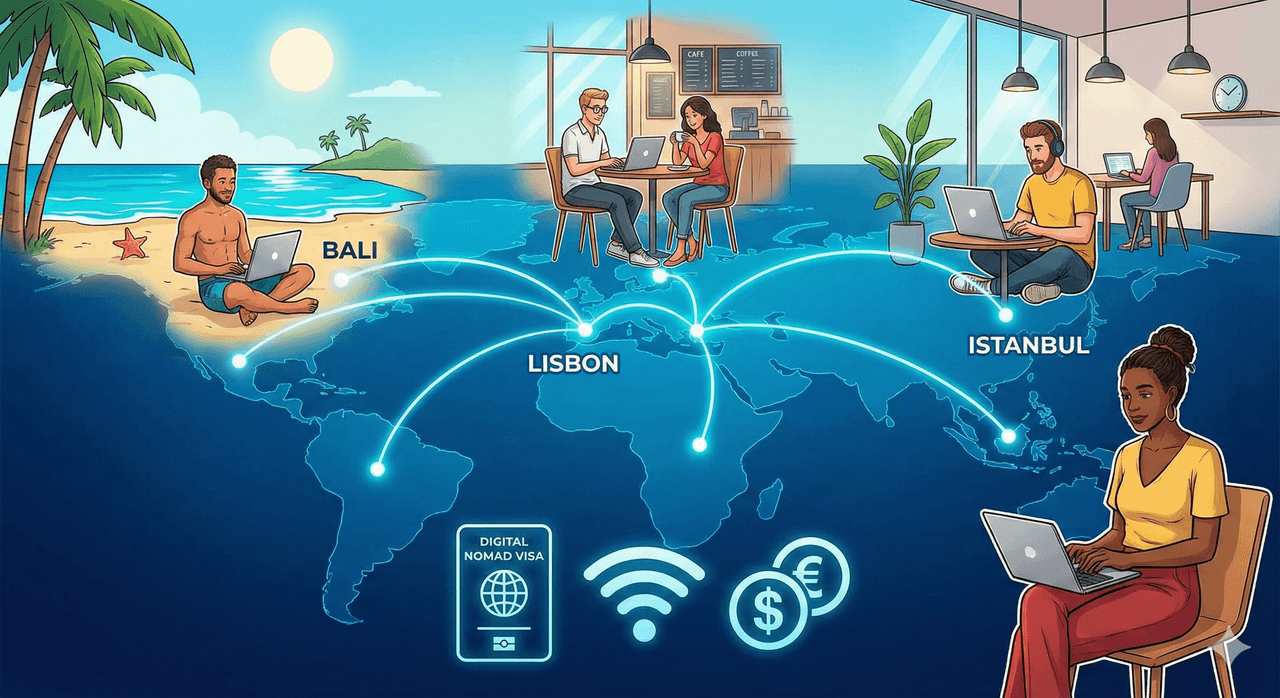
Visual Representing Digital Nomadism (Generated with Artificial Intelligence)
Fundamental Concept | Independence from Place | ||||||||
|---|---|---|---|---|---|---|---|---|---|
Economic Model | Geographic Arbitrage | ||||||||
Catalyst Event | COVID-19 Pandemic | ||||||||
Popular Centers | Bali, Lisbon, Chiang Mai, Istanbul | ||||||||
Legal Status | Digital Nomad Visa | ||||||||
Related Concept(s) | Gig Economy Remote Work | ||||||||
Digital nomadism is a socio-economic phenomenon defined as individuals practicing their professions independently of location using internet technologies while maintaining a nomadic lifestyle. This concept goes beyond the practice of “remote work” and represents a new philosophy of life that integrates professional work with travel freedom, prioritizing experience over ownership and mobility over permanence. Emerging as a subculture in the early 21st century, digital nomadism has evolved into a global labor movement due to advancements in telecommunications infrastructure and the transformative impact of the COVID-19 pandemic on work practices.
The term “digital nomad” was first introduced in 1997 in a book of the same name by Tsugio Makimoto and David Manners. The authors predicted that as technology advanced, people would break away from settled lifestyles and return to a nomadic way of life.【1】 However, the concept gained widespread popularity in popular culture and practice following Timothy Ferriss’s 2007 book The 4-Hour Workweek. Ferriss challenged the traditional “9-to-5” work model and introduced the idea of earning income through internet-based business models and spending it in countries with lower living costs.【2】
The economic rationale behind digital nomadism is based on the concept of “geographic arbitrage.” This strategy involves earning income in a “strong currency” (such as the US dollar, euro, or British pound) while spending it in countries that use a “weak currency” (such as Thailand, Indonesia, Türkiye, Colombia), where the cost of living is significantly lower. As a result, individuals can achieve a standard of living far above what would be possible in their home countries while working fewer hours.
This economic model has also reshaped global capital flows. Cities such as Bali (Ubud), Chiang Mai, Lisbon, Medellín, and Istanbul have become global hubs where digital nomads congregate in large numbers. While this influx brings foreign currency into local economies, it also generates socio-economic challenges including rising housing prices and the displacement of local residents from their neighborhoods (gentrification).
Sociologically, digital nomadism aligns with Zygmunt Bauman’s concept of “liquid modernity.” Individuals no longer feel allegiance to a specific geography or nation but instead identify with a global community bound by shared lifestyles and values. Shared workspaces (coworking spaces) and shared living spaces (coliving spaces) serve as social hubs for these new “tribes.” These spaces are not merely offices providing internet access but also social clubs designed to combat loneliness and foster collaboration and networking opportunities.【3】 However, this lifestyle also entails psychological challenges such as rootlessness and the transience of relationships. Constant relocation can make it difficult to form deep, lasting human connections.
Initially operating in a legal gray area under tourist visas, digital nomads have gradually gained formal legal status as governments seek to prevent tax losses and attract skilled labor. Estonia’s 2020 launch of the “digital nomad visa” was the first of its kind globally, followed by countries such as Portugal, Croatia, Spain, and Greece. These visas allow foreigners to reside long-term in the country without working for a local employer, relying instead on income earned from abroad.【4】
Türkiye has emerged as an attractive destination for digital nomads, particularly in cities such as Istanbul, Antalya, and İzmir. In April 2024, the Ministry of Culture and Tourism launched a special visa program targeting foreign digital nomads. The program is designed for remote workers with a minimum monthly income of 3,000 US dollars and aged between 21 and 55. Key factors driving Türkiye’s appeal include its affordable cost of living, advanced internet infrastructure, rich cultural heritage, and strategic geographic location.
Digital Nomads GoTürkiye. "Dijital Göçebeler GoTürkiye." *T.C. Kültür ve Turizm Bakanlığı*. Accessed December 2, 2025. https://digitalnomads.goturkiye.com/
Ferriss, Timothy. The 4-Hour Workweek: Escape 9-5, Live Anywhere, and Join the New Rich. New York: Crown Publishers, 2007.
Hannonen, Olga. "In Search of a Digital Nomad: Defining the Phenomenon." *Information Technology & Tourism* 22. (2020): 335-353. Accessed December 2, 2025. https://link.springer.com/article/10.1007/s40558-020-00177-z
MBO Partners. "The Digital Nomad Search Continues." *Research Brief*. 2021. Accessed December 2, 2025. https://webinar.hbrturkiye.com/storage/uploads/digital-nomad-research-brief-6152c2658471d.pdf
Makimoto, Tsugio and David Manners. Digital Nomad. New York: Wiley, 1997.
Thompson, Beverly Yuen. "The Digital Nomad Lifestyle: (Remote) Work/Leisure Balance, Privilege, and Constructed Community." *International Journal of the Sociology of Leisure* 2 (2019): 27-42. Accessed December 2, 2025. https://link.springer.com/article/10.1007/s41978-018-00030-y
[1]
Tsugio Makimoto ve David Manners, Digital Nomad (New York: Wiley, 1997), 12.
[2]
Timothy Ferriss, The 4-Hour Workweek (New York: Crown Publishing, 2007), 240.
[3]
Beverly Yuen Thompson, "The Digital Nomad Lifestyle", International Journal of the Sociology of Leisure 2/1 (2019): 35.
[4]
Olga Hannonen, "In Search of a Digital Nomad", Information Technology & Tourism 22/3 (2020): 340.


Visual Representing Digital Nomadism (Generated with Artificial Intelligence)
Fundamental Concept | Independence from Place | ||||||||
|---|---|---|---|---|---|---|---|---|---|
Economic Model | Geographic Arbitrage | ||||||||
Catalyst Event | COVID-19 Pandemic | ||||||||
Popular Centers | Bali, Lisbon, Chiang Mai, Istanbul | ||||||||
Legal Status | Digital Nomad Visa | ||||||||
Related Concept(s) | Gig Economy Remote Work | ||||||||
Origin and Historical Development
Economic Foundation: Geographic Arbitrage
Sociological Impacts and “New Tribalism”
Government Policies: Digital Nomad Visas
Digital Nomadism in Türkiye