
This article was automatically translated from the original Turkish version.

Imagine you are building a nuclear reactor. It requires billions of dollars in investment, tens of thousands of tons of concrete and steel, and above all a safety culture with zero tolerance for error. In the past, engineers often had to construct expensive and time-consuming physical prototypes to verify their theories. Today, however, during this period of renaissance for next-generation nuclear reactor designs, power plants begin operating at full capacity in a virtual environment—inside supercomputers—long before the foundation is even laid.
This era is known as the Simulation Age. Replicating a system with temperatures of thousands of degrees and extreme pressure on a computer screen without a single atom being split is one of modern engineering’s greatest achievements.
The core region, the heart of light water reactors (LWRs), is an astonishing order within chaos. Neutrons collide with uranium atoms, releasing immense heat, which is transferred to the coolant fluid, altering its density. The way to translate these complex physical phenomena into a computer is to express them as mathematical equations.
Engineers divide the reactor core virtually into millions of tiny cells using Computational Fluid Dynamics (CFD) and subchannel analysis codes.【1】 For each small cell, the laws of conservation of mass, momentum, and energy (Navier-Stokes equations) are solved millions of times per second. As a result, even before the plant is built, engineers can report with millimeter precision which channels the water flows through fastest and which fuel rods are approaching their surface temperature safety limits.
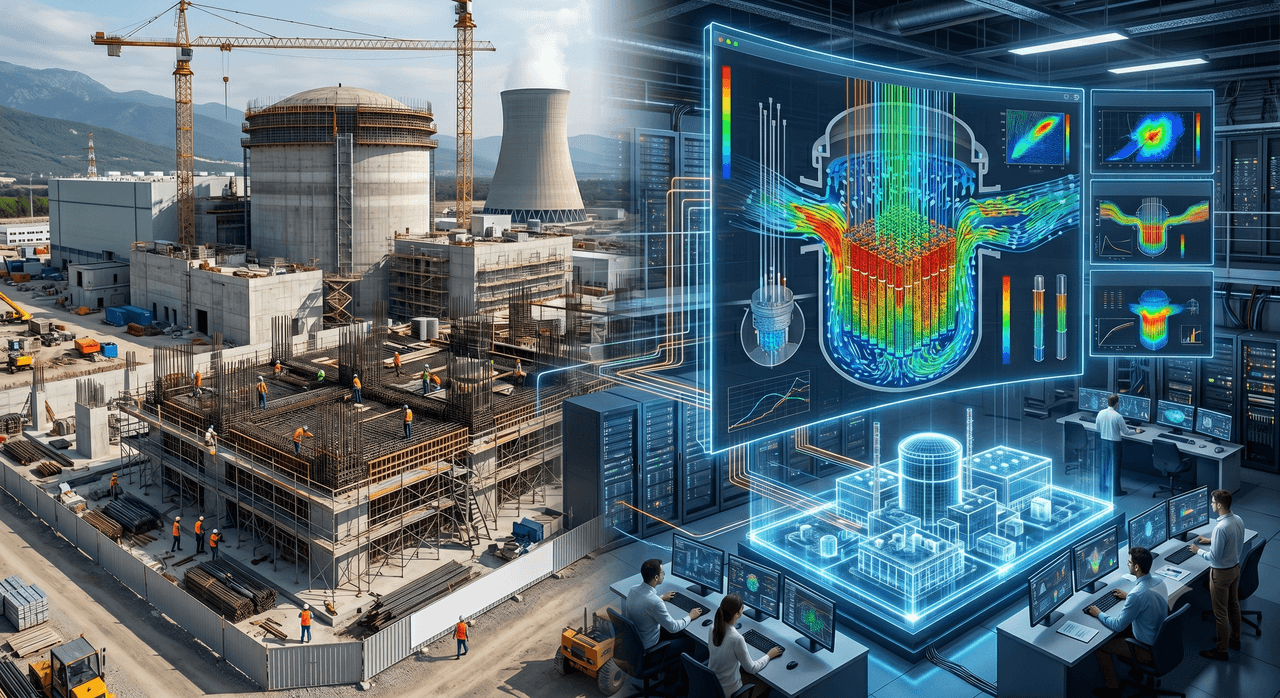
Depiction of a Constructed Reactor and Its Digital Twin (Generated with AI Assistance)
The most challenging aspect of nuclear simulation is that no system operates independently. Simulations rest on three fundamental pillars:
These calculations, once performed separately, are now conducted simultaneously using coupled multiphysics codes. For example, as water heats up its density decreases; lower-density water slows neutrons less effectively, directly affecting reactor power. The flawless simulation of these feedback mechanisms in the virtual environment forms the backbone of thermal-hydraulic analysis.【2】
The most vital value of simulation lies in its ability to test accident scenarios that must never occur in real life. Design Basis Accidents such as the failure of a cooling pump or the rupture of a critical pipe are recreated virtually using developed codes.
Engineers monitor second by second whether emergency core cooling systems (ECCS) activate and whether Critical Heat Flux (CHF) limits are exceeded. If trends indicate that fuel integrity is at risk, the design is immediately optimized.
The current pinnacle of this evolution is the concept of the Digital Twin. When a nuclear power plant is constructed, an exact virtual copy—calibrated in thermodynamics and neutronics—lives on servers. Real-time data from the site (temperature, pressure, mass flow) is fed directly into this digital twin. The digital twin enables predictive maintenance by forecasting the plant’s future behavior and alerting operators to potential anomalies weeks in advance.【3】
For instance, EDF in France uses digital twins to detect microscopic efficiency losses in its plants; while ITER, the world’s largest fusion project, assembles its massive components virtually before any physical construction begins.【4】
Nuclear energy is no longer merely about heavy industry, concrete, and steel; it is also the product of advanced algorithms and coupled simulation codes. The reactors of the future are being built inside processors before they are constructed on sites, enabling them to be commissioned more efficiently, economically, and safely than ever before.
ITER Organization. "AI Ignites Innovation in Fusion." *ITER News*, June 2, 2025. Accessed May 8, 2026. https://www.iter.org/node/20687/ai-ignites-innovation-fusion
OECD/NEA. *State-of-the-Art Report on Multi-scale Modelling of Nuclear Fuels*. NEA/NSC/R(2015)5. Paris: OECD Publishing, 2015. Accessed May 8, 2026. https://www.oecd-nea.org/jcms/pl_19666/state-of-the-art-report-on-multi-scale-modelling-of-nuclear-fuels
Todreas, Neil E., and Mujid S. Kazimi. *Nuclear Systems Volume I: Thermal Hydraulic Fundamentals*. 2nd ed. Boca Raton, FL: CRC Press, 2011. Accessed May 8, 2026. https://www.taylorfrancis.com/books/mono/10.1201/b14887/nuclear-systems-volume-neil-todreas-mujid-kazimi
[1]
Neil E. Todreas and Mujid S. Kazimi, Nuclear Systems Volume I: Thermal Hydraulic Fundamentals, 2nd Edition (Boca Raton: CRC Press, 2011), p. 142.
[2]
OECD/NEA, State-of-the-Art Report on Multi-scale Modelling of Nuclear Fuels, NEA/NSC/R(2015)5 (Paris: OECD Publishing, 2015), pp. 55-58.
[3]
Electric Power Research Institute (EPRI), Digital Engineering and Digital Twins in the Nuclear Power Industry (Palo Alto: EPRI, 2021), pp. 2-4.
[4]
ITER Organization. "AI Ignites Innovation in Fusion." ITER News, 2 June 2025. Accessed: 8 May 2026. https://www.iter.org/node/20687/ai-ignites-innovation-fusion.
The Power of Mathematics: Dividing the Reactor into Parts
Multiphysics: Integration of Disciplines
Learning from Design Basis Accidents Without Ever Experiencing Them
Digital Twin Technology
Conclusion