


This article was automatically translated from the original Turkish version.
+3 More
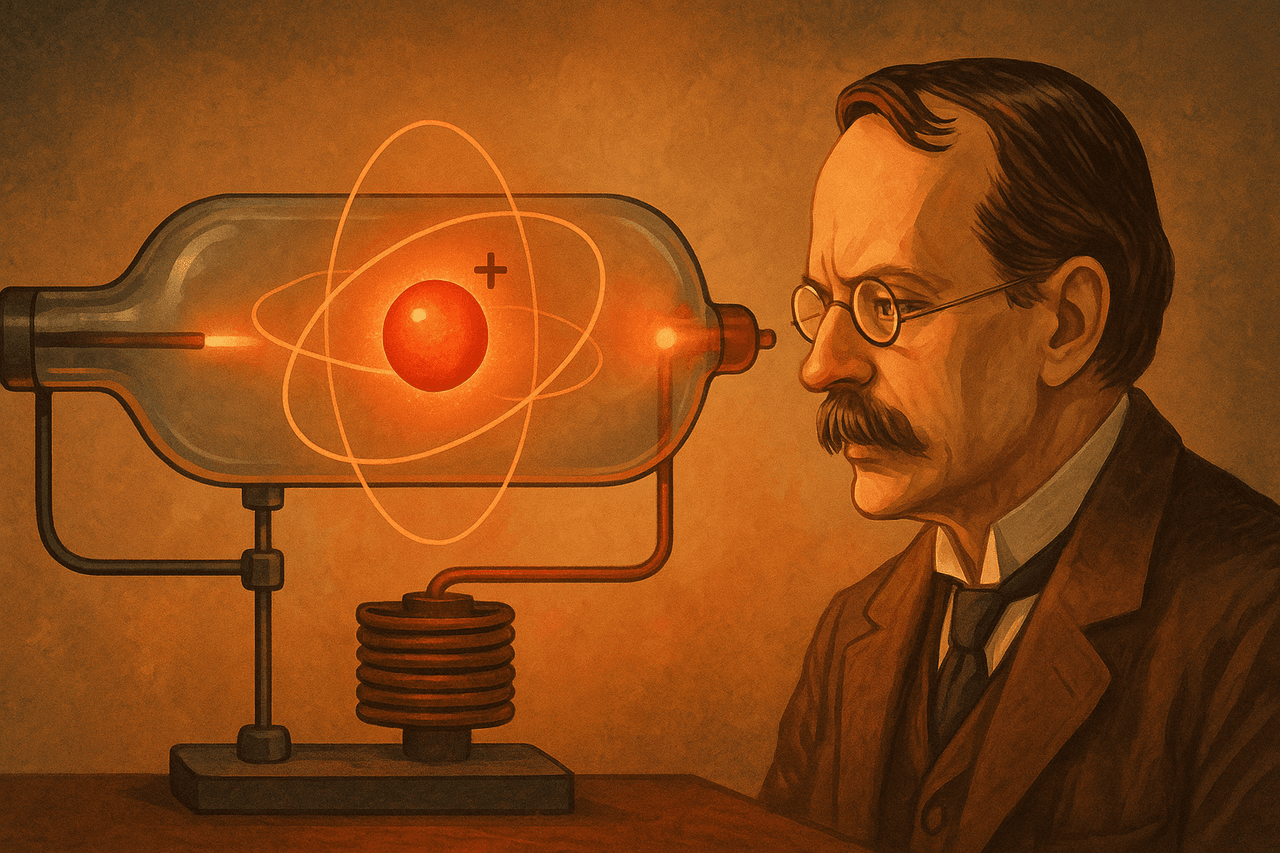
The Discovery of the Electron
Discoverer(s) | Joseph John Thomson | ||||||||
|---|---|---|---|---|---|---|---|---|---|
Year of Discovery(ies) | 1897 | ||||||||
Method(s) | Cathode ray experiment | ||||||||
Particle Type | Subatomic particle, Lepton | ||||||||
Electric Charge | -1.602 x 10⁻¹⁹ Coulomb | ||||||||
Mass | 9.109 x 10⁻³¹ kilogram | ||||||||
Significance | Proved the divisibility of the atom and laid the foundation of modern physics. | ||||||||
An electron is a fundamental subatomic particle with a negative electric charge. It is found in orbits around the atomic nucleus or may exist freely. In the Standard Model of particle physics, it is a member of the family of particles known as leptons. It was discovered in 1897 by the British physicist Joseph John Thomson through experiments on cathode rays. This discovery overturned the prevailing belief that atoms were indivisible, creating a breakthrough in modern physics and chemistry and paving the way for new models of atomic structure. The discovery of the electron also provided a deeper understanding of the nature of electricity and laid the foundation for modern electronic technologies.
The path to the discovery of the electron was paved by 19th-century studies on electricity and magnetism. The ancient Greeks observed that amber (Greek: elektron) attracted small objects when rubbed with fur, one of the earliest observations of static electricity. However, scientific investigation of this phenomenon took centuries. Between 1838 and 1851, scientists such as Richard Laming proposed that atoms consisted of an electrically charged nucleus surrounded by unit-charged particles. In 1891, the Irish physicist George Johnstone Stoney introduced the term "electron" to describe the unit of charge observed in electrolysis experiments.
The first concrete experimental evidence for the existence of electrons emerged from studies of the electrical conductivity of gases under low pressure. In 1858, the German physicist Julius Plücker and in 1869 his student Johann Wilhelm Hittorf observed rays emanating from the negative electrode (cathode) in partially evacuated glass tubes (gas discharge tubes) when high voltage was applied, causing luminescence. In 1876, Eugen Goldstein named these rays "cathode rays." The nature of these rays was a subject of debate at the time; some scientists argued they were a form of electromagnetic radiation (waves), while others believed they consisted of negatively charged particles.
In the 1870s, the British physicist and chemist Sir William Crookes designed advanced cathode ray tubes, known as Crookes tubes, achieving higher vacuum levels. In his experiments with these tubes, Crookes demonstrated that cathode rays traveled in straight lines, cast shadows of objects placed in their path, and could be deflected by a magnetic field. The deflection in the magnetic field indicated that the rays behaved like negatively charged particles. Based on these observations, Crookes proposed that cathode rays were a form of "radiant matter," a fourth state of matter. Other physicists, such as Arthur Schuster, attempted to build on Crookes's experiments to estimate the charge-to-mass ratio of these particles, but the values they obtained were much higher than expected and thus received little attention at the time.
In 1897, the British physicist Joseph John Thomson, working at the Cavendish Laboratory of Cambridge University, conducted a series of experiments to definitively determine the nature of cathode rays. Thomson improved upon the Crookes tube by designing a setup that could apply both an electric field and a magnetic field perpendicular to the path of the rays.

Representative Cathode Ray Experiment Setup (Generated by AI)
In the first phase of his experiment, Thomson placed two parallel metal plates along the path of the cathode rays and applied a voltage across them to create an electric field. He observed that the rays were deflected toward the positively charged plate. This result conclusively demonstrated that cathode rays carried a negative electric charge.
In the next stage of his experiment, Thomson aimed to determine the properties of these particles more quantitatively. He balanced the deflection caused by the electric field by applying a magnetic field in the opposite direction. He adjusted the strength of the magnetic field until the rays traveled in a straight line without deflection. Under these conditions, the electric force and the magnetic force acting on the particles were equal. Using the magnitudes of these two forces, Thomson calculated the velocity of the particles. He then measured the deflection caused by either the electric field alone or the magnetic field alone to determine the charge-to-mass ratio (e/m) of the particles.
The most revolutionary finding of Thomson’s experiment was that this e/m ratio was a universal constant. Regardless of the metal used for the cathode (aluminum, platinum, etc.) or the type of gas inside the tube, the calculated charge-to-mass ratio remained approximately the same. This ratio was about 1,000 times greater than that of the lightest known ion, the hydrogen ion. This implied that either the particles carried an unusually large charge or had an unusually small mass. Thomson concluded that the mass of these particles was a tiny fraction of the mass of a hydrogen atom. The fact that these particles exhibited identical properties regardless of their source atom indicated that they were a fundamental component of all atoms. Thomson initially named these fundamental particles "corpuscles," but later adopted the term "electron," proposed by George Francis Fitzgerald and previously introduced by G. Johnstone Stoney.
J. J. Thomson’s discovery of the electron marked a turning point in the history of science. It fundamentally challenged the 19th-century doctrine, formulated by John Dalton, that atoms were the indivisible smallest units of matter. It was now proven that atoms were composed of smaller parts. This necessitated the development of new theories and models to explain the internal structure of the atom. Thomson, based on his discovery, proposed the "plum pudding" model, in which negatively charged electrons were embedded uniformly in a positively charged sphere. Although this model was later disproven by Ernest Rutherford’s experiments, it represented a crucial intermediate step in understanding atomic structure.
The discovery of the electron had profound implications not only for atomic physics but also for chemistry and electricity. It became clear that chemical bonds arise from the sharing or transfer of electrons between atoms. It was also established that electric current is the movement of electrons through a conducting material. This fundamental understanding opened the door to electronic innovations in the 20th century. The development of radio, television, computers, and countless other technological devices became possible only because the behavior of electrons could be controlled. For his theoretical and experimental work on the electrical conductivity of gases, Thomson was awarded the Nobel Prize in Physics in 1906. The charge of the electron was later measured with greater precision in 1909 by Robert Millikan through his famous oil-drop experiment.
According to the Standard Model of modern physics, the electron is a fundamental particle, meaning it is not composed of smaller constituents and is treated as a point particle. It is a member of the first generation of leptons. Its fundamental properties are as follows:
Mass: The rest mass of an electron is approximately 9.109 × 10⁻³¹ kilograms. This is about 1/1836 the mass of a proton. Consequently, its contribution to the total mass of an atom is generally negligible.
Electric Charge: The electron carries a negative electric charge of -1.602 × 10⁻¹⁹ coulombs. This value is known as the elementary charge (e) and represents the smallest observable free charge in nature.
Spin: The electron possesses an intrinsic angular momentum, or spin, of 1/2. This property classifies it as a fermion and causes it to obey the Pauli exclusion principle, which states that no two electrons can occupy the same quantum state simultaneously. This principle plays a critical role in determining the electron shell structure of atoms.
Electrons are quantum mechanical entities that exhibit both particle-like and wave-like behavior. This dual nature is exploited in technologies such as electron microscopes and emerging fields such as quantum computing. In 1937, George Paget Thomson, J. J. Thomson’s son, was awarded the Nobel Prize in Physics for his electron diffraction experiments, which demonstrated the wave-like behavior of electrons. This creates an intriguing historical parallel: the father discovered the electron as a particle, while the son demonstrated its wave nature.
American Institute of Physics. “J.J. Thomson and the Discovery of the Electron.” Accessed July 9, 2025. https://history.aip.org/exhibits/electron/jjhome.htm.
American Physical Society. "Discovery of the Electron." Accessed July 9, 2025. https://www.aps.org/apsnews/2000/10/discovery-of-the-electron.
ChemLibreTexts. "The Discovery of the Electron." Accessed July 9, 2025. https://chem.libretexts.org/Bookshelves/General_Chemistry/Map%3A_A_Molecular_Approach_(Tro)/02%3A_Atoms_and_Elements/2.04%3A_The_Discovery_of_the_Electron.
Crowther, J. G. British Scientists of the Twentieth Century. London: Kegan Paul, 1951.
Heilbron, J. L. Electricity in the 17th and 18th Centuries: A Study of Early Modern Physics. Berkeley: University of California Press, 1979.
IEEE Spectrum. "Discovery of the Electron." Accessed July 9, 2025. https://spectrum.ieee.org/discovery-of-the-electron.
Khan Academy. “Elektron ve Çekirdeğin Keşfi (Makale).” Accessed June 24, 2024. https://tr.khanacademy.org/science/chemistry/electronic-structure-of-atoms/history-of-atomic-structure/a/discovery-of-the-electron-and-nucleus.
Pais, Abraham. Inward Bound: Of Matter and Forces in the Physical World. Oxford: Clarendon Press, 1986.
TÜBİTAK. "Yazı: Discovery of the Electron." Accessed July 9, 2025. https://services.tubitak.gov.tr/edergi/yazi.pdf;jsessionid=rOUnbWFzrGCGVQephYCDzTFT?dergiKodu=4&cilt=30&sayi=361&sayfa=28&yaziid=10273.
Whittaker, Edmund. A History of the Theories of Aether and Electricity: The Classical Theories. 2nd ed. New York: Dover Publications, 1989.

The Discovery of the Electron
Discoverer(s) | Joseph John Thomson | ||||||||
|---|---|---|---|---|---|---|---|---|---|
Year of Discovery(ies) | 1897 | ||||||||
Method(s) | Cathode ray experiment | ||||||||
Particle Type | Subatomic particle, Lepton | ||||||||
Electric Charge | -1.602 x 10⁻¹⁹ Coulomb | ||||||||
Mass | 9.109 x 10⁻³¹ kilogram | ||||||||
Significance | Proved the divisibility of the atom and laid the foundation of modern physics. | ||||||||
No Discussion Added Yet
Start discussion for "Discovery of the Electron" article
Developments Before the Discovery and Cathode Rays
J. J. Thomson's Experiments and the Discovery of the Electron
Consequences and Impact of the Discovery
Key Properties of the Electron