
badge icon

This article was automatically translated from the original Turkish version.

Article

Dival İşi

Quote
Technical
Belongs to the tack stitch group; the upper thread does not pass under the fabric and is secured with waxed thread from below
Material
Executed on velvetsatinor leather backgrounds using sequinsgold threadand beads
Usage
Bindallı dresseskaftansşalvar pantswalletswater flasksQuran cases

Dival işi is a decorative craft that finds rare examples in traditional Turkish women’s clothing, with original samples gradually diminishing. Today, it is being preserved by Maturation Institutes and girls’ technical schools. This technique, also known as "Maraş işi," "sim-sırma işi," "mukavva işi," "basdırma," and "mıhlama," is a single-sided embroidery applied to tightly woven fabrics or leather, producing a surface that differs on its reverse side. This art form, used across diverse domains from imperial garments to home décor, holds an important place among traditional Turkish handcrafts.

History and Development

The history of Turkish embroidery draws from a layered heritage extending from Central Asia through Islamic and Anatolian civilizations, with the earliest examples of dival işi emerging during the Seljuk period. Thanks to the economic vitality of the Maraş region, advancements in gold and silver threadwork led to the technique being branded as "Maraş işi." In the 14th century, it was introduced to the Ottoman court through the trousseau of Emine Hatun, solidifying its place among court arts. During the 15th and 16th centuries, when decorative arts flourished, this technique appeared widely across items ranging from kaftans to book covers under the name "zerduz işi." In the 17th and 18th centuries, its applications expanded significantly, and by the 19th century, it evolved further with the addition of intricate details such as light-and-shadow effects and small metallic sequins resembling caterpillars, introduced during the reign of Mahmud II. Although the number of master artisans declined somewhat after the proclamation of the Republic, dival işi continues to be preserved today through traditional methods, practiced by both amateur and professional artisans in homes, schools, and official institutions as a cultural legacy.

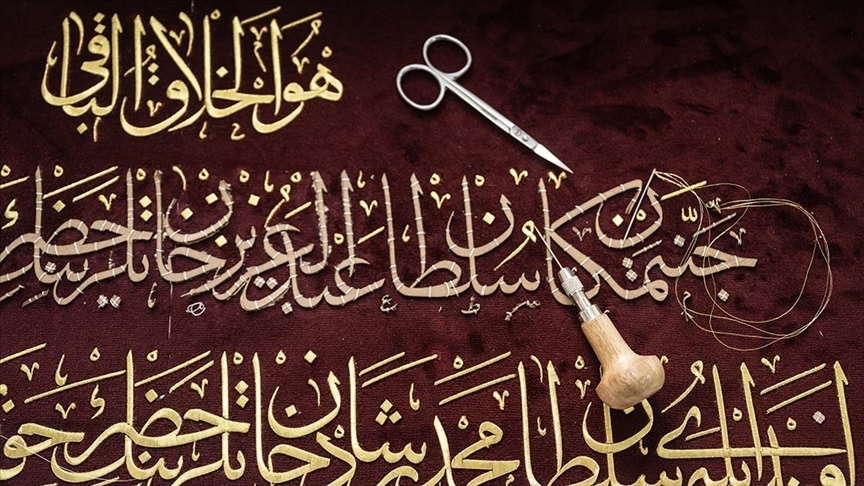
Çamlıca Camii Sanat Atölyesi, Beze İşlenmiş Dival İşi Sanatı (Fotoğraf: Ahsen Buyurkan)

Technical Features and Production Stages

Dival işi belongs to the group of techniques known as "atma iğneler", in which the warp and weft threads are covered. The most distinctive feature of this technique is the use of auxiliary layers that give the patterns a three-dimensional appearance.

Tools and Materials

  • Cülde (Workbench): A tool with an "L"-shaped base used to tightly hold the fabric being worked on.
  • Biz: A pointed tool used to pierce cardboard and push the needle upward from below.
  • Möhlüke (Carving Knife): A curved-bladed knife used to carve the design out of cardboard.
  • Materials: Velvet and atlas fabrics are most commonly used. For the upper threads, gold or silver sim, sırma, and kılaptan are employed; while for embellishment, caterpillars, sequins, beads, and occasionally precious stones such as ruby and coral are added. For the lower threads, strong silk threads coated with beeswax are preferred.

Production Process

  1. Design Preparation: The pattern is drawn on thin paper and adhered to reinforced cardboard.
  2. Carving: The design is carved out of the cardboard using the möhlüke to create a stencil.
  3. Adhesion: The back of the carved stencil is moistened and affixed to the fabric or leather surface in accordance with the composition.
  4. Embroidery: While the stencil remains on the fabric, multiple layers of metal threads are stitched from above, and waxed silk threads are passed from below using the biz tool to interlock them securely. This ensures that the upper metal threads never pass through to the underside of the fabric.

Dival İşi Sanatı Yapım Süreci (Anadolu Ajansı)

Applications

Dival işi has a wide range of applications in both clothing and utilitarian objects:
  • Traditional Clothing: Trousers, vests, kaftans, and especially bridal gowns known as bindallı are the most common uses of dival işi. In regions such as Ayaş, these garments are still worn during henna nights as "baş entari."
  • Leather Goods: Leather items with a long tradition, such as wallets, Qur’an cases, bath towels, basin holders, weapon sheaths (kuburluk), ammunition pouches, and boots, are decorated using dival işi.
  • Household and Military Items: Bedspreads, trunks, mattress covers, pillows, curtains, prayer rugs, as well as military flags, standards, and uniform epaulettes, are embellished using this technique.

Author Information

Avatar
AuthorAhsen BuyurkanApril 24, 2026 at 10:44 AM

Tags

Discussions

No Discussion Added Yet

Start discussion for "Dival İşi" article

View Discussions

Contents

  • History and Development

  • Technical Features and Production Stages

  • Tools and Materials

  • Production Process

  • Applications

Ask to Küre