

This article was automatically translated from the original Turkish version.
+1 More
Site | Republic of Djibouti, Capital Djibouti, Salines Ouest Quarter | ||||||||
|---|---|---|---|---|---|---|---|---|---|
Project Owner | Turkish Diyanet Foundation | ||||||||
Construction Start | 2015 | ||||||||
Completion | First quarter of 2019 | ||||||||
Opening Date(s) | 29 November 2019 | ||||||||
Architectural Style(s) | Classical Ottoman architecture | ||||||||
Area(s) | 10 000 m² (built on land reclamation) 000–13 | ||||||||
Construction Area | 2,500–3,000 m² | ||||||||
Worship Capacity | 5,000–6,000 people | ||||||||
Architectural Elements | Ottoman-style chandeliers and lighting elements Ottoman calligraphy decorations 1 main dome (27 m high - 20 m diameter) 2 minarets (46 m high - double balconied) | ||||||||
Material(s) | Stone woodwork and decorative elements were brought from Türkiye marble | ||||||||
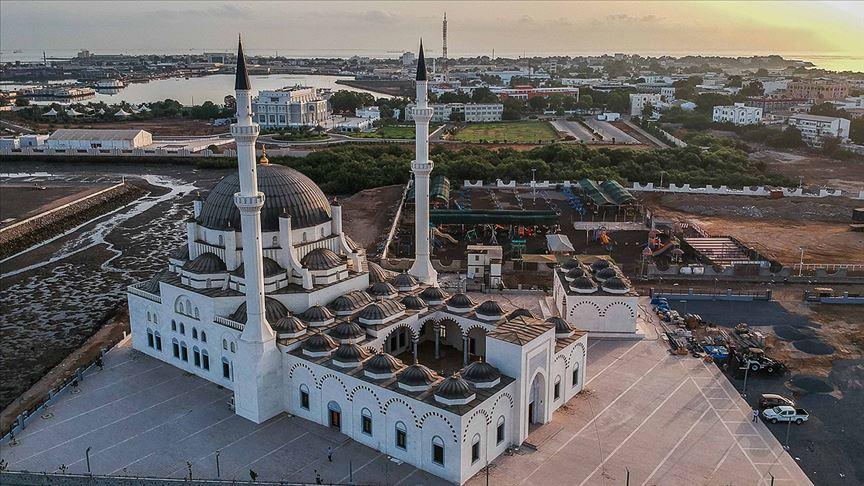
Djibouti 2nd Sultan Abdulhamid Mosque and Complex is a place of worship and religious complex located in the capital of the East African country Djibouti, featuring elements of Ottoman architecture and serving as the country’s largest mosque. The project, initiated by the Turkish Directorate of Religious Affairs in 2015, was completed and opened for service in 2019.

Djibouti 2nd Sultan Abdulhamid Mosque – Exterior Facade and Minarets (Türkiye Diyanet Foundation)
The initial proposal for the mosque’s construction arose during a visit by Turkish President Recep Tayyip Erdoğan to Djibouti in 2015. Djibouti’s President Ismail Omar Guelleh expressed his desire during this visit to see a mosque reflecting Ottoman architectural style and to hear the call to prayer performed in the Istanbul tradition. In response to this request, the Turkish Directorate of Religious Affairs took on the project, and work commenced the same year with the laying of the mosque’s foundation.

General View of the Prayer Hall and Upper Gallery (Türkiye Diyanet Foundation)
The mosque is built on a reclaimed land area of approximately 10,000 to 13,000 square meters in the Salines Ouest District, which also hosts the Djibouti Presidential Palace. For structural reinforcement, 96 bored piles were installed, and construction was completed in the first quarter of 2019.
Architecturally, a classical Ottoman style was adopted. The mosque features two minarets, each 46 meters high and equipped with double balconies. Its main dome is 27 meters high and 20 meters in diameter.

Main Dome Chandelier and Decorative Detail (Türkiye Diyanet Foundation)

View of the Mihrab and Minbar Inside the Mosque (Türkiye Diyanet Foundation)
The official inauguration of the mosque took place on 29 November 2019. The ceremony was attended by Mustafa Şentop, Speaker of the Turkish Grand National Assembly, Ali Erbaş, President of the Directorate of Religious Affairs, Levent Şahinkaya, Turkish Ambassador to Djibouti, and numerous Turkish and Djiboutian officials.
Djibouti’s Minister of Endowments and Religious Affairs, Mümin Hasan Barreh, described the mosque and its complex as a gift from Türkiye to the Djiboutian people in his speech at the ceremony. Following the ceremony, Ali Erbaş led the Friday prayer.

Interior View During Congregational Prayer (Türkiye Diyanet Foundation)
AA (Anadolu Ajansı). "Sentop: Cibuti 2. Abdülhamid Han Camii’ni açtı." Anadolu Ajansı. Accessed September 22, 2025. https://www.aa.com.tr/tr/dunya/sentop-cibuti-2-abdulhamid-han-camisini-acti/1659357
Anadolu Ajansı. "Cibuti’nin en büyük camisinin resmi açılışı yapılacak." Accessed September 22, 2025. https://www.aa.com.tr/tr/dunya/cibutinin-en-buyuk-camisinin-resmi-acilisi-yapilacak/1654552
Siyahkalem. "Cibuti 2. Abdülhamid Han Camii Şantiyesi." Accessed September 22, 2025. https://www.siyahkalem.com/tr/4/2/49
TDV (Türkiye Diyanet Vakfı). "2. Abdülhamid Han Camii Cibuti’nin Simgesi Oldu." TDV. Accessed September 22, 2025. https://tdv.org/tr-TR/2-abdulhamid-han-camii-cibutinin-simgesi-oldu/
TDV (Türkiye Diyanet Vakfı). "Cibuti 2. Abdülhamid Han Camii ve Külliyesi." TDV. Accessed September 22, 2025. https://tdv.org/tr-TR/proje/cibuti-2-abdulhamid-han-camii-ve-kulliyesi/
TRT Haber. "Cibuti 2. Abdülhamid Han Camii açıldı." Accessed September 22, 2025. https://www.trthaber.com/haber/yasam/cibuti-2-abdulhamid-han-camii-acildi-443728.html

Site | Republic of Djibouti, Capital Djibouti, Salines Ouest Quarter | ||||||||
|---|---|---|---|---|---|---|---|---|---|
Project Owner | Turkish Diyanet Foundation | ||||||||
Construction Start | 2015 | ||||||||
Completion | First quarter of 2019 | ||||||||
Opening Date(s) | 29 November 2019 | ||||||||
Architectural Style(s) | Classical Ottoman architecture | ||||||||
Area(s) | 10 000 m² (built on land reclamation) 000–13 | ||||||||
Construction Area | 2,500–3,000 m² | ||||||||
Worship Capacity | 5,000–6,000 people | ||||||||
Architectural Elements | Ottoman-style chandeliers and lighting elements Ottoman calligraphy decorations 1 main dome (27 m high - 20 m diameter) 2 minarets (46 m high - double balconied) | ||||||||
Material(s) | Stone woodwork and decorative elements were brought from Türkiye marble | ||||||||
No Discussion Added Yet
Start discussion for "Djibouti 2 Abdülhamid Han Mosque and Complex" article
History and Project Initiation
Construction Process and Architectural Features
Inauguration Ceremony
Religious, Cultural and Diplomatic Significance