


This article was automatically translated from the original Turkish version.
https://news.stonybrook.edu/newsroom/press-release/general/2016-02-23-study-reveals-dodo-birds-not-stupid-as-previously-thought/
The dodo ( Raphus cucullatus ) is an extinct, flightless bird species endemic to the island of Mauritius, located east of Madagascar in the Indian Ocean. It belongs to the subfamily Raphinae, a group of extinct flightless birds within the pigeon and dove family (Columbidae). The dodo’s closest living relative is the Nicobar pigeon.
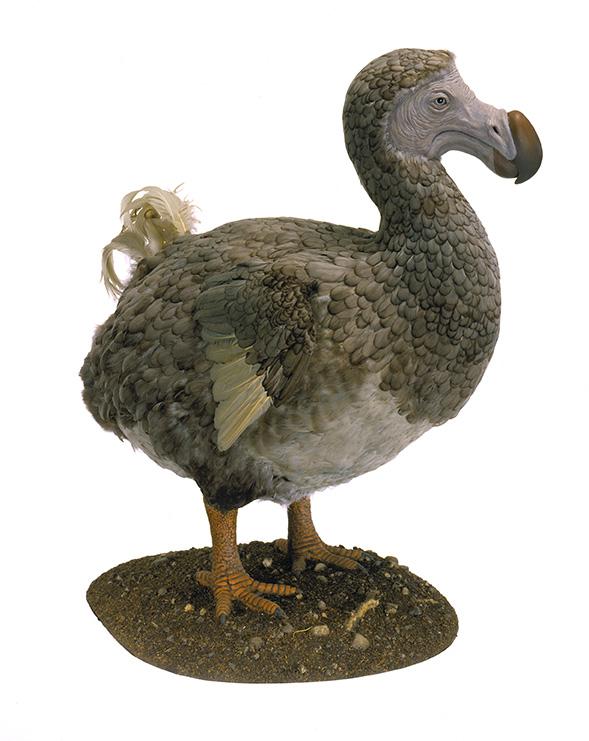
The appearance of the dodo is known only from 17th-century drawings, paintings, and written accounts. Consequently, its exact appearance in life remains uncertain. According to most depictions, the dodo had grayish or brownish plumage, lighter primary feathers, and a tuft of curly, light-colored feathers at its rear. Its head was gray and bare, its beak green, black, and yellow, and its legs stout and yellowish with black talons. Subfossil remains indicate that dodos stood approximately 62.6 to 75 cm tall. Sexual dimorphism was present; males were larger and had proportionally longer beaks. Weight estimates vary between studies, but the average body mass is thought to have been around 14.1 kg.
The skeletal anatomy of the dodo was adapted to a flightless lifestyle. Its pelvis was wider than that of its relatives, and its leg bones were more robust. A study by researchers at Stony Brook University revealed that the dodo’s brain size was proportional to its body size and that its intelligence was comparable to that of pigeons. Additionally, the dodo possessed an enlarged olfactory bulb, the part of the brain responsible for smell; this is an unusual trait among birds, which typically rely primarily on vision.

Image: Various historical drawings and modern reconstructions of the dodo. (Stony Brook University)
The evolution of the dodo was shaped by the isolated environment of Mauritius. The reduced need for flight and the absence of predators led to its evolution into a flightless form. Along with the Rodrigues solitaire, the dodo is believed to have formed a distinct lineage within the Columbidae family.
Genetic studies have confirmed that the Nicobar pigeon is the dodo’s closest living relative. These studies also indicate that the dodo and the Rodrigues solitaire diverged approximately 23 million years ago. Analysis of the dodo’s genome continues to provide further insights into the species’ evolutionary history and genetic structure.
The dodo became extinct in the late 17th century due to human activity and the introduction of invasive species to the island. First documented by sailors in the late 16th century, dodos showed no fear of humans and were easy to hunt. Overhunting, habitat loss, and the introduction of invasive species such as pigs, monkeys, and rats caused the dodo population to decline rapidly. The last confirmed sighting of a dodo is estimated to have occurred in 1662.
The arrival of humans on Mauritius proved catastrophic for the dodo. Sailors and settlers hunted the birds for food and also introduced invasive species that preyed on dodo eggs and damaged their habitat. The extinction of the dodo has become a symbol of the impact human activities can have on fragile island ecosystems.
The extinction of the dodo raised awareness about the importance of species conservation and biodiversity. Today, the story of the dodo continues to inspire efforts to protect endangered species and reduce the environmental impact of human activities.
Brassey, C. A., et al. "Convex-hull mass estimates of the dodo (Raphus cucullatus)." PMC, January 11, 2016. Accessed July 6, 2025. https://pmc.ncbi.nlm.nih.gov/articles/PMC4715441/.
Cambridge Core. “Dead as a Dodo” | TDR, March 10, 2023. Accessed July 6, 2025. https://www.cambridge.org/core/journals/the-drama-review/article/dead-as-a-dodo/5529A8D8C86D9B575042C0C957912303.
Carver, Robert E. "Dodo bird extinction." EBSCO Research Starters, Accessed July 6, 2025. https://www.ebsco.com/research-starters/science/dodo-bird-extinction.
Hume, J. P. "The Dodo and the Red Hen, A Saga of Extinction, Misunderstanding, and Name Transfer: A Review." MDPI, February 18, 2020. Accessed July 6, 2025. https://www.mdpi.com/2571-550X/3/1/4.
Institute of Science and Technology Austria (ISTA). "Scientists Revive Extinct Dodo." April 1, 2025. Accessed July 6, 2025. https://ista.ac.at/en/news/scientists-revive-extinct-dodo/.
Live Science. "Facts about the dodo." April 22, 2022. Accessed July 6, 2025. https://www.livescience.com/facts-about-the-dodo.
Rijsdijk, K. F., et al. "A review of the dodo and its ecosystem: insights from a vertebrate concentration Lagerstätte in Mauritius." Taylor & Francis Online, 2015, Accessed July 6, 2025, https://www.tandfonline.com/doi/full/10.1080/02724634.2015.1113803.
Stony Brook University. "Study Reveals Dodo Birds Not Stupid as Previously Thought." *SBU News*, February 23, 2016. Accessed July 6, 2025. https://news.stonybrook.edu/newsroom/press-release/general/2016-02-23-study-reveals-dodo-birds-not-stupid-as-previously-thought/.
van Heteren, A. H., et al. "Neither slim nor fat: estimating the mass of the dodo (Raphus cucullatus, Aves, Columbiformes) based on the largest sample of dodo bones to date." PMC, December 5, 2017. Accessed July 6, 2025. https://pmc.ncbi.nlm.nih.gov/articles/PMC5721909/.

https://news.stonybrook.edu/newsroom/press-release/general/2016-02-23-study-reveals-dodo-birds-not-stupid-as-previously-thought/
Morphology and Physical Characteristics
Anatomical Details
Evolution and Classification
Genetic Research
Extinction
Human Impact
Conservation Efforts