


This article was automatically translated from the original Turkish version.

Imagine one morning sipping your coffee and reading a striking piece of writing. Then you learn it was generated by an artificial intelligence (AI). Does something inside you change? Does the writing still feel “creative”?
With the 2020s, literature journalism and content creation have entered an entirely new phase. Models like GPT Claude and Gemini do not merely write texts—they behave as if they were authentic authors. But the real question is:
Does artificial intelligence create or merely imitate?
Texts written by AI can be poetic accurate and even compelling. But is it fair to place a writer who has spent decades honing their craft alongside an algorithm that produces text in seconds?
“Artificial intelligence does not draw inspiration feel pain or suffer. Therefore what it writes is not literature but a simulation of literature.” — Emrah Polat 2024
Literature is not merely a collection of words. It is rooted in lived experience pain hope contradiction and thought. Can AI provide this?
AI models are massive algorithms trained on billions of words. They recombine what they have learned statistically. A 2023 Stanford University study revealed that certain sections of AI-generated writing are indistinguishable from those produced by human authors. Yet the vast majority of these texts are derivative versions of prior content.
“An AI can write like Shakespeare… but it is not Shakespeare.”
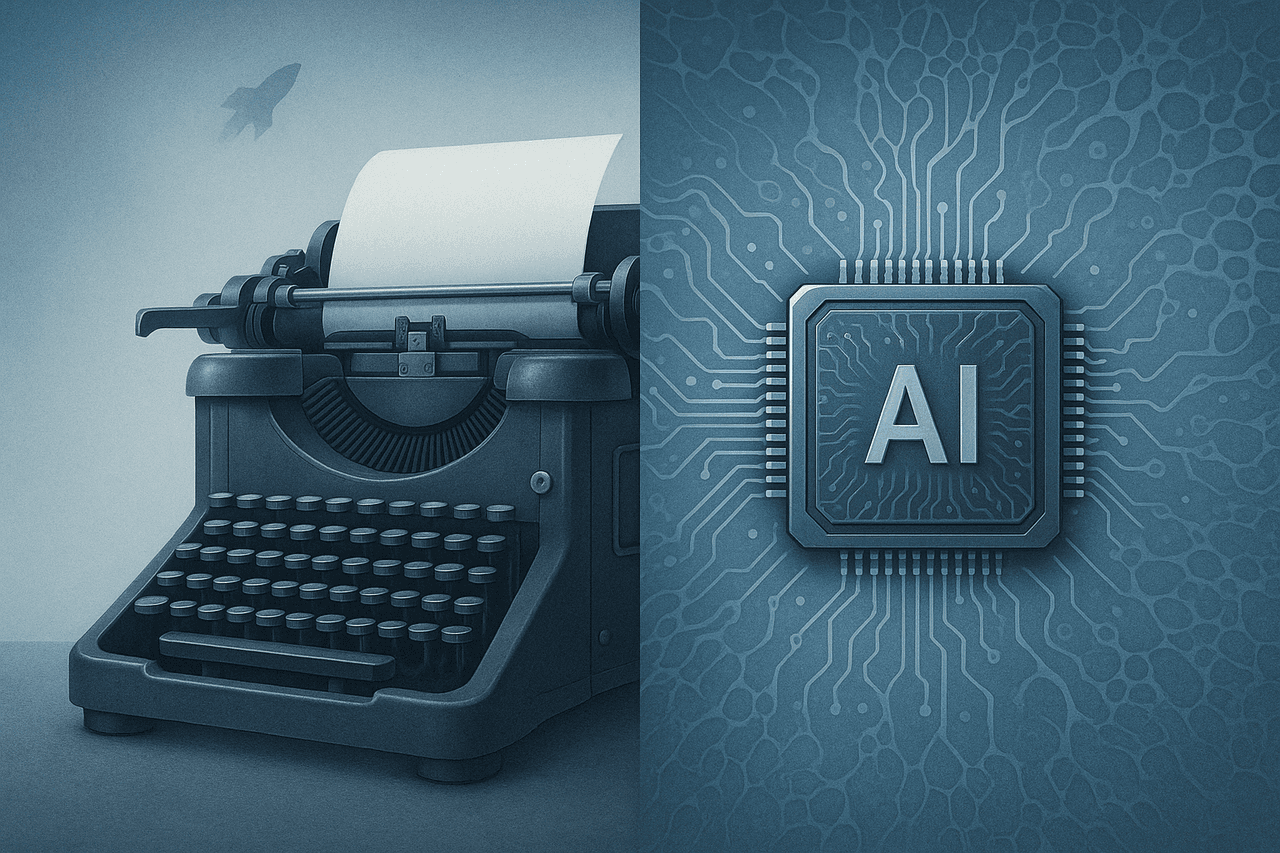
From Pen to Code: The Transformation of Literature by AI
AI can construct impressive sentences but cannot build a narrative infused with emotion. Because elements like empathy and inner conflict are rooted in uniquely human experiences. Yet we must ask this question:
Can empathy be imitated?
As a language model AI can analyze thousands of emotional expressions and produce a formal “simulation of empathy.” It can define the grief of a mother who lost her child the hope lost in war or the loneliness after a separation. Yet it does not truly experience these emotions—it only predicts them based on observed data. Like an actor’s tears: the audience is moved but those tears stem not from real pain but from acting skill. AI’s “empathy” remains at this level: a narrator who performs but does not live.
Artificial intelligence was once merely a tool—it is now a potential collaborator and even a rival. Some writers view AI-assisted content production as a threat to literary originality and professional effort. They argue that AI generates an abundance of content while eroding high-quality authorship. According to this view “easily produced texts” devalue narratives born of lived experience. Yet for other writers this change is not destruction but evolution. These writers see AI as a source of ideas a drafting assistant or a writing aid and argue that literature concerns essence not form.
American writer Robin Sloan is among those who embraced this transformation early. In 2020 while drafting a novel he used OpenAI’s GPT-2 model as a “creative partner.” Yet Sloan limited this use with this statement:
“It provides the words but I decide what to say.” — Robin Sloan “A Year of New Words” 2020
According to a 2023 report by PEN America the future of literary production lies not in outright rejection of AI but in conscious integration. The report warns:
“Writers should focus on using artificial intelligence ethically transparently and in alignment with creative processes.” — PEN America “Artificial Intelligence and Authorship” 2023
Similarly The Atlantic writer Ian Bogost argues that AI-assisted writing resembles “collage art rather than autobiography”:
“AI authorship does not arise from lived experience like classical authorship; it is a carefully curated form of copying.” — Ian Bogost The Atlantic 2023
Every technological leap changes the form and methods of art—but not its essence.
Just as the printing press buried handwritten manuscripts and opened knowledge to the public AI in the digital age is bringing literature to the threshold of a new era. To some this change is a crisis to others a creative revolution.
Works written with AI can be formally satisfying especially in short stories essays and advertising copy. Yet narrative depth emotional consistency and layers of subjective meaning still emerge from human experience.
“Artificial intelligence did not kill literature—it accelerated and expanded it. The real question is: Does this speed harm the soul of storytelling?” — Katherine Hayles “Writing Machines” 2002
In publications such as Literary Hub and The Guardian a recurring debate in recent years has been whether the rise of AI-generated texts will render human authorship invisible.
After co-writing a story with OpenAI writer Stephen Marche remarked:
“I provided the ideas; AI provided the language. It was a writer-editor collaboration—but who is truly the author?” — Stephen Marche The Atlantic 2022
Such collaborations reveal not a change in literature but a transformation in the definition of authorship. Authorship is no longer solely the inner explosion of a single individual—it may become a multilayered creative process driven by human-machine collaboration.
Literature is not dying. But a shift in eras is underway. And this new era advances not only through emotion but through the synthesis of emotion and data.
Let us not forget: What makes a novel valuable is not that it is “correctly” written but that it touches through its human depth. AI may learn this… but it cannot feel it.
Therefore readers of literature must now ask this question:
“Is this writing beautiful?” not “Who truly wrote this?”
At the beginning we asked: “Can artificial intelligence write or does it merely copy?” Now let us end with another question:
How much of this text reflects human effort and how much is the contribution of artificial intelligence?
Perhaps some passages feel intuitive and warm while others seem overly smooth and systematic. Can we truly distinguish between them? This increasingly blurred boundary appears destined to define the literature of the digital age.
The time has come to ask of every text every line and every story:
Not “Who wrote it?” but “How was it written?”
Admin, & Admin. (2023, June 21). Yapay zekâ mı yalan makinesi mi? | Metin Celâl | Edebiyat Haber. *Edebiyat Haber | Türkiye’nin Edebiyat Platformu*. https://www.edebiyathaber.net/yapay-zeka-mi-yalan-makinesi-mi-metin-celal/
Admin, & Admin. (2025, July 9). Yapay zeka çağında yazar gerçekten ölüyor mu? | Emrah Polat | Edebiyat Haber. *Edebiyat Haber | Türkiye’nin Edebiyat Platformu*. https://www.edebiyathaber.net/yapay-zeka-caginda-yazar-gercekten-oluyor-mu-emrah-polat/
Sloan, R. (2020). *A Year of New Words*. https://www.robinsloan.com
The Literary Crisis of the Digital Age
The Algorithm’s Pen: Where Is the Real Author?
Creativity or Data Mashup?
The Power and Limits of AI
The Future of Writers: Threat or Transformation?
Is Literature Dying or Evolving?
How Much of This Text Is AI and How Much Is Human?