


This article was automatically translated from the original Turkish version.
+1 More
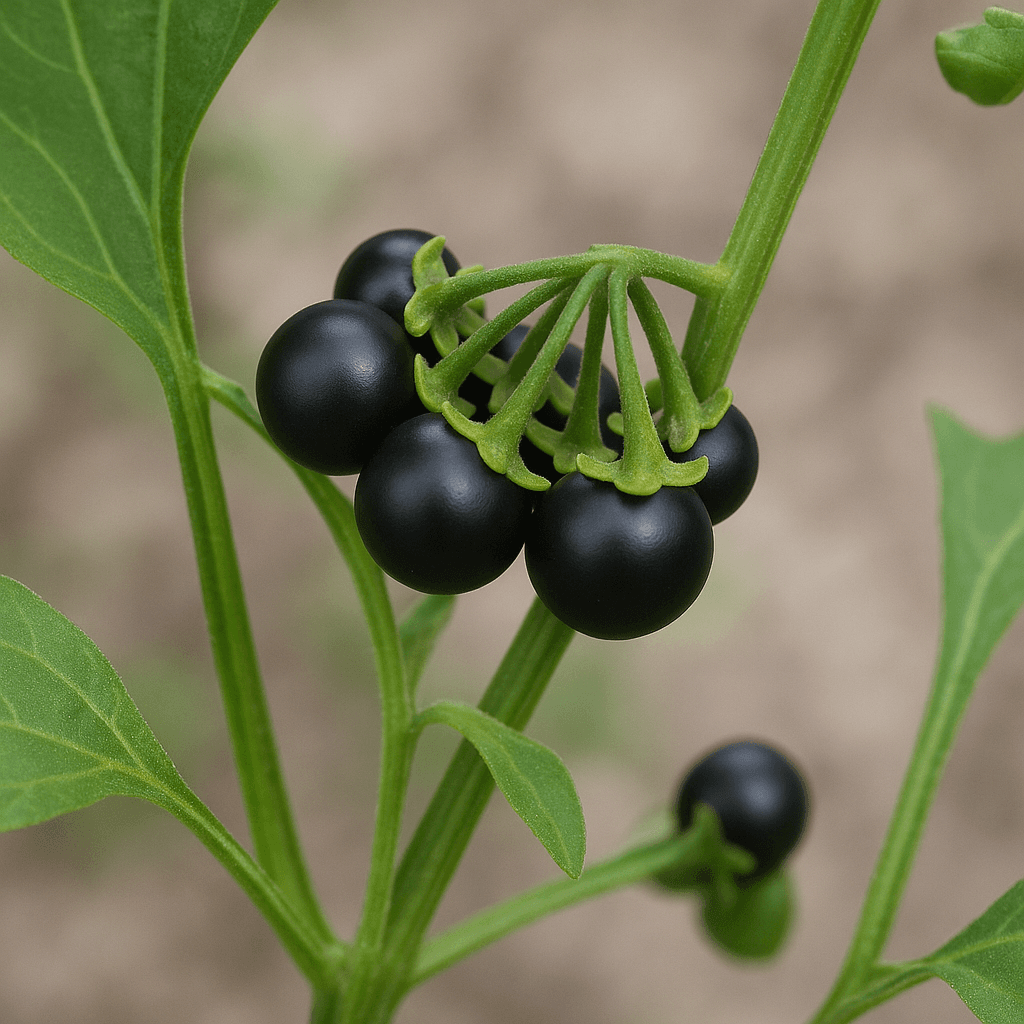
Köpek Üzümü (Solanum nigrum L.) (Yapay zeka tarafından oluşturulmuştur)
Black nightshade (Solanum nigrum L.) is a herbaceous plant belonging to the Solanaceae (nightshade) family, either annual or perennial. It commonly grows spontaneously along road edges, within fields, gardens, grasslands, and fallow areas. It is widely recognized as a common weed species. Black nightshade exhibits a broad distribution worldwide and is naturally found in the flora of Türkiye. Other common folk names for this plant include “karaçilek”, “it üzümü”, and “kara ot”.
The black nightshade plant can reach an average height of 20–60 cm and has green stems, occasionally with a purplish tint. The stem may be upright or prostrate and is typically hairy. Leaves are alternate, oval or elliptical in shape, with toothed margins. Flowers are white, five-petaled, and usually pendulous. Flowering generally begins in summer and can continue into autumn. Fruits are small, juicy, spherical, and dark purple approaching black. Unripe fruits are green and darken as they mature.
Black nightshade is a resilient species capable of growing in various soil types. It exhibits faster development especially in nitrogen-rich soils. It is commonly found in areas cultivated with summer crops and can thrive in sunny or partially shaded environments. Reproduction occurs primarily through seeds; a single plant can produce thousands of seeds during one growing season. Seeds retain viability in the soil for several years.
Black nightshade is commonly encountered in agricultural fields and can compete with crop plants, leading to yield losses. When it forms dense populations, particularly in vegetable fields, it negatively affects the growth of the main crop by interfering with processes such as photosynthesis and nutrient uptake. It is also known to act as a vector or alternate host for certain plant viruses.
Different levels of resistance to chemical control methods increase the importance of this species in agricultural management. Additionally, because certain components of black nightshade (e.g., solanine) exhibit toxic effects, it is considered an undesirable species in forage mixtures intended for animal feed.
In some countries, the ripe fruits or young shoots of black nightshade are processed to eliminate their toxic effects and used as folk remedies or food. However, such uses require controlled knowledge and experience. In Türkiye, this plant is generally classified as a weed and regarded as an undesirable species in agricultural production.
Solanum nigrum is one of the most common and significant weed species in Turkish agricultural areas requiring management. Its morphological and biological characteristics make it well-adapted to diverse environments. Due to its negative impact on agricultural production, it must be carefully monitored and appropriate control strategies developed.
Aksoy, Eda. “Köpek Üzümü (Solanum nigrum L.).” Türkiye Herboloji Derneği Yayını. https://www.turkiyeherboloji.org.tr/upload/File/YabanciOt/17-SOLNIG.pdf.
Baltacıer, Gamze; Donat, Sevgi and Acar, Okan. “Solanum nigrum L. (Köpek Üzümü)’un Kuraklık ve Tuz Stresine Fizyolojik Tepkilerinin Karşılaştırılması.” Turkish Journal of Weed Science, 26(3), 225-231. https://dergip ark.org.tr/tr/pub/tjws/issue/82220/1396667.
Kumral, Nabi; Çobanoğlu, Sultan. “Köpek üzümü bitkilerinin (Solanaceae) zararlı veya avcı akarlar için barınak bitki olma potansiyelleri.” *Turkish Journal of Entomology* 39, no. 1 (April 2015): 91–108. https://dergipark.org.tr/tr/pub/entoted/issue/5706/76293.

Köpek Üzümü (Solanum nigrum L.) (Yapay zeka tarafından oluşturulmuştur)
No Discussion Added Yet
Start discussion for "Dogberry (Solanum nigrum L.)" article
Morphological Characteristics
Biological and Ecological Characteristics
Detrimental Effects and Agricultural Significance
Benefits and Potential Uses