


This article was automatically translated from the original Turkish version.
+1 More
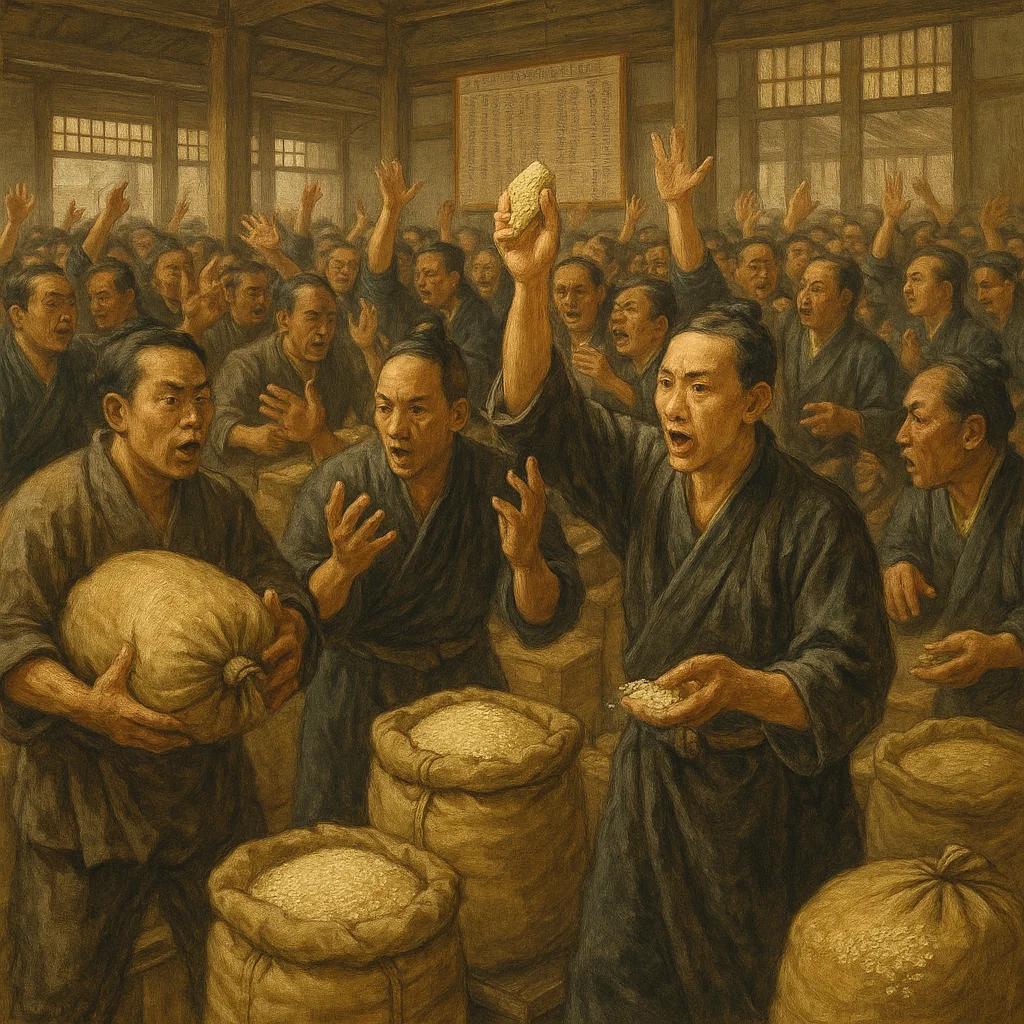
Generated with artificial intelligence.
Dojima Rice Exchange
Founding Year | 1730 (Informal beginning: 1697) | ||||||||
|---|---|---|---|---|---|---|---|---|---|
Location | Osaka Japan | ||||||||
Historical Significance | The world's first organized futures exchange | ||||||||
Transaction Type | Futures contracts for rice | ||||||||
The Dojima Rice Exchange, established in the 18th century in Osaka, Japan, became one of the pivotal turning points in financial history. This exchange is recognized not only as a catalyst for the development of the Japanese economy but also as a forerunner of structural change in the global financial system. The commercial practices developed at Dojima laid the foundations for modern futures and derivatives markets and shaped the evolution of financial instruments.
During Japan’s Edo period (1603–1868), the economic system was based on a feudal structure, yet trade activity flourished significantly in certain urban centers. Osaka, a port city located in western Japan, served as the center of rice production and trade. This region became the focal point of economic relationships among the imperial household, the daimyo class, and merchants, all conducted through rice. During this era, rice was not merely a foodstuff but also a standard of value and a medium of payment. Feudal lords received the majority of their tax revenues in rice and converted these revenues into cash through merchants in Osaka.
This economic structure necessitated a shift beyond physical delivery of goods, creating a demand for setting prices today for rice to be delivered in the future. Such transactions began informally in 1697 and acquired an organized structure in 1730, when the Dojima Rice Exchange was formally established. Thus, the world’s first organized futures exchange came into operation.

Generated by artificial intelligence
Transactions at the Dojima Exchange were based on contracts for future delivery. These contracts obligated parties to deliver a specified quantity of rice on a predetermined date, with the price fixed in advance. This practice enabled participants to hedge against price fluctuations and engage in economic planning for the future.
The exchange also employed documents known as “rice tickets,” which were traded without any physical delivery of rice. This system constituted a primitive version of today’s derivative instruments. Through the buying and selling of these tickets, profit could be made solely based on price expectations, without any spot market transactions. This practice also paved the way for the first speculative trades and risk-hedging strategies.
One of the most notable features of the Dojima Exchange was its successful fulfillment of the price discovery function. The transparent determination of rice prices according to supply and demand contributed to the formation of reference prices used throughout Japan. It also helped maintain price stability between producers and consumers.
The institutionalization of trade strengthened the economic and social standing of the merchant class. Osaka became a center for economic decision-making in Japan, leading to increased political influence for merchants. Furthermore, the establishment of price stability provided reliable data that could serve as a reference for state interventions during periods of scarcity.
The structure developed at Dojima served as a direct model for modern futures exchanges established in the Western world during the 19th century. The founding principles of exchanges such as the Chicago Board of Trade (CBOT) were influenced by Dojima’s structural principles. The mitigation of price volatility, forward price determination, and standardization became foundational pillars of modern financial markets.
Moreover, the Dojima model provides a crucial example for understanding the evolutionary development of today’s forward, futures, and options contracts. The origins of modern derivative products used across diverse sectors—such as energy, agriculture, indices, and foreign exchange—can be traced back to this historical exchange.
The historical significance of the Dojima Rice Exchange extends beyond its status as the world’s first organized futures market. It also successfully fulfilled core functions of modern financial systems—including market transparency, price stability, risk hedging, and the reduction of information asymmetry among economic actors—at an early stage.
Dojima demonstrated how financial institutions could shape operations based not merely on capital but on information and foresight. Even today, the institutional structure and trading methods of this exchange are studied as case examples in financial education and market historiography.
The Dojima Rice Exchange is a unique historical precedent that laid the foundations of modern financial market structures. Emerging in the 18th-century Japanese economy, this institution introduced an organized futures system ahead of its time and served as a vital instrument for achieving economic stability. In this regard, it played a significant role not only in Japan’s development but also in shaping the history of global finance. The first institutional application of mechanisms such as price discovery, risk management, and speculation has cemented the Dojima Exchange as one of the cornerstones of financial history.
Adalı, Zafer, and K.S. Kalyoncuoğlu. "8.1. Türev Piyasaların Tanımı ve Özellikleri." ResearchGate. Accessed https://www.researchgate.net/profile/Zafer-Adali/publication/326998229_Unite_8_Forward_ve_Futures_Piyasalar/links/5b72e94ba6fdcc87df79f16c/Uenite-8-Forward-ve-Futures-Piyasalar.pdf.
Bayındır, M.S. *Bankacılık Sektöründe Türev Araçlarının Yeri ve Türk Bankacılık Sektörüne Etkileri*. İstanbul Üniversitesi. Accessed https://nek.istanbul.edu.tr/ekos/TEZ/54810.pdf.
Deniz, A.G.D.M.H., and O. Özçelebi. “Küresel Rekabet Koşullarında Türkiye’de Lisanslı Depoculuğun Gelişmesinin Türk Tarım Ürünlerinin Rekabet Gücüne Etkisi.” *İstanbul Üniversitesi İktisat Fakültesi Dergisi*, 2011. Accessed https://dergipark.org.tr/en/download/article-file/8552.
Ekiz, Ömer. *Vadeli İşlem Sözleşmelerinin Volatilite Modelinde Varyans Faktörü Olarak İşlem Miktarı ve Döviz Kuru: BIST30 Endeks Vadeli İşlem Sözleşmesi Üzerine Bir Uygulama*. İstanbul Ticaret Üniversitesi, 2020. Accessed https://acikerisim.ticaret.edu.tr/bitstreams/35effda1-b698-4906-9783-c94f1366ef76/download
Güzel, Fatih. *Spot ve Türev Piyasaların Fiyat Keşfi ve Volatilite Etkileşimlerinin Analizi: Borsa İstanbul Üzerine Ampirik Bir Uygulama*. PhD thesis, İstanbul Üniversitesi, 2021. Accessed https://iav.org.tr/wp-content/uploads/2020/07/Fatih_GUZEL_Doktora_2021.pdf
Hancı, A., and D. Akçalı. *Türkiye'de Türev Araçların Bankacılık Sektörüne Etkileri*. İstanbul Üniversitesi. Accessed https://nek.istanbul.edu.tr/ekos/TEZ/ET001914.pdf.
Işık, Orhan Osman. *Hukuki Açıdan Borsa ve Borsa Türleri*. Yalova Üniversitesi. Accessed https://yalova.edu.tr/Files/UserFiles/83/10_Isik.pdf.
Nadirgil, Ozan. *Avrupa Birliği ve Türkiye’deki Ticari Ürün Borsaları ve Karşılaştırmalı Analizi*. Master's thesis, Ministry of Agriculture and Forestry, 2015. Accessed http://www.tarim.gov.tr/ABDGM/Belgeler/%C4%B0DAR%C4%B0%20%C4%B0%C5%9ELER/Uzmanlik%20Tez%20may%C4%B1s%202015/Ozan%20Nadirgil.pdf
Suna, K. “Forward, Türev Piyasaları, Futures ve Opsiyonlar Üzerine Teorik Bir Araştırma.” Parion Akademik Bakış Dergisi, 2024. Accessed https://dergipark.org.tr/en/pub/pabd/issue/82909/1383077
Yılmaz, S. “Türkiye'de Finansal Piyasaların İçerisinde Vadeli İşlem ve Opsiyon Borsası'nın Etkinliği.” Master's thesis, İstanbul Üniversitesi. Accessed https://nek.istanbul.edu.tr/ekos/TEZ/47283.pdf.

Generated with artificial intelligence.
Dojima Rice Exchange
Founding Year | 1730 (Informal beginning: 1697) | ||||||||
|---|---|---|---|---|---|---|---|---|---|
Location | Osaka Japan | ||||||||
Historical Significance | The world's first organized futures exchange | ||||||||
Transaction Type | Futures contracts for rice | ||||||||
No Discussion Added Yet
Start discussion for "Dojima Rice Exchange" article
Historical Background and Reasons for Establishment
Operational Mechanism and Financial Innovations
Economic and Social Impacts
The Influence of the Dojima Model on the Global Financial System
Evaluation and Historical Legacy