


This article was automatically translated from the original Turkish version.
+2 More
Dual Coding Theory
Theorist | Allan Paivio | ||||||||
|---|---|---|---|---|---|---|---|---|---|
Year(s) | 1971 | ||||||||
Application Area(s) | Education E-learning Psychology | ||||||||
The Dual Coding Theory (English: Dual Coding Theory) is a cognitive learning theory that posits individuals learn and recall information more effectively when both verbal and visual representations are used simultaneously. Proposed in 1971 by Canadian psychologist Allan Paivio, this theory is based on the assumption that information processing occurs through two fundamental systems: the verbal system and the nonverbal or imagery system. According to the theory, the interaction and parallel operation of both systems enhance the quality of learning and lead to stronger representations in memory.
The core claim of the theory is that when the human mind interacts with information, more durable learning occurs if the information is encoded through multiple symbolic systems rather than a single channel. This has important implications not only for educational psychology but also for fields such as visual design media literacy and human-computer interaction.
The verbal system refers to the cognitive structure responsible for processing language-based information. It plays a role in the perception analysis interpretation and storage of written and spoken language. This system is active during activities such as reading speaking writing and listening. Representations are constructed through words and sentence structures. For example when we hear the word “apple” the verbal system processes the linguistic information associated with it.
The visual system generates mental representations of objects shapes scenes and other visual content. This system is not limited to the sense of sight; it also encompasses the individual’s ability to generate and mentally reconstruct images. The visual system is associated with spatial relationships face recognition symbols diagrams and imagery. For instance when we hear the word “apple” we not only process the word but also mentally visualize the image of an apple. This process activates the visual system.
The original contribution of the Dual Coding Theory lies in its emphasis on the capacity of these two systems to work together. When information is encoded through both verbal and visual pathways multiple traces are created in memory. This increases the likelihood of successful recall because multiple retrieval routes are available. Moreover since these systems operate in a complementary manner the process of meaning construction becomes more profound.
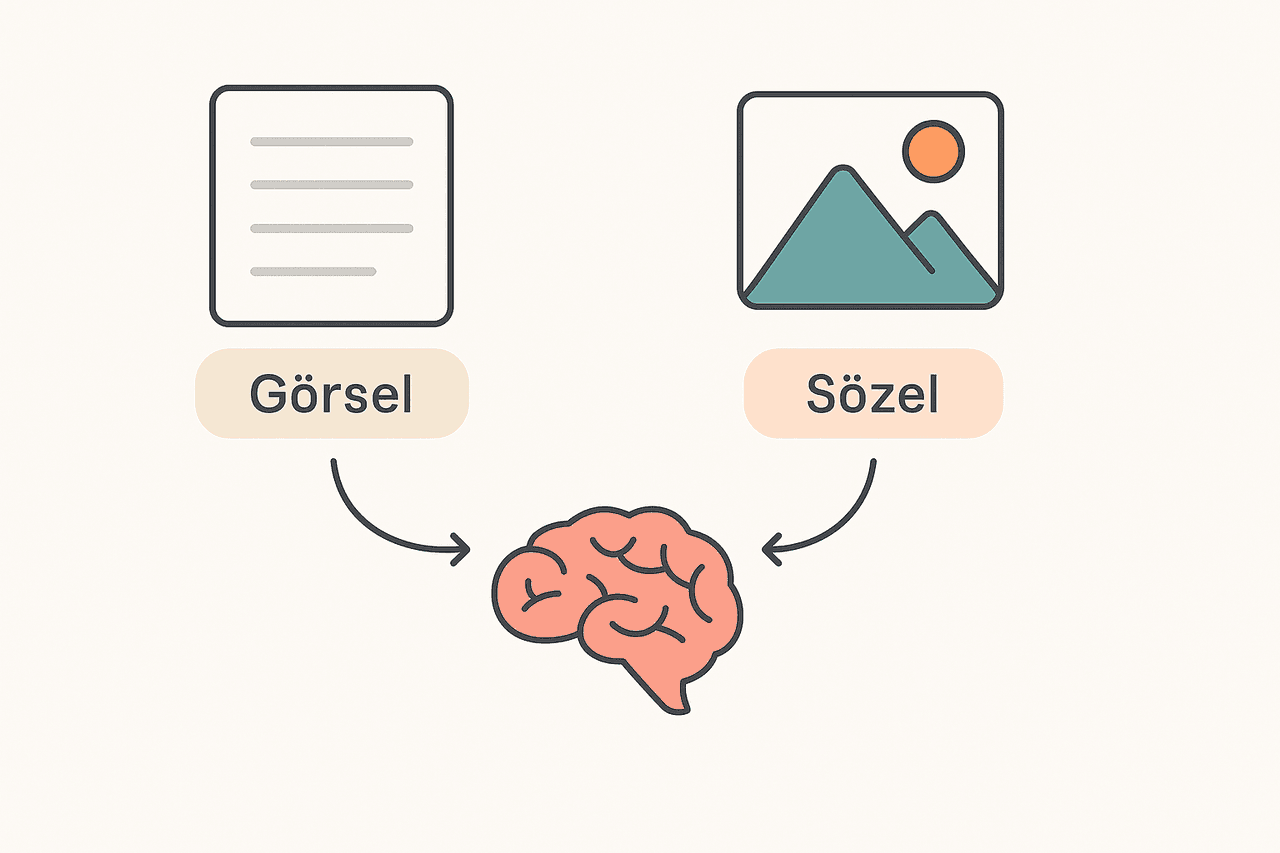
The Dual Coding Theory aligns with contemporary cognitive models that support a multichannel structure of memory. Particularly during the transition between short-term memory and long-term memory simultaneous verbal and visual encoding facilitates learning. This process can be summarized as follows:

(Generated with the assistance of artificial intelligence.)
The Dual Coding Theory has found broad application in instructional design and content development. The theory recommends the combined use of visual and verbal elements to make information more comprehensible and enduring for learners. Educational methods aligned with this theory include:
For instance in a geometry lesson if the concept of “parabola” is explained only verbally students may struggle to mentally visualize it. However when presented simultaneously with a graph both the definition and the visual representation are learned together. This can enhance understanding and facilitate transfer to long-term memory.
Modern neuroimaging techniques particularly fMRI and PET scans have shown that verbal and visual stimuli are processed in distinct cortical regions of the brain. Linguistic content is typically processed in the left temporal lobe and the Broca-Wernicke areas while visual content is more densely represented in the occipital lobe and parietal regions of the right hemisphere. Additionally neural connections between the two systems have been observed. These findings provide scientific support for the neurological basis of the Dual Coding Theory.
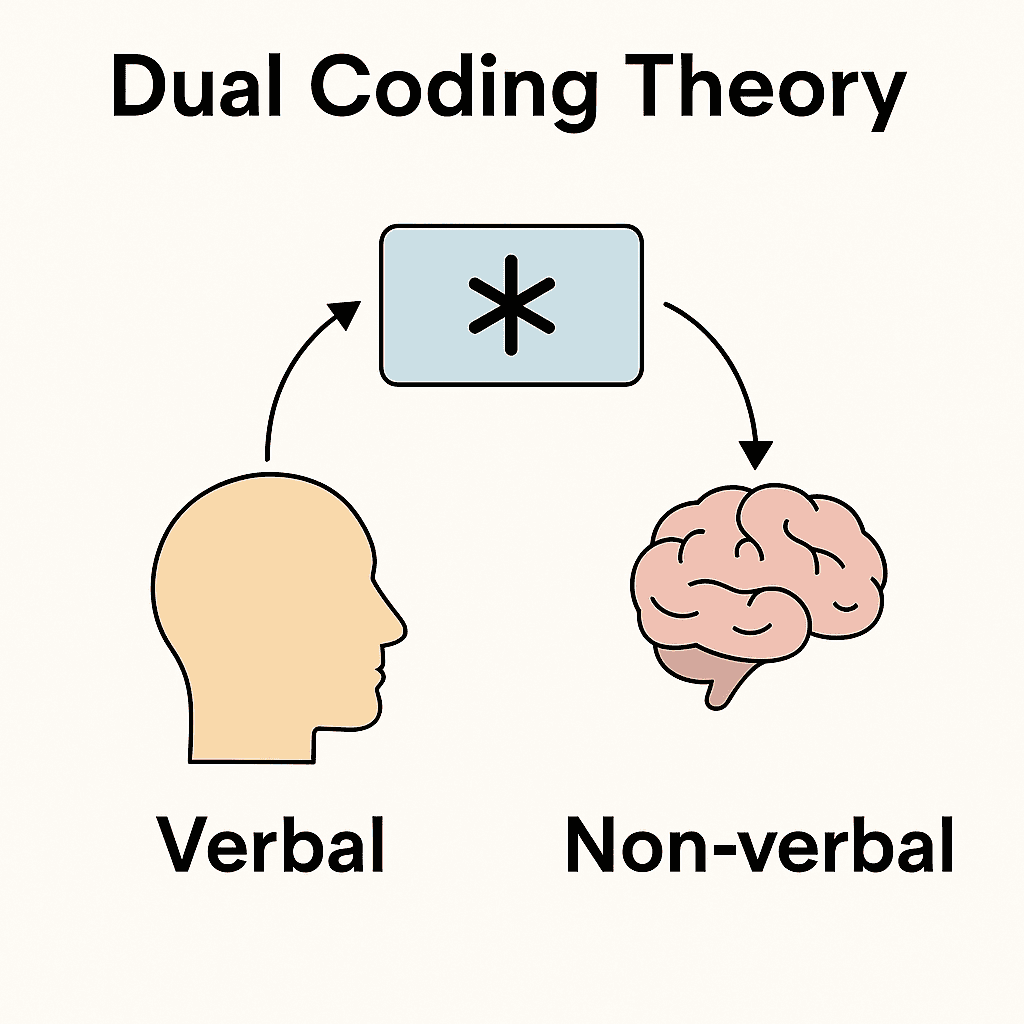
(Generated with the assistance of artificial intelligence.)
Although the Dual Coding Theory is widely accepted it has several limitations:
The Dual Coding Theory is closely related to the Multimedia Learning Theory developed by Richard Mayer. This theory argues that learning is more effective when verbal and visual channels are used together. Mayer’s “simultaneous presentation principle” and “modality principle” are directly grounded in Paivio’s dual coding approach.
The theory also intersects conceptually with working memory models Paivio’s imagery research cognitive load theory Gardner’s theory of multiple intelligences and cognitive theory-based instructional design models.
In conclusion the Dual Coding Theory is a contemporary approach that supports learning through multiple pathways rather than a single channel. It has broad applications in both cognitive psychology and educational technology. Supported at both theoretical and empirical levels this approach has become one of the foundational principles in the design of digital educational materials today.
Clark, Ruth Colvin, and Richard E. Mayer. *E-Learning and the Science of Instruction: Proven Guidelines for Consumers and Designers of Multimedia Learning.* 4th ed. San Francisco: Pfeiffer, 2016. https://www.researchgate.net/publication/264477172_E Learning_and_the_Science_of_Instruction_Proven_Guidelines_for_Consumers_and_Designers_of_Multimedia_Learning.
Mayer, Richard E. “Multimedia Learning.” *Psychology of Learning and Motivation* 41 (2002): 85–139. Accessed May 10, 2025. .
Paivio, Allan and Clark, Jim. “Dual Coding Theory and Education.” In *Pathways to Literacy Achievement for High-Poverty Children*, edited by Susan Neuman and David Dickinson. Newark, DE: International Reading Association, 2001. https://www.researchgate.net/publication/225249172_Dual_Coding_Theory_and_Education.
Paivio, Allan. *Imagery and Verbal Processes.* New York: Holt, Rinehart & Winston, 1971. https://archive.org/details/imageryverbalpro0000paiv.

Dual Coding Theory
Theorist | Allan Paivio | ||||||||
|---|---|---|---|---|---|---|---|---|---|
Year(s) | 1971 | ||||||||
Application Area(s) | Education E-learning Psychology | ||||||||
Theoretical Foundations
Verbal System
Visual-Imaginal System
Interaction Between Systems
Cognitive Processes and Memory Dynamics
Applications in Education
Application Example
Neuroscientific Findings and Supporting Evidence
Criticisms and Limitations
Relationship with Other Theories