


This article was automatically translated from the original Turkish version.
+2 More
The Short and Long Pathways of Emotion – LeDoux’s Theory is a neuroscientific model proposed by American neuroscientist Joseph LeDoux in 1996 and 2002 to explain how the brain processes emotional responses. According to the theory, emotional stimuli are processed in the brain via two distinct pathways: a fast direct and unconscious short path (low road) and a slower more detailed and conscious evaluation-based long path (high road). This model is significant because it demonstrates how the brain generates responses at different levels particularly in the processing of vital emotions such as fear and threat perception.
The short path occurs when emotional stimuli are transmitted directly from the thalamus to the amygdala. This pathway produces a rapid but less detailed emotional response and is crucial for immediate reactions to dangerous situations. The short path generates a direct fear or defensive response without any conscious evaluation process.
The long path involves the transmission of emotional stimuli from the thalamus to the sensory cortex where they are processed in greater detail before being sent to the amygdala. Although this pathway operates more slowly it allows for a more accurate and nuanced assessment of the stimulus. This mechanism helps reduce false alarms.
The Dual Pathways theory explains how emotions are processed both rapidly and in detail highlighting the importance of fast survival responses such as the escape reflex and cognitive evaluations such as analyzing the validity of a threat. LeDoux’s work has been supported particularly by fear conditioning experiments.
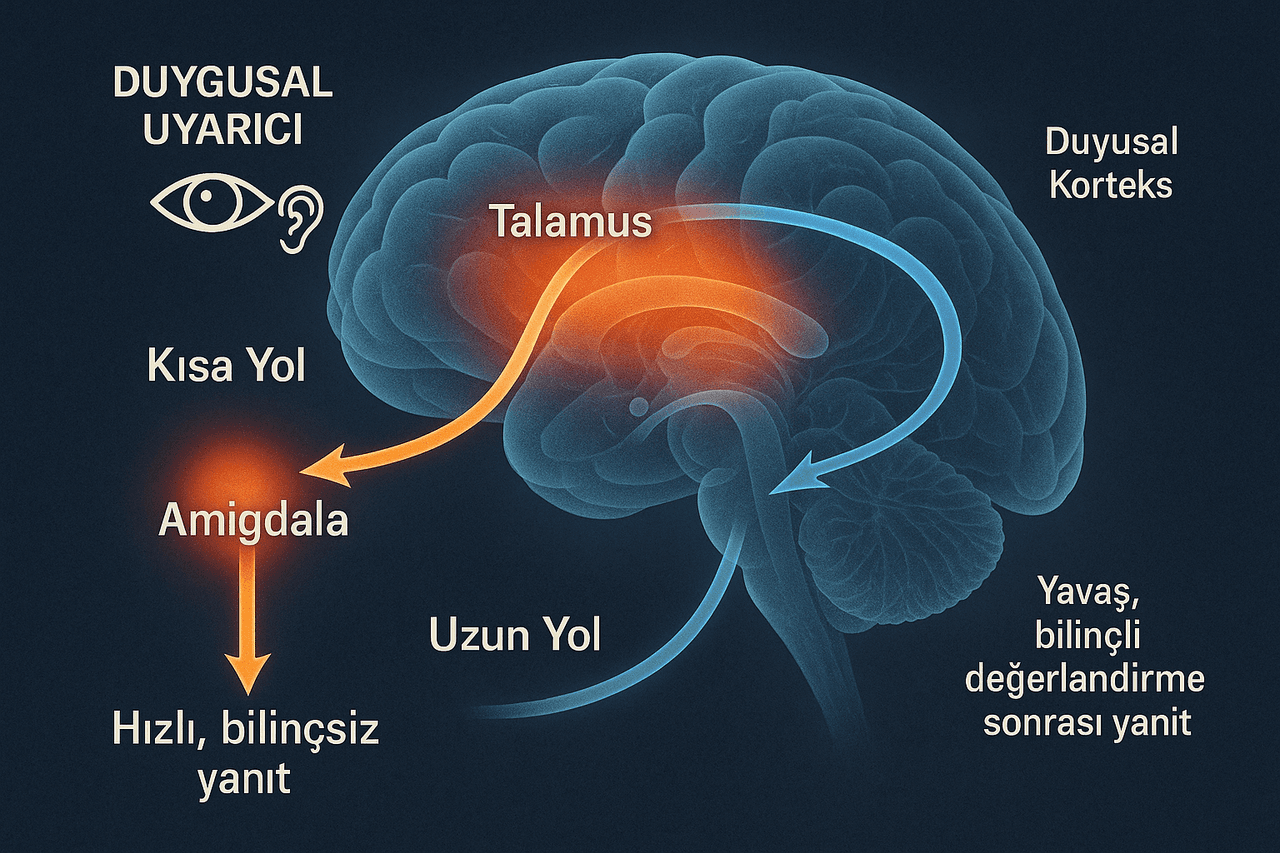
Emotional Brain Map Image (Generated by artificial intelligence)
The Dual Pathways model has had an impact not only in neuroscience but also across various disciplines and applications:
Joseph LeDoux’s Dual Pathways model has demonstrated that emotional responses are not merely products of conscious thought but are also governed by evolutionarily developed rapid automatic mechanisms essential for survival. This dual structure has paved the way for new applications in both clinical psychology and technology regarding fear anxiety and threat perception. The theory provides a comprehensive perspective on the neurobiological foundations of human behavior.
Barrett, Lisa Feldman. How Emotions Are Made: The Secret Life of the Brain. Boston: Houghton Mifflin Harcourt, 2017.
Damasio, Antonio R. Descartes’ Error: Emotion, Reason, and the Human Brain. New York: Avon Books, 1994.
LeDoux, Joseph E. Anxious: Using the Brain to Understand and Treat Fear and Anxiety. New York: Viking, 2015.
LeDoux, Joseph E. Synaptic Self: How Our Brains Become Who We Are. New York: Viking Penguin, 2002.
LeDoux, Joseph E. The Emotional Brain: The Mysterious Underpinnings of Emotional Life. New York: Simon & Schuster, 1996.
Panksepp, Jaak. Affective Neuroscience: The Foundations of Human and Animal Emotions. New York: Oxford University Press, 1998.

No Discussion Added Yet
Start discussion for "Dual Pathways (LeDoux Theory)" article
Short Path (Low Road)
Long Path (High Road)
Significance
Applied Implications
LeDoux’s Works