


This article was automatically translated from the original Turkish version.
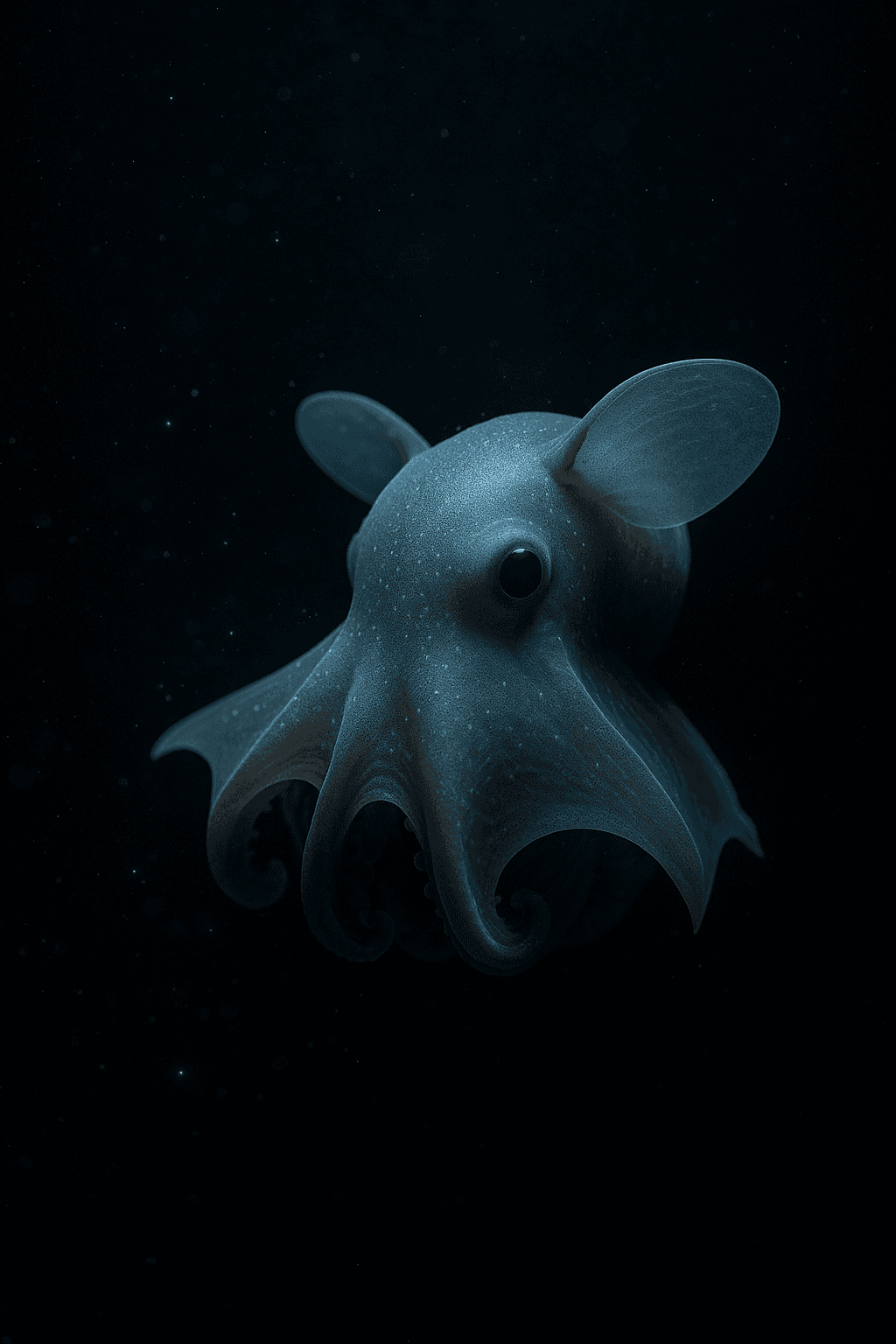
Dumbo octopus (Grimpoteuthis), is a rare and rarely observed genus of cephalopod that inhabits deep oceans. It derives its name from ear-like fins that resemble the famous Disney character Dumbo. These fins assist the animal in gliding through the water. Typically found at depths of 3,000 to 5,000 meters, these creatures live in the dark and high-pressure regions of the ocean. Scientific research has provided significant insights into the morphology, behavior and reproductive strategies of Dumbo octopuses.
Dumbo octopuses are approximately 20 to 30 centimeters in length and possess a soft, jelly-like body structure. Large fins located above their heads give them a distinctive appearance and aid in locomotion. Their eight arms are connected by thin membranes, a structure that is effective for capturing prey and exploring their environment. Additionally, small projections on these arms help them detect and navigate water currents. The brain of the Dumbo octopus is protected within a cartilaginous structure, and its advanced nervous system enables complex behaviors and rapid responses to environmental stimuli. Its gills are situated within the mantle cavity and continuously extract oxygen through a steady flow of water.
These octopuses typically glide near the ocean floor. By flapping their fins and directing their arms, they can move in any desired direction. Their feeding habits have adapted to the deep-sea environment. They feed on small crustaceans, marine worms and other invertebrates. Since they lack teeth, they swallow their prey whole. The projections on their arms play a crucial role in capturing prey and guiding it toward their mouths.
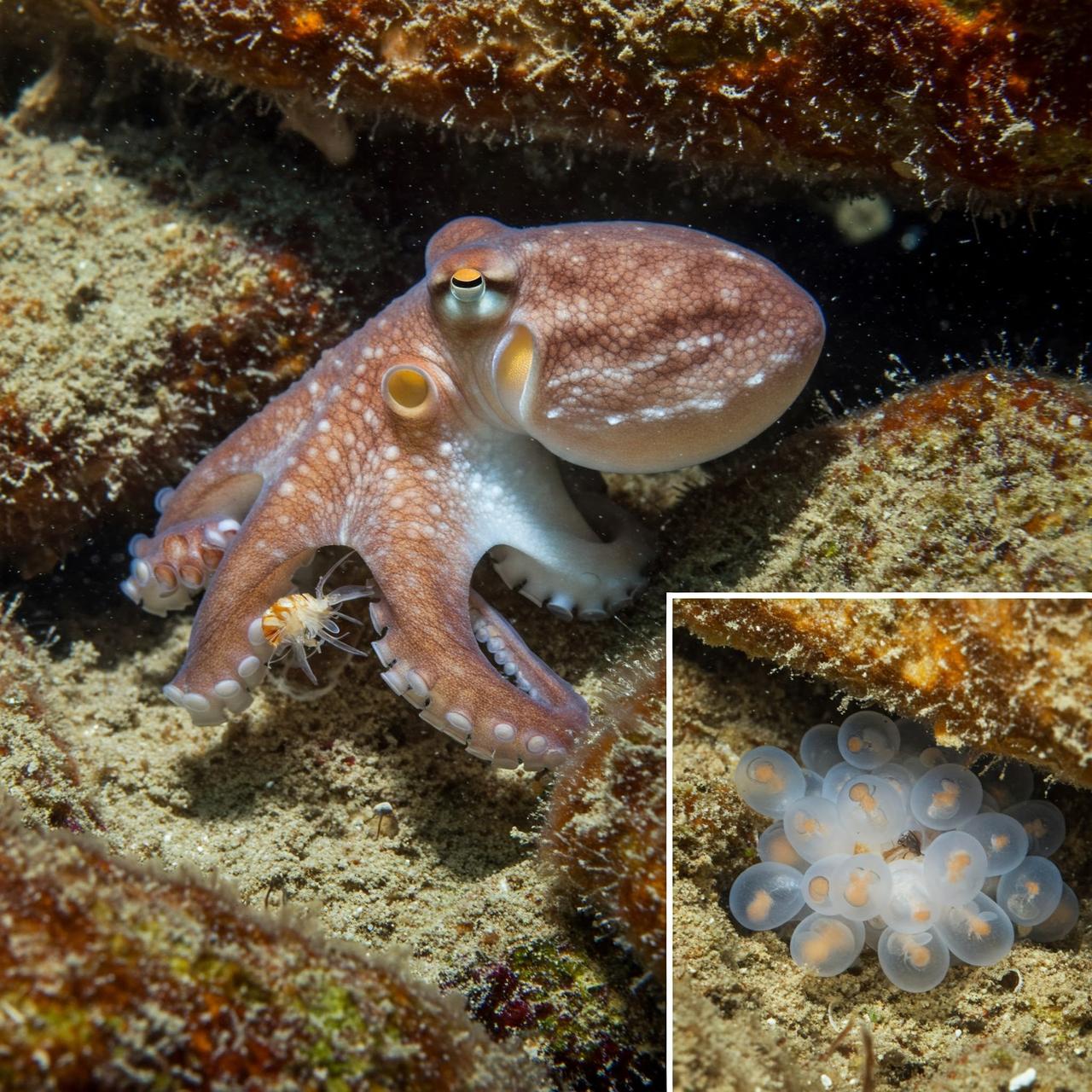
Dumbo Octopus Hunting and Reproduction (Generated by Artificial Intelligence)
The reproductive strategies of Dumbo octopuses differ from those of many other cephalopod species. There is no specific breeding season; females can carry eggs at various stages of development simultaneously. Males transfer sperm packets called spermatophores into the female’s mantle cavity. Females can use these sperm to fertilize their eggs when environmental conditions are favorable. Eggs are usually deposited on hard surfaces on the seafloor, and females do not exhibit protective behavior toward them. Upon hatching, the juveniles are immediately independent and possess defensive mechanisms against environmental threats.
Daly, H. I., P. R. Boyle, and M. A. Collins. “Reproductive Status of Opisthoteuthis sp. over an Annual Cycle.” South African Journal of Marine Science 20, no. 1 (1998): 187–192. Accessed May 23, 2025. https://doi.org/10.2989/025776198784126403.
Deutsche Botanische Gesellschaft. *Berichte der Deutschen Botanischen Gesellschaft.* 1900. Accessed May 23, 2025. https://www.biodiversitylibrary.org/page/42164314.
Jellyman, D. J., and G. J. Glova. “Habitat Use by Juvenile Lampreys (Geotria australis) in a Large New Zealand River.” New Zealand Journal of Marine and Freshwater Research 36, no. 3 (2002): 503–510. Accessed May 23, 2025. https://doi.org/10.1080/00288330.2002.9517105.
Ziegler, A., and C. Sagorny. “Holistic Description of New Deep Sea Megafauna (Cephalopoda: Cirrata) Using a Minimally Invasive Approach.” BMC Biology 19, no. 1 (2021). Accessed May 23, 2025. https://doi.org/10.1186/s12915-021-01000-9.

No Discussion Added Yet
Start discussion for "Dumbo Octopus (Grimpoteuthis)" article
Morphology and Anatomical Features
Behavior and Feeding
Reproduction and Life Cycle