


This article was automatically translated from the original Turkish version.
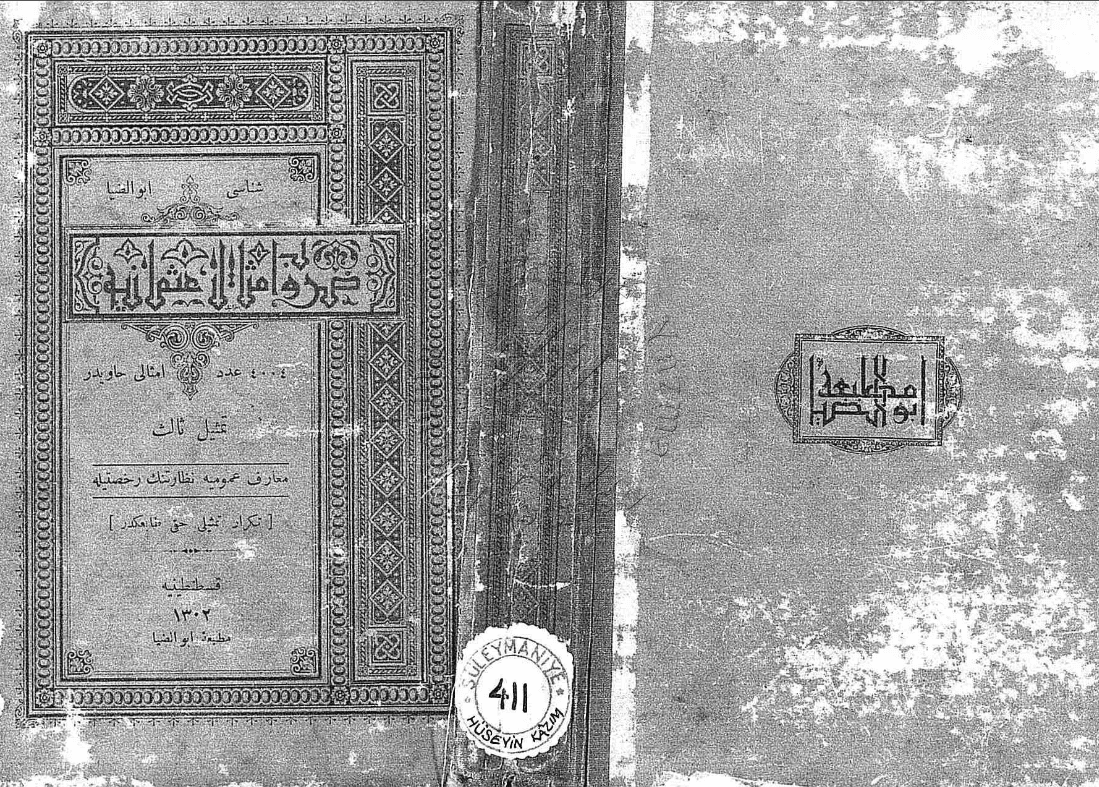
Durûb-ı Emsâl-i Osmâniyye Front and Back Covers
Author(s) | İbrahim Şinasi | ||||||||
|---|---|---|---|---|---|---|---|---|---|
Publication Year | 1884/1885 (H. 1302) | ||||||||
Publication Place | Matbaa-i Ebüzziya, İstanbul | ||||||||
Subject(s) | Proverbs and Idioms | ||||||||
Durûb-ı Emsâl-i Osmâniyye is a comprehensive work compiled by the 19th-century Ottoman intellectual Şinâsi, written in Ottoman Turkish and containing proverbs and idioms. Notable for its literary, linguistic, and folkloric characteristics, this compilation uniquely documents both the variety of usage of proverbs and idioms and their presence in written sources. The edition presented to contemporary readers and researchers was prepared by Professor Dr. Süreyya Beyzadeoğlu and published under the series of the Ministry of National Education’s Science and Culture Works.
Durûb-ı Emsâl-i Osmâniyye, published in 1302/1885, contains a total of 4,006 proverbs and idioms along with 838 couplets. In this regard, the work is regarded as an important source reflecting the linguistic, cultural, and literary sensibilities of its time. The proverbs and idioms are presented not only by meaning but also through their usage in both prose and poetic examples. This feature elevates the work beyond a mere compilation, transforming it into a study that enables observation of the literary and cultural functions of language within its context.
The lexical inventory in the work is not limited to Turkish alone; it also includes 64 Arabic, 226 Persian, 122 French, and 2 Latin proverbs and idioms. This diversity offers significant insights into the multilingual and multicultural structure of Ottoman society.
The content of the work is systematically classified both thematically and structurally. As emphasized by Professor Dr. Süreyya Beyzadeoğlu’s study, Durûb-ı Emsâl-i Osmâniyye not only provides the meanings of proverbs and idioms but also includes examples of how they are employed in specific literary texts. In this context, two primary features of the work stand out:
The proverbs and idioms in the work are examined under specific thematic categories:
The text has also been analyzed according to formal distinctions:
In its modern edition, Durûb-ı Emsâl-i Osmâniyye is organized into four main sections:
One of the most striking thematic groupings in the text is expressions concerning Turkish identity. These expressions reflect the social norms and ethnic representations of the period. Examples from the work include:
As these examples illustrate, such expressions record both individual and collective behavioral codes through folkloric formulations.
Durûb-ı Emsâl-i Osmâniyye is not merely a collection of proverbs; it also functions as a cultural mirror. The expressions within it carry traces of diverse nations, religions, and social groups, reflecting the Ottoman society’s worldview, everyday life, and value systems. The coexistence of commentary on different communities, personality types, professions, and geographic regions reveals the broad and layered structure of popular memory.
Ahmet Mithat Efendi. Durûb-ı Emsâl-i Osmaniye: Şinâsî Hikemiyatının Ahkâmı -Tasvir-. Hazırlayan İnci Enginün. İstanbul: Dergâh Yayınları, 2013.
Yeşiloğlu, Ayşegül Mine. “Şinâsî Durûb-ı Emsâl-i Osmanîye.” *Trakya Üniversitesi Sosyal Bilimler Dergisi* 2, no. 7 (December 2005): 148–151. Accessed https://dergipark.org.tr/tr/download/article-file/321825.
İbrahim Şinasi. *Durûb-ı Emsâl-i Osmâniyye*. Matbaa-i Ebüzziya. İstanbul 1302. Kitap Kapağı. Accessed June 11, 2025.
Durûb-ı Emsâl-i Osmâniyye Front and Back Covers
Author(s) | İbrahim Şinasi | ||||||||
|---|---|---|---|---|---|---|---|---|---|
Publication Year | 1884/1885 (H. 1302) | ||||||||
Publication Place | Matbaa-i Ebüzziya, İstanbul | ||||||||
Subject(s) | Proverbs and Idioms | ||||||||
No Discussion Added Yet
Start discussion for "Durub al-Masal al-Osmaniyye (Book)" article
Definition and Nature of the Work
Form and Content Features
Thematic Classifications
Structural Features
Compilation and Modern Publication
The Turkish Image in the Work
Cultural Value